A dramatic pre-dawn assault on Venezuela has sent shockwaves across Latin America, as Washington claims its forces have seized President Nicolás Maduro in an operation that could redraw the region’s political map.
Explosions echoed across Caracas before dawn as thick plumes of smoke rose above the Venezuelan capital, signalling a sudden and extraordinary escalation in tensions between the United States and Venezuela. US officials confirmed that American military strikes were underway, describing the operation as a decisive move after months of mounting pressure on the Maduro administration.

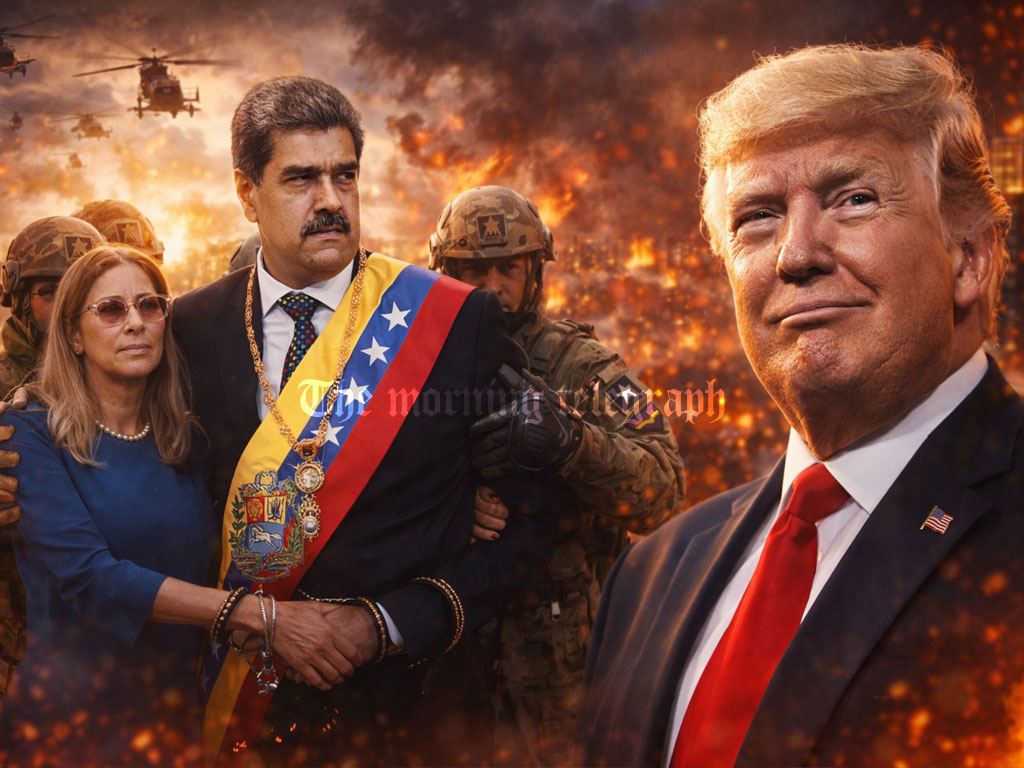
US President Donald Trump publicly claimed that Venezuelan President Nicolás Maduro and his wife, Cilia Flores, had been “captured” and flown out of the country following what he described as a meticulously planned military operation targeting Caracas and surrounding regions.
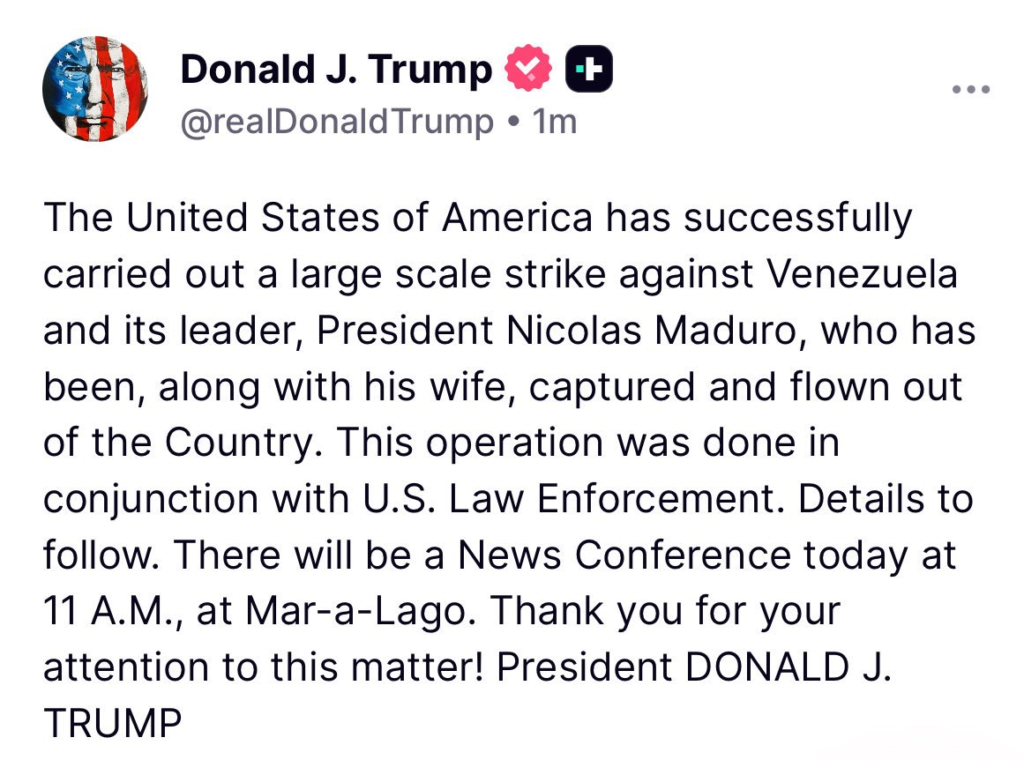
“It was a brilliant operation, actually,” Trump told the New York Times, praising what he called extensive planning and elite troops. Writing on social media, he confirmed that US forces had launched “a large-scale strike against Venezuela” and said further details would be announced at a press conference at his Mar-a-Lago residence in Florida.
US media reports said Maduro was captured by members of Delta Force, the elite US Army unit previously involved in the 2019 operation that killed Islamic State leader Abu Bakr al-Baghdadi. The White House and Pentagon declined to comment publicly on operational details.
On Venezuelan state television, Vice President Delcy Rodríguez appeared to acknowledge the capture of Maduro and Flores, stating that she did not know their whereabouts. She demanded immediate “proof of life” for the couple and accused the US of “murdering humble and innocent Venezuelan men and women” during the assault.
“At this moment Venezuela is calm, absorbing the significance of a military aggression of this nature,” Rodríguez said in a brief phone interview, while warning that the attack marked a dangerous turning point for the country and the wider region.
Earlier, Venezuela’s government accused the United States of striking both civilian and military targets, urging citizens to rise up against what it described as an extremely serious act of military aggression that risked plunging Latin America into chaos. “The entire country must mobilise to defeat this imperialist aggression,” the government statement said.
In a defiant video address, Defence Minister Vladimir Padrino López accused Washington of launching a “deplorable” and “criminal” regime change operation. He said the invading forces had “desecrated our sacred land” and described the attack as the greatest outrage Venezuela had ever suffered. Authorities, he added, were still attempting to assess civilian casualties caused by helicopter attacks on urban areas.
“They have attacked us but they will not vanquish us,” he said. “We will form an indestructible wall of resistance. Our vocation is peace, but our heritage is the fight for freedom.”
Venezuela’s government confirmed that the states of Miranda, La Guaira and Aragua were also targeted. It accused the US of seeking control over Venezuela’s strategic resources, particularly oil and minerals, and called on the international community to denounce what it said was a flagrant violation of international law that placed millions of lives at risk.
Regional reaction was swift. Colombian President Gustavo Petro said Venezuela was under attack, writing on social media that missiles were being used against Caracas and calling for an emergency session of the UN Security Council. Cuban President Miguel Díaz-Canel denounced what he called a criminal assault, accusing Washington of state terrorism against Venezuela and the wider region.
Witnesses in Caracas reported at least seven explosions around 2am, with residents rushing into the streets as the ground shook. Smoke was seen rising from La Carlota military airfield in the heart of the capital and the Fuerte Tiuna military base, long believed to be a residence of Maduro. Another airport east of Caracas, Higuerote, was also reportedly hit.
The strikes followed a five-month US pressure campaign aimed at forcing Maduro from power. Since August, Washington has built up military assets off Venezuela’s northern coast, conducted airstrikes on alleged narco vessels, expanded sanctions and seized oil tankers in a tightening economic blockade.
As Venezuela absorbs the shock of the assault, the region now braces for the consequences of a military move that has already altered the political landscape and raised fears of wider instability across Latin America.