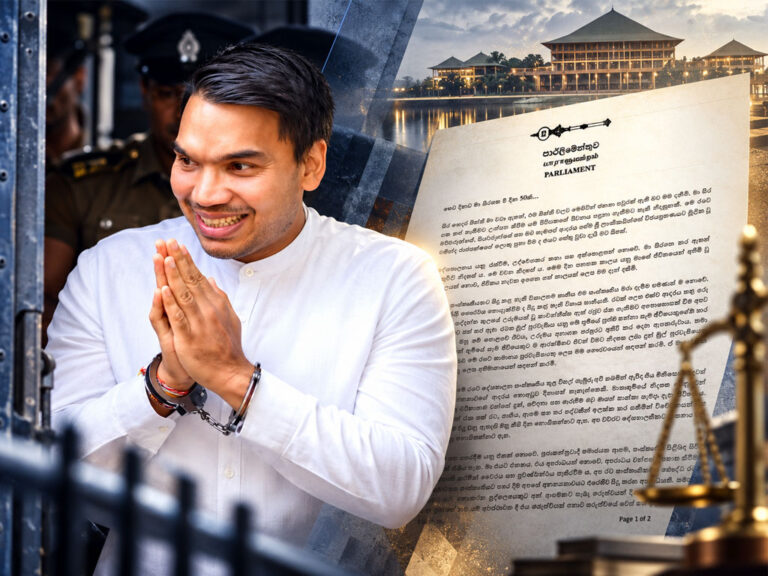
Shiranthi Rajapaksa faces scrutiny over a Rs. 400 million Colombo 7 mansion as investigators probe alleged unexplained wealth.
Shiranthi Rajapaksa is now facing fresh scrutiny over a Rs. 400 million Colombo 7 mansion linked to the name “Mary Lourdes Wickramasinghe” on Torrington Avenue.
A property long surrounded by political questions is now at the centre of a major investigation by the Commission to Investigate Allegations of Bribery or Corruption.

The mansion, located at No. 260/17, Torrington Avenue, Colombo, is valued at over Rs. 400 million. It is not merely another luxury property in Colombo 7. The controversial CSN television channel, once rumoured to belong to Yoshitha Rajapaksa, also had its registered headquarters on this same land.
Although the property was purchased around a decade ago under the name “Mary Lourdes Wickramasinghe,” that name was not widely known in the political sphere. It is reportedly the real name appearing on the birth certificate of former First Lady Shiranthi Rajapaksa.
The background of the property goes back to 2001. At that time, the house was obtained on rent for Mahinda Rajapaksa, who was then the Opposition Leader, through the intervention of then Prime Minister Ranil Wickramasinghe.
After Mahinda Rajapaksa became President, the property came under the ownership of the Sinnakkarawa Rajapaksa family.
However, the issue now raising serious questions is that a land said to be worth around Rs. 400 million was allegedly purchased at a heavily undervalued assessment of just Rs. 35 million.
When questioned by the Bribery Commission on how such wealth was acquired, the former First Lady has reportedly not yet provided a proper explanation.
The notary who prepared the relevant deed has confirmed that no financial transaction took place in his presence.
Shiranthi Rajapaksa has claimed that the property was purchased in cash by the son of former SriLankan Airlines Chairman Nishantha Wickramasinghe from businessman Prabath Nanayakkara, and was later transferred to her.
However, investigators are said to be examining whether such a money transfer actually took place.
The most serious question surrounding this discreet transaction is whether the mansion was allegedly received as a bribe by the Rajapaksa family in return for awarding major state projects, including expressways, to businessman Prabath Nanayakkara.
Investigation officers are now examining whether commission payments linked to infrastructure projects built using public tax money were converted into luxury properties.
To investigate this disputed property transaction, the government is now using the newly enforced Proceeds of Crime Act No. 5 of 2025.
Under Section 34(1) of this law, if it appears that property in a person’s possession was not acquired through legitimate income, the court has the power to presume that it was acquired through crime.
A key legal point is that under Section 34(3) of the Act, the full burden of proving that the property was acquired from legitimate income now falls on the suspect, Shiranthi Rajapaksa.
Based on the wide powers granted under Sections 68(1) and 71(1) of the Act, investigation officers have already issued orders completely prohibiting the sale or alienation of the Torrington mansion.
This process also goes beyond traditional legal action, where authorities usually wait until a criminal case is fully proven.
According to Sections 125 and 126 of the Act, if the defence fails to prove the legitimacy of the property, the government has the power to confiscate it without a criminal conviction.
Investigation teams have indicated that all relevant facts will be filed before the High Court within the next ninety days.
Under Section 127(17) of the Act, the property could be vested in the government if it becomes impossible to prove its legitimate ownership.
However, questions remain over how the property was acquired, whether the stated cash transaction can be verified, and whether investigators can establish a link between public projects and alleged unexplained wealth.
What happens next could be critical, as the Torrington Avenue mansion may become one of the first major tests of Sri Lanka’s new proceeds of crime framework.