The detention of former State Intelligence Service Director Suresh Sallay forces Sri Lanka to confront a rare constitutional dilemma: how to pursue accountability within its intelligence apparatus without destabilising the rule of law, national security, and institutional credibility it seeks to protect.
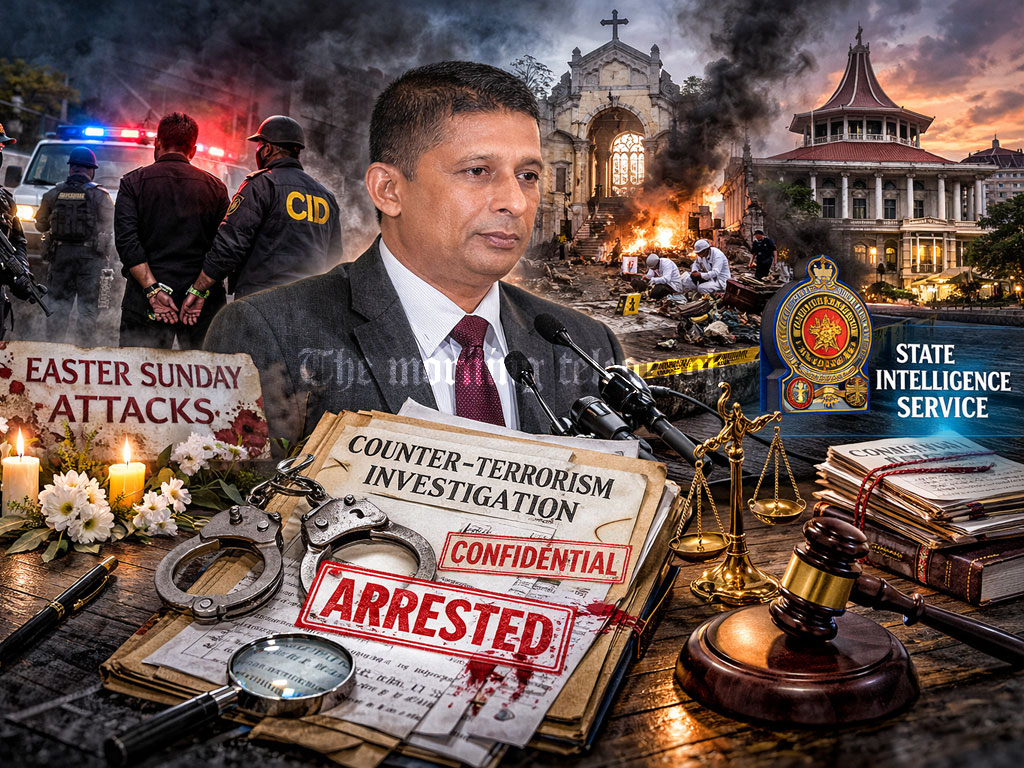
The arrest of Major General Suresh Sallay, retired, former Director of the State Intelligence Service, marks a moment of profound legal and political significance in Sri Lanka’s modern history. Detained under the country’s counter terrorism framework, his apprehension signals more than an individual prosecution. It raises an unsettling question about how a state confronts allegations within its own intelligence hierarchy while preserving the constitutional balance between justice and stability.

Sallay was not taken into custody by uniformed police in a public procedure. He was reportedly detained by plain clothes officers attached to the Criminal Investigation Department, a method more commonly associated with covert criminal inquiries than with the arrest of a former intelligence chief. The allegations relate to purported links to the 2019 Easter Sunday attacks, the deadliest act of mass violence in Sri Lanka since the end of the civil war. The gravity of that tragedy, which claimed hundreds of lives, ensures that any investigation connected to it carries enormous public and emotional weight.
In the years since those attacks, Sallay consistently rejected the accusations levelled against him. He initiated legal action against Channel 4 following a documentary that relied heavily on a single source. The programme’s director later acknowledged publicly that the narrative rested on that lone testimonial without independent corroboration. Separate legal proceedings were filed against representatives of the Catholic Church in Sri Lanka over statements he considered defamatory. Those matters remain before the courts. Allegations circulated by the International Truth and Justice Project were also withdrawn with an apology after evidentiary shortcomings were acknowledged. This contested legal background forms the context within which his current detention must be understood.
The present incarceration is reportedly extendable to ninety days without formal indictment and without immediate recourse to counsel under national security provisions. That procedural dimension has prompted debate among constitutional lawyers and legal scholars. Many argue that in cases involving former intelligence leadership, adherence to due process, transparency, and judicial oversight becomes especially critical. The principle at stake is not personality but procedure. In a democracy, the integrity of the method matters as much as the substance of the accusation.
International history offers parallels, though each arose under distinct political conditions. In Peru, Vladimiro Montesinos, intelligence adviser to President Alberto Fujimori, was captured in 2000 amid a sweeping corruption scandal. Videotaped bribery exposed systemic abuse, leading to multiple convictions. Julio Salazar Monroe, another Peruvian intelligence figure, received a lengthy sentence for his role in the La Cantuta killings and died in custody years later. These prosecutions unfolded within a context of institutional collapse and regime crisis.
Italy’s 1974 arrest of Vito Miceli, then head of military intelligence, occurred amid Cold War turbulence and alleged coup plotting. Although ultimately acquitted, the episode reflected a nation destabilised by ideological violence. In Russia, Sergei Mikhailov, a senior counter intelligence official within the Federal Security Service, was arrested on treason charges in largely closed proceedings. That case illustrated a system where secrecy and executive power dominated public accountability.
Such examples demonstrate that intelligence leaders have indeed been detained. Yet these detentions frequently coincided with systemic scandal, authoritarian consolidation, or extraordinary political rupture. They were not routine administrative measures but responses to crises that shook the foundations of governance.
In contrast, established democracies have often treated allegations against intelligence chiefs through inquiry rather than spectacle. In the United States, William Casey became entangled in the Iran Contra affair while leading the Central Intelligence Agency. Congressional investigations were exhaustive and public, but no arrest followed before his death. Michael Hayden, who headed both the National Security Agency and later the CIA, faced intense scrutiny over warrantless surveillance programmes that ignited constitutional controversy. The accountability mechanism remained legislative and judicial rather than custodial.
David Petraeus, after leaving his post, admitted mishandling classified information. He resolved the matter through a plea agreement, probation, and a financial penalty. The response constituted a legal reprimand, not preventive detention. Robert Mueller, who directed the Federal Bureau of Investigation during periods of heightened intelligence controversy, encountered investigation and criticism but never arrest. The prevailing American doctrine has been cautious about criminal proceedings against intelligence command unless evidence of personal wrongdoing is direct, incontrovertible, and demonstrably separate from policy disputes.
The British constitutional experience reflects a similar instinct. John Scarlett, chief of the Secret Intelligence Service, was criticised for allegedly shaping intelligence assessments prior to the Iraq War. Parliamentary committees and the Butler Review examined institutional failures in public reports. The matter remained one of systemic accountability rather than criminal prosecution. Comparable scrutiny occurred within the Security Service during counter terror controversies, yet prosecutorial action against leadership did not materialise.
Israel presents another model. Operating within an enduring security environment, its intelligence agencies function under constant operational pressure. Meir Dagan of Mossad faced international criticism for aggressive covert action, including targeted killings. Domestically, these operations were debated within the framework of statecraft rather than treated as criminal offences. Yoram Cohen of Shin Bet was subjected to sustained human rights critique over interrogation policies, yet oversight mechanisms remained internal, judicial, and parliamentary.
India offers further comparison. Senior officials of the Research and Analysis Wing and the Intelligence Bureau, including A K Verma, have periodically faced allegations ranging from operational lapses to politicisation. The Indian state has generally responded through confidential review processes, executive supervision, or quiet retirement rather than arrest. The calculus has been that the credibility of intelligence institutions is intertwined with national stability.
Viewed against these international patterns, the Sri Lankan development appears distinctive. Other democracies have tended to preserve institutional continuity while permitting scrutiny through commissions, courts, or legislative inquiries. Immediate custodial action against a former intelligence chief is rare outside contexts of demonstrable systemic breakdown. That does not imply immunity from prosecution. Rather, it underscores the sensitivity of timing, method, and transparency.
The perception created by swift detention under counter terrorism provisions may be interpreted in divergent ways. Supporters argue that no individual, however senior, should be insulated from investigation where credible allegations exist. Critics caution that the optics of anonymity and limited public explanation risk suggesting punitive haste rather than measured justice. In matters touching national security, perception itself carries constitutional consequence.
No serious legal thinker maintains that intelligence officials stand above the law. If substantiated evidence exists linking any individual to criminal conduct, prosecution is not merely permissible but obligatory. Yet the strength of such prosecution rests on procedural integrity. Due process, visible fairness, and independent judicial scrutiny are indispensable. When the state moves against one who previously functioned as its clandestine guardian, the action must appear anchored in law rather than expediency.
Sri Lanka’s own constitutional trajectory has been shaped by decades of conflict, counter terrorism operations, and post war reconciliation efforts. The Easter Sunday attacks represent a traumatic rupture in that history. Public demand for accountability remains intense. At the same time, institutional confidence in intelligence structures remains a cornerstone of national security. Balancing those imperatives requires careful calibration.
The present moment therefore tests more than individual culpability. It tests whether Sri Lanka can demonstrate that accountability within the intelligence apparatus can proceed without undermining the very rule of law it seeks to affirm. A transparent judicial process, supported by credible evidence and open court review, offers the only sustainable answer.
Ultimately, the equilibrium between justice and security defines constitutional maturity. If proceedings are conducted with impartiality, evidence based reasoning, and full adherence to procedural safeguards, the state strengthens its legitimacy. If shortcuts or opacity dominate, the risk extends beyond one case to the credibility of institutions themselves.
In pursuing accountability, Sri Lanka stands at a crossroads. The detention of Suresh Sallay may prove either a demonstration of principled rule of law or a source of enduring constitutional debate. The difference will lie not in rhetoric but in the scrupulous conduct of the judicial process that follows.