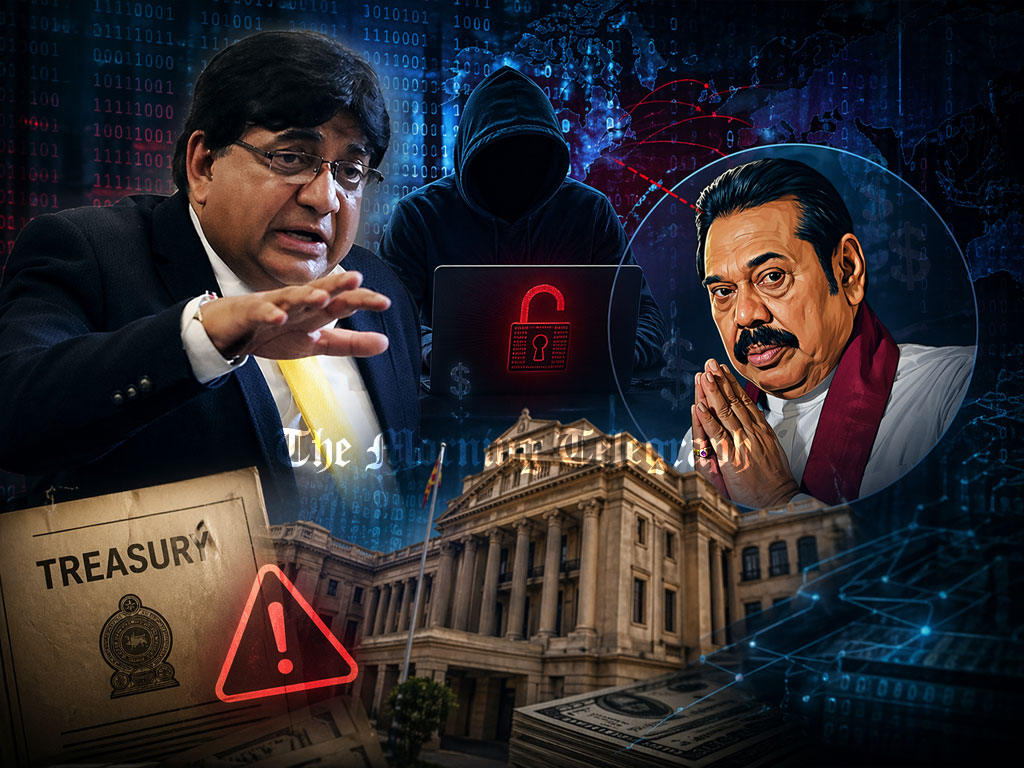
A sharp political attack alleges gross negligence, a looming cover-up, and a familiar blame game as Sri Lanka’s Treasury cyber fraud spirals into a national controversy.
Former Minister Dilan Perera has sparked fresh political controversy by suggesting that the government may attempt to shift blame for the Treasury hacking incident onto individuals linked to former President Mahinda Rajapaksa, rather than accepting responsibility for what he describes as a serious governance failure.
Speaking on the ongoing financial fraud involving the diversion of a loan installment to a hacker-controlled account, Perera claimed that the government is already preparing a narrative to deflect accountability. According to him, the incident is not merely a technical glitch or an email-related error but a major lapse in financial oversight and public administration.

He stressed that such a high-value international payment, processed through multiple layers of approval, cannot be casually dismissed. He noted that the transaction would have required authorization and monitoring by nearly a dozen officials across different levels, including the Secretary to the Treasury, making it difficult to attribute the failure to a single point of error.
Perera argued that the fact that funds were transferred into an unauthorized account despite these safeguards highlights what he described as gross negligence within the system. He questioned how a structured process involving both senior and junior officials could have been bypassed so easily without detection.
The former minister also accused the current administration of repeatedly downplaying or denying wrongdoing while misleading the public. He pointed to a pattern in recent controversies, including the import of substandard coal, the release of hundreds of containers from customs without proper inspection, concerns over exposure to inappropriate online content during education reforms, and the purchase of fuel at elevated global prices.
Drawing a parallel with these incidents, Perera suggested that the government has consistently attempted to shift blame rather than address underlying governance issues. He said the same pattern is now visible in the handling of the Treasury cyber fraud case.
In a sarcastic remark, he stated that the government, which often attributes responsibility to political opponents, might now claim that the hacker involved is somehow connected to Mahinda Rajapaksa’s extended family. The comment reflects growing political tensions surrounding the incident and the narratives being shaped around it.
Perera went further to criticize what he described as the government’s lack of administrative competence. Referring to it as a “loaf pan government” and a “bottle newspaper government,” he argued that those in power lack a clear understanding of how to manage state affairs effectively.
He emphasized that governing a country requires more than electoral victory, pointing out that leadership must ensure systems are aligned, transparent, and accountable. According to him, failures such as the Treasury hacking incident undermine public confidence and expose systemic weaknesses.
Concluding his remarks, Perera stated that the fallout from the hacking scandal has not only damaged the credibility of the government but has also highlighted deeper issues in public financial management. He warned that unless responsibility is clearly established and corrective action taken, similar incidents could continue to emerge, further eroding trust in state institutions.