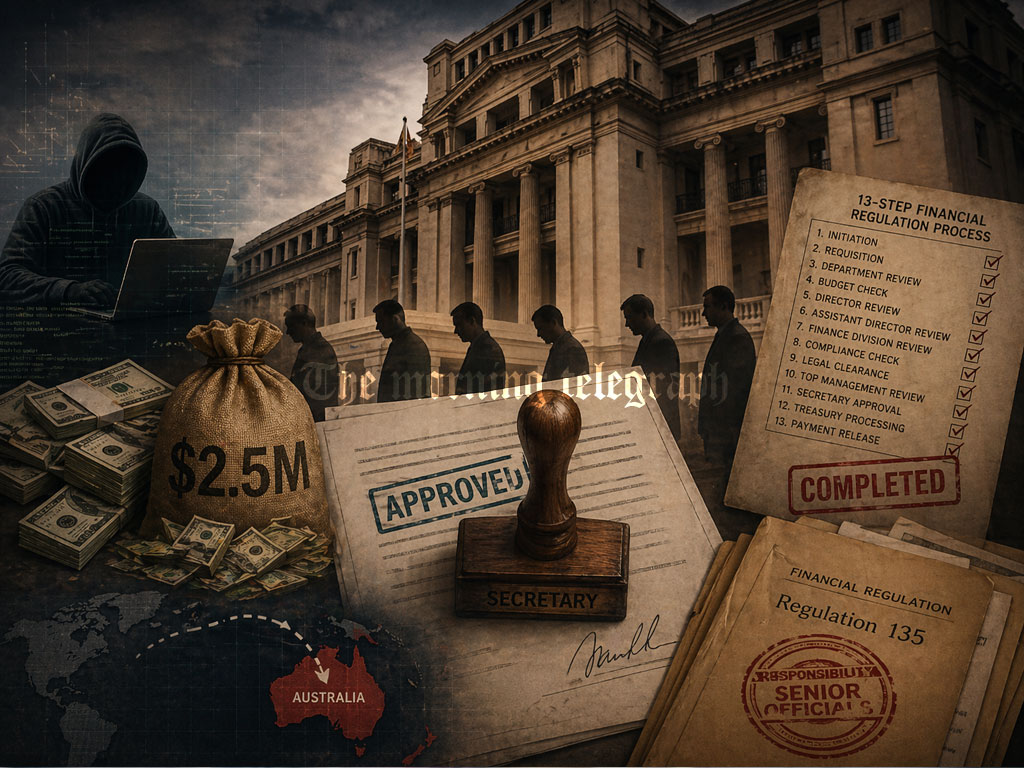
A former top official alleges the $2.5M Treasury scandal was not a cyberattack but a fully approved transaction, raising serious concerns over accountability, governance failure, and financial oversight in Sri Lanka.
The financial irregularity involving more than $2.5 million at Sri Lanka’s Treasury is now being challenged as something far more serious than a cyberattack, with former Governor Rajitha Keerthi Tennakoon asserting that the transaction followed all required government financial procedures.
Speaking at a media briefing, Tennakoon emphasized that the incident should not be classified as computer hacking, but rather as a payment that moved through the complete chain of financial approvals under existing Treasury regulations.

He further stated that while lower level officers are being blamed and suspended, senior officials who hold primary responsibility are attempting to distance themselves from the controversy.
According to Tennakoon, a standard foreign term loan repayment must pass through a structured process of 13 approval stages, beginning with the Ministry Secretary and extending down to operational staff within the department.
He explained that this was not an isolated breach carried out by an external actor, but a coordinated financial transaction approved at multiple administrative levels, involving Directors, Assistant Directors, and clerical officers.
Tennakoon also pointed to a lack of institutional experience as a key factor, alleging that the current Secretary to the Ministry of Finance, Harshana Suriyapperuma, lacks sufficient familiarity with Sri Lanka’s public financial system and administrative procedures.
It was revealed that no loan repayment can be processed without the Secretary’s authorization, and that the disputed transaction was linked to a private institution in Australia where the Secretary had previous professional connections.
So far, only four lower level officers, including an Assistant Director and an Accountant, have faced disciplinary action, raising concerns about selective accountability within the system.
Referring to Financial Regulation 135, Tennakoon stressed that ultimate responsibility lies with senior officials, as no payment of this magnitude can be executed without top level approval within the Treasury framework.
He criticized the current approach, stating that junior officers are being made scapegoats for a significant financial lapse, while decision makers at higher levels remain unaffected.
Tennakoon urged the government to take immediate corrective action by appointing a Finance Secretary with a deep understanding of public service operations, warning that such incidents threaten the integrity of national financial management.
He concluded by cautioning that unless accountability is properly enforced and systemic weaknesses are addressed, the risk of further institutional collapse within the Treasury cannot be ruled out.