10.6 billion fraud claim over dairy cow imports sparks fresh scrutiny as Justice Minister links it to old corruption cases and IMF comparisons.
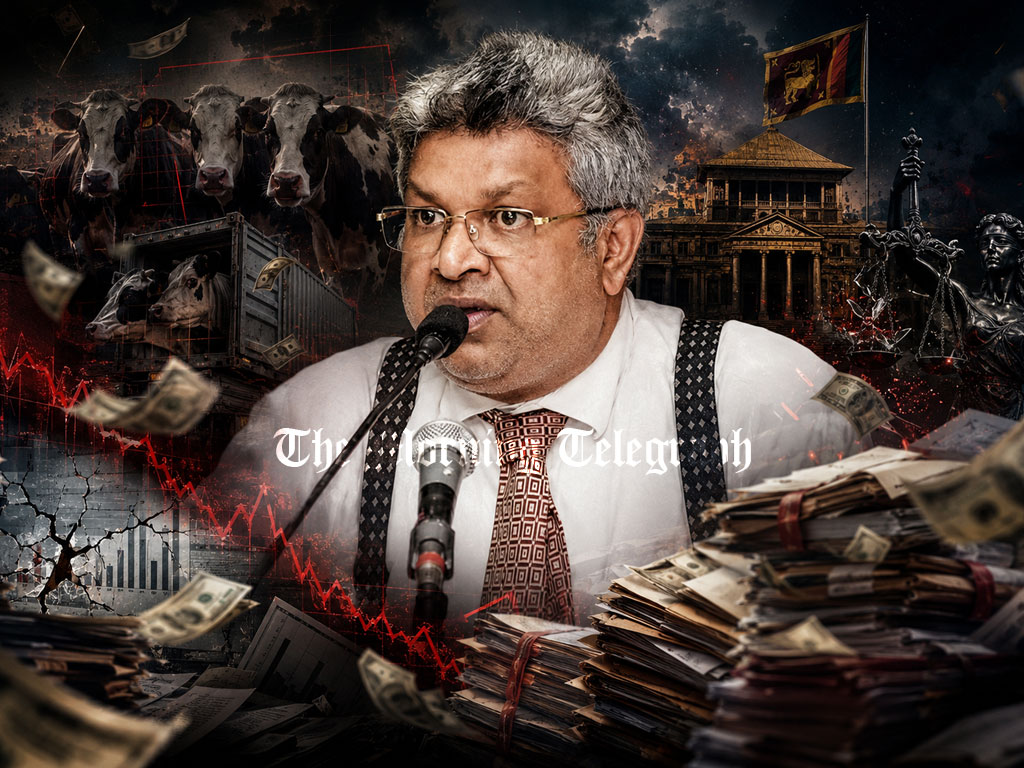
The 10.6 billion fraud allegation raised by Justice Minister Harshana Nanayakkara has triggered fresh political attention over one of the biggest corruption claims linked to Sri Lanka’s recent past.
Nanayakkara revealed that a dairy cow import project carried out during the 2016–2017 period, allegedly through the intervention of former minister P. Harrison and a former president’s wife, had caused a staggering loss of $10.6 billion to the government.

The Minister said opposition MPs are now loudly criticizing an alleged $2.5 million loss said to have taken place under the current government, while remaining silent over far larger corruption scandals that allegedly occurred when they held power.
He stressed that the present government was not attempting to hide or protect anyone involved in fraud. According to him, formal investigations into the $2.5 million loss have already begun with international assistance.
Nanayakkara further said the current administration had also reopened several old corruption and fraud cases. These include the $12.6 million loss from the Greek bond transaction, the Rs. 6 billion transaction through the Central Bank, the $1.4 million fraud linked to the procurement of goods for the Hambantota Hospital, and the Gin Nilwala project, which reportedly caused a loss of Rs. 4,000 million.
“We came to catch thieves and punish thieves. That is what we are doing,” the Minister said, adding that many corruption cases would be filed in court before the end of this year.
If the $10.6 billion figure mentioned by the Minister is correct, it represents an enormous amount when compared with Sri Lanka’s total external debt burden. According to the latest data from the Central Bank of Sri Lanka, the country’s central government external debt is approximately $37 billion.
On that basis, the alleged $10.6 billion loss would represent around 28.6% of Sri Lanka’s external debt. It would also be more than three times the $2.9 billion that Sri Lanka is scheduled to receive from the International Monetary Fund.