Ladakh’s new districts from two to seven spark Buddhist-Muslim divide fears. Critics warn statehood push weakened as geopolitical tensions rise.
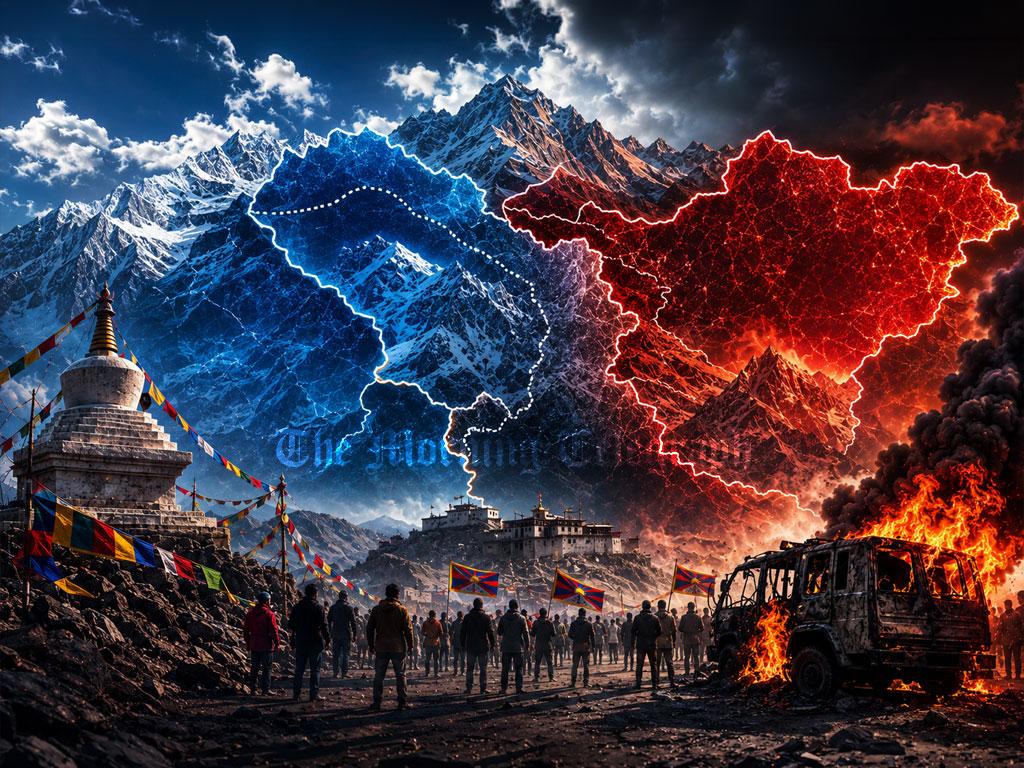
The recent redrawing of Ladakh’s administrative map has triggered a fresh wave of political unease and communal apprehension across the high-altitude Union Territory, with critics warning that the restructuring risks sharpening divides between Buddhist-majority Leh and Muslim-majority Kargil. According to reporting by Frontline India, the Centre’s decision to expand Ladakh from two districts into seven has been projected by the government as a long-pending administrative reform aimed at improving governance in remote regions.
However, voices from within the region argue that the move could reshape internal representation in ways that deepen long-standing grievances. This is particularly true in Kargil, where resentment over political marginalisation has been growing since Ladakh was carved out as a Union Territory in 2019. On April 27, Lieutenant Governor Vinai Kumar Saxena approved a notification creating five new districts: Zanskar, Drass, Sham, Nubra, and Changthang. The proposal had received clearance from the Ministry of Home Affairs in August 2024.

With this notification, Ladakh’s administrative structure has expanded from the original Leh and Kargil districts to a total of seven. Saxena described the decision as a fulfilment of “aspirations and long-pending demand of the people of Ladakh.” He formally inaugurated the new districts on April 29, instructing newly appointed deputy commissioners and senior police officials to prioritise grievance redressal and law and order management. The government maintains that the restructuring is designed to bring administration closer to scattered populations across one of India’s largest but least densely populated territories.
Yet the announcement has been met with sharp criticism in Kargil. Political and legal representatives argue that the new boundaries disproportionately weaken the Muslim-majority region’s administrative weight. Lawyer Ghulam Mustafa Haji, also legal adviser to the Leh Apex Body (LAB), told Frontline India that the redrawn map effectively reduces Kargil’s territorial and demographic coherence by restricting it to 80 revenue villages. He argued that several regions, including Shargole, Chiktan, and Suru, had strong claims to district status but were reorganised in a manner that dilutes Kargil’s significance.
Haji further contended that the combined population of the reorganised Kargil district now exceeds 150,000. This intensifies concerns that the restructuring has been done without adequate consideration of local aspirations. Haji also framed the decision in political terms, suggesting it reflects a broader pattern of marginalisation felt by Muslim communities in different parts of India. He claimed that the absence of clarity on the role of Hill Councils raises questions about democratic accountability, especially without Statehood or Sixth Schedule protections.
According to him, unless constitutional safeguards are extended, the restructuring risks reinforcing an increasingly centralised administrative model imposed after the abrogation of Article 370 in 2019. Similar concerns have been echoed by Mohammad Jaffer Akhoon, chairman and chief executive councillor of the Ladakh Autonomous Hill Development Council in Kargil. He described the exclusion of several Muslim-majority subdivisions, including Sankoo and Shakar Chiktan-Shargole, as “discriminatory and deeply unfortunate.”
Multiple local voices from Kargil have argued that at least two additional districts could have been created within the region itself to ensure more balanced representation. Of the seven districts now formed in Ladakh, five are Buddhist-majority while only two are Muslim-majority. Critics say this demographic distribution reflects underlying asymmetries in administrative design. These developments have intensified fears that the new map could fragment the fragile unity that has characterised the joint Buddhist-Muslim movement for Statehood and Sixth Schedule status in Ladakh.
Sajjad Kargili, a member of the Kargil Democratic Alliance, told Frontline India that the timing and structure of the redistricting appear politically significant. He suggested it could be an attempt to weaken a shared platform that has historically brought Leh and Kargil leaders together on constitutional demands. Analysts also point out that while Ladakh has no legislative assembly and only one Lok Sabha seat, the political implications of administrative reorganisation still carry significant weight in shaping representation and influence.
Political scientist Noor Ahmad Baba has described the Centre’s move as one that could aggravate existing resentment in Kargil while attempting to ease administrative pressures in remote regions. Speaking in the context of Union Home Minister Amit Shah’s visit to Leh for the Sacred Exposition of the Holy Relics of the Tathagata, Baba suggested that New Delhi’s approach combines administrative reform with symbolic reassurance. Shah avoided direct political commentary and instead emphasised Buddhist spiritual heritage, urging local leadership to maintain faith in Lord Buddha.
Meanwhile, environmentalist Sonam Wangchuk, a key figure in the Leh Apex Body, met the Home Minister during the visit. A follow-up round of talks between the LAB-Kargil Democratic Alliance and the Ministry of Home Affairs sub-committee is scheduled for May 22. This raises expectations of renewed negotiations on Statehood and constitutional safeguards. The controversy over district creation has also drawn attention to Ladakh’s demographic composition. According to the 2011 Census, the Union Territory has a population of 274,289, with Muslims forming 46.40 per cent, largely concentrated in Kargil, and Buddhists accounting for 39.65 per cent, primarily in Leh.
Political reactions have been sharp at the national level as well. All India Majlis-e-Ittihadul Muslimeen president Asaduddin Owaisi criticised the restructuring, arguing that the district distribution does not correspond proportionately to population patterns. He warned that it could be interpreted as an attempt to divide the unified statehood movement. Beyond domestic politics, the redrawing of Ladakh’s map has also generated geopolitical reactions.
Pakistan has rejected the Union Territory’s status, reiterating its long-standing position that Ladakh remains a disputed region. The Pakistani Foreign Office has described the creation of new districts as a unilateral action inconsistent with United Nations Security Council resolutions. China, which also disputes the status of parts of the region, has historically reacted strongly to administrative changes in Ladakh, particularly following the 2019 reorganisation of Jammu and Kashmir. Analysts note that both neighbouring countries continue to view Ladakh within the broader framework of territorial dispute, making internal administrative decisions internationally sensitive.
While the Indian government insists that the restructuring will improve governance, accessibility, and service delivery across Ladakh’s difficult terrain, critics argue that its political and social consequences may outweigh administrative benefits. As highlighted in Frontline India’s reporting, the new district map has become more than a bureaucratic exercise. It has emerged as a flashpoint in the ongoing contest over identity, representation, and constitutional rights in one of India’s most strategically sensitive regions.