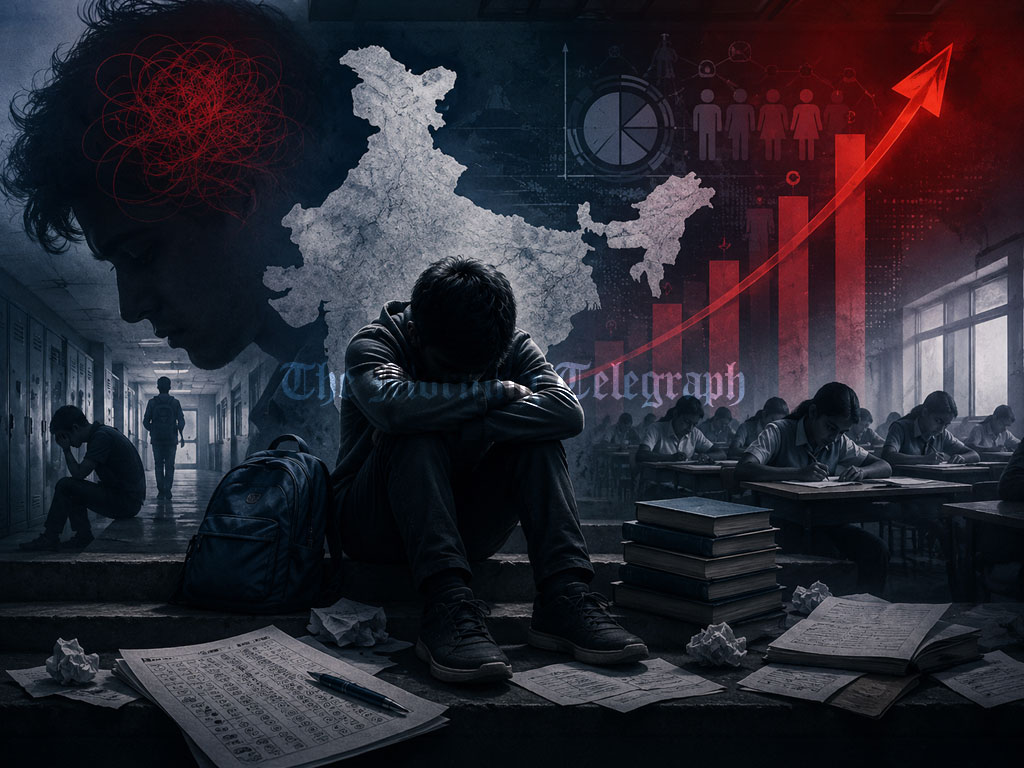
Student suicides in India rose to 14,488 in 2024, growing faster than overall suicides, NCRB data shows.
Student suicides in India reached a record high of 14,488 in 2024, rising faster than the country’s overall suicide rate, according to NCRB data.
The figures released by the National Crime Records Bureau on Wednesday show that student suicides rose by 4.3 percent from 13,892 cases in 2023.
This increase came even as India’s overall suicide numbers declined marginally by 0.4 percent, from 171,418 cases in 2023 to 170,746 in 2024.

According to the NCRB report, student suicides accounted for 8.5 percent of the total suicides recorded in 2024.
This was higher than 2023, when student suicides made up 8.1 percent of the country’s 171,418 suicide cases.
The long-term trend is even more worrying.
While overall suicides in India rose by 11.6 percent over five years, from 153,052 in 2020 to 170,746 in 2024, student suicides increased at a sharper pace.
Student suicides rose by 15.7 percent in five years, from 12,526 in 2020 to 14,488 in 2024.
Over the past decade, the rise has been far steeper.
Overall suicides increased by 27.8 percent from 133,623 in 2015, while student suicides grew by 62.2 percent from 8,934 in 2015.
Between 2015 and 2024, a total of 115,850 students died by suicide in India.
The share of student suicides within India’s overall suicide cases has also increased over the years.
In 2015, student suicides accounted for 6.7 percent of the total 133,623 suicide cases.
By 2020, that proportion had risen to 8.2 percent of 153,052 cases.
In 2024, the figure climbed further to 8.5 percent.
Experts say the rising number of student suicides reflects a deepening student mental health crisis driven by academic pressure, untreated psychological distress, weak support systems, and limited access to timely intervention.
They have called for stronger counselling systems, early identification of distress, greater awareness of government helplines, and easier access to mental health support in educational institutions.
Dr. Om Prakash, Professor of Psychiatry and Deputy Medical Superintendent at the Institute of Human Behaviour and Allied Sciences in Delhi, said exam pressure, intense competition, parental expectations, career fears, and social media often act as major triggers.
However, he said many students who attempt suicide or die by suicide are also struggling with untreated depression, anxiety, bipolar disorder, or deeper emotional distress that was not identified in time.
“We urgently need early identification, stigma-free counselling and stronger mental health support systems in educational institutions,” he said.
Ganesh Kohli, founder of the Mumbai-based International Career and College Counseling Movement, which works on student mental health issues, said mental health awareness must become part of mainstream education.
He said educational institutions must treat mental health support as an essential student support system.
Kohli also said teachers and parents need greater sensitisation to recognise early signs of distress and create environments where students feel safe seeking help without fear of judgment.
Of the 14,488 students who died by suicide in 2024, 7,669 were male and 6,819 were female.
Maharashtra reported the highest proportion of student suicides at 13.2 percent.
It was followed by Uttar Pradesh with 10.9 percent, Madhya Pradesh with 10 percent, and Tamil Nadu with 8.9 percent.
The largest share of student suicides involved those educated up to Class 10 or secondary level, accounting for 25.6 percent.
This was followed by students educated up to Class 12 or higher secondary level at 18.3 percent, Class 8 or middle level at 17.7 percent, and Class 5 or primary level at 14.4 percent.
Illiterate individuals accounted for 10.1 percent of student suicide cases, while 5.6 percent were among graduates or those with higher education.
Family problems remained the leading reported cause of suicides in 2024, accounting for 33.5 percent of all cases.
Illness accounted for 17.9 percent, while drug or alcohol addiction accounted for 7.6 percent.
Unemployment accounted for 1.5 percent, while failure in examinations accounted for 1.2 percent of reported suicide cases.