Sri Lanka rupee crisis worsens as private credit rebounds, fx swaps expand liquidity, and critics warn of another debt default risk.
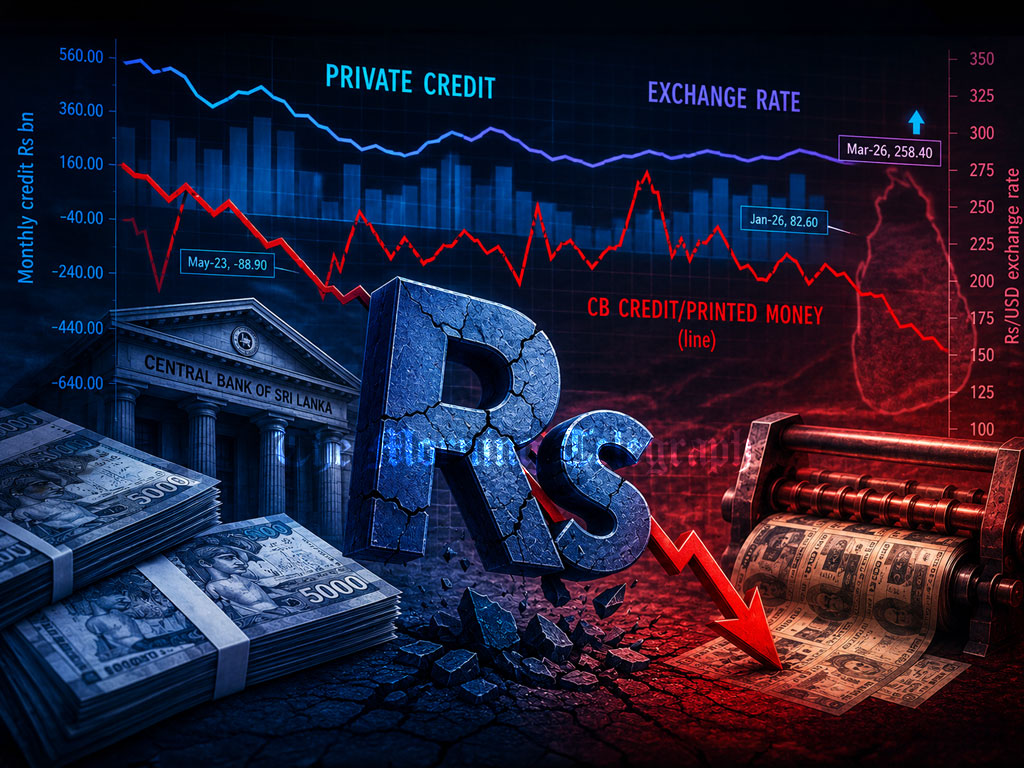
Sri Lanka rupee crisis concerns intensified in March as private credit recovered sharply, while the currency weakened under pressure from credit growth, fx swaps, and dollar purchases that signalled further depreciation to the market.
The external pressure is now emerging even as Sri Lanka records both current and overall budget surpluses.
On Tuesday, the rupee fell to 323.25/75 against the US dollar, from around 322/322.30 levels, in a constrained spot market that remained largely inactive.
One-week forwards were quoted close to 324 to the US dollar, market participants said.
The Sri Lanka rupee had already depreciated from 309.50/60 on December 30, 2025, long before the Middle East War. Yet that conflict is now being used as a convenient excuse by macro-economists to escape accountability.

Fx Swaps and Dollar Purchases Backfire
The rupee was also aggressively weakened from 292 to the US dollar to 309 during 2025 through the purchase of dollars with new money, effectively monetizing the balance of payments, while dollars were not supplied when unsterilized liquidity returned as imports.
The Central Bank had a chance, perhaps its last clear chance, to allow the rupee to appreciate in February and restore market confidence in one decisive move. Private credit had collapsed after the Ditwah shock, and a US$460 million balance of payments surplus had developed.
Instead, that surplus was ruthlessly monetized and left unsterilized.
Amid strong public opposition to conventional Central Bank money printing against domestic assets, which raises the cost of living and triggers external trouble, the agency resorted to printing money through swaps. These swaps were also left unsterilized.
Banks brought back offshore dollars they had collected during a credit contraction, allowing the Central Bank to monetize them.
Finance companies also borrowed abroad and swapped funds with the bank, echoing the swaps once used by hedge funds to attack East Asian currencies.
The Central Bank then denied convertibility by refusing to provide dollars for the newly created rupees, further depreciating the currency.
In April, the Central Bank sold dollars to the market on a net basis, providing some weak-side convertibility.
However, it should not have bought dollars in the first place at depreciated prices, creating strong-side convertibility when there was no genuine strong side, and signalling the market to weaken the currency.
The Middle East war had little to do with the present pressure, though such shocks often expose weaknesses in a country’s operating framework.
The Reserve Bank of India, once seen as South Asia’s original bad-boy central bank, is facing a similar challenge. Macro-economists in India have imposed draconian exchange controls, taxed gold, and introduced trade controls after gaining control of the Reserve Bank of India.
Defaulting on the Note Issue
When a reserve-collecting central bank denies convertibility to newly created rupees that return as imports, it defaults on its own note issue.
That default on the note issue later becomes a default on other payments, including government debt.
This column had warned that an external default caused by forex shortages created through the Central Bank’s 5 percent inflation target and deeply flawed operating framework can happen regardless of whether taxes improve the budget.
The rupee has recently depreciated even amid monthly budget surpluses. That is a remarkable development after several years of currency stability, which has now been lost.
For decades, macro-economists who printed money by monetizing new government debt or debt from past deficits held in banks to keep interest rates down blamed budget deficits to escape responsibility for their actions.
In the first two months of 2026, Sri Lanka recorded a Rs.170 billion budget surplus.
After depreciating the rupee and destroying capital, including bank savings and EPF balances, macro-economists forced the government to borrow abroad and create a surplus in the financial account. They then scapegoated the “current account deficit” or trade deficit, relying on Mercantilism to escape accountability.
The exchange rate as the first line of defence, promoted by the International Monetary Fund, has also become an institutionalized excuse for a reserve-collecting central bank to default on its note issue and avoid responsibility.
A reserve-collecting central bank resorting to “exchange rate as the first line of defence” after issuing new money is similar to a person dishonouring cheques. Bank notes, in origin, were cheques.
Escaping Accountability and Surviving
Sri Lanka’s exchange controls also show that the Central Bank has remained completely unaccountable for printing money and creating external trouble for decades. Yet it has survived to create fresh crises and new IMF programs.
Sri Lanka’s external problems come from rejecting classical economics, mainly Hume’s price-specie flow mechanism, while the Central Bank behaves like the rogue note-issuing bank described by Adam Smith.
When an inflationist 5 percent inflation-targeting operating framework is used to keep rates down for a long enough period, the country can default on external debt, regardless of improvements in the budget.
The Central Bank has several tools in its arsenal to trigger the next sovereign default.
The first is the single policy rate enforced with excess liquidity, also known as the mid-corridor or floor system. This was also used during the first sovereign default.

Political Ravishment of the Rupee
In the current episode of external trouble, excess liquidity was created through money printed via swap liquidity, or the monetizing of foreign assets of banks, and excessive purchases of dollars with new money, or the monetizing of the balance of payments.
The second key tool is the Central Bank’s money monopoly, which blocks the Treasury from buying dollars to repay debt and makes it hostage to Central Bank reserves and new debt.
However, the Central Bank is singularly unqualified to collect reserves because it creates new money in the reserve collection process, unlike the Treasury.
If the new rupees are not mopped up by selling down the Central Bank’s bond stock outright, or by selling to the Treasury for new rupees as a back-to-back transaction, the rupee depreciates when new notes turn into imports through private credit.
This is the main tool through which the country is pushed into a “debt trap” by inflationist macro-economics.
The Central Bank has also blocked the Treasury from charging taxes in dollars, using the ancient privilege granted by kings to favoured note-issuing banks called “Government Acceptance.”
This is the third tool through which reserve-collecting central banks in defaulting countries force governments into a “debt trap” and eventual default.
However, Sri Lanka already has legal tender law. This ancient privilege, which blocks the second source of non-debt dollar inflows to repay debt, is not needed to force people to use the Central Bank’s unsound, inflating, depreciating money.
This column had earlier pointed out that Argentina routinely brings debt down to 60 percent of GDP, similar to Germany, and then defaults by keeping rates down and using the exchange rate as the first line of defence. Mexico entered a credit crisis with a budget surplus in the 1990s.
Sri Lanka now has very high income tax levels, which are uncompetitive against countries with monetary stability. This has weakened the growth framework simply because the Central Bank rejects classical economics and insists on high inflation and depreciation.
This problem began with the first currency crisis created by the Central Bank in 1952.
Inflation Politics of Independent Central Banks
The inflation politics of “independent” central banks appeared through full employment policies in the 1960s, the post-2000 reflation mania that ended with the housing bubble, and the abundant reserve regime that followed through floor systems or single policy rates.
In Sri Lanka, it is seen through potential output targeting, the 5 percent inflation target, and the single policy rate.
The Central Bank appears to believe inflation, rather than stability, produces growth, despite triggering repeated currency crises and a sovereign default.
There can be no credible policy of ending stability and entering a growth path, whether there is a budget surplus or not.
Persistent inflation and the destruction of real wages by macro-economists who run abundant reserve regimes have made countries increasingly difficult to govern. In the UK, the Bank of England’s operating framework has coincided with six prime ministers in 10 years. There could be another.
In the United States, Donald Trump has been elected twice. In Europe, nationalist parties are rising. But like the Gotabaya Rajapaksa administration, they are also falling, as seen in Hungary, where the forint depreciated steeply in the last election cycle.
This is a far worse situation than the 1970s, when central banks ran unanchored policy for 10 years.
Now, the bad policies of “independent central banks” have continued for around 25 years, with no political pushback comparable to the late 1970s and early 1980s.
The situation may be closer to the 1930s, which led to the rise of Hitler and other fascist parties in Europe after the Fed invented the policy rate and triggered the Great Depression. That later led to peacetime depreciation and the birth of Keynesianism and “macro-economic policy.”
Default Risk Even With Budget Surpluses
A root cause of Sri Lanka’s current external problems lies in the final phase of the IMF program, where the Central Bank was expected to collect reserves without selling down its bond stock, meaning without reducing domestic assets through a falling ceiling for net credit to government, unlike in previous phases of the program.

The May 2025 rate cut and the introduction of the single policy rate then further weakened the ability to collect foreign exchange reserves.
The impact of the rate cut and single policy rate was covered up with swaps, misstating gross reserves and misleading Parliament on net reserves. The Committee on Public Finance has questioned both actions.
These events have shown the danger of granting “independence” to a Central Bank that believes inflation, rather than monetary stability, leads to growth.
However, it is still possible to pull the country away from the default track.
The Central Bank must extinguish excess liquidity either by terminating swaps or selling down its bond stock, allowing an interest rate structure compatible with debt repayments to re-emerge.
It must also give up monopolies and privileges that push the Treasury into a debt trap and deny it non-debt dollar inflows needed to service debt.
The new IMF program must force the Central Bank to sell down its bond stock in proportion to its reserve target through deflation policy.
If not, to compensate for the lack of deflationary policy enabling the Central Bank to build reserves through current inflows, the Treasury must be allowed to buy current dollars from its rupee revenues, like the Ceylon Petroleum Corporation or anyone else.
Otherwise, Sri Lanka can default even with budget surpluses.