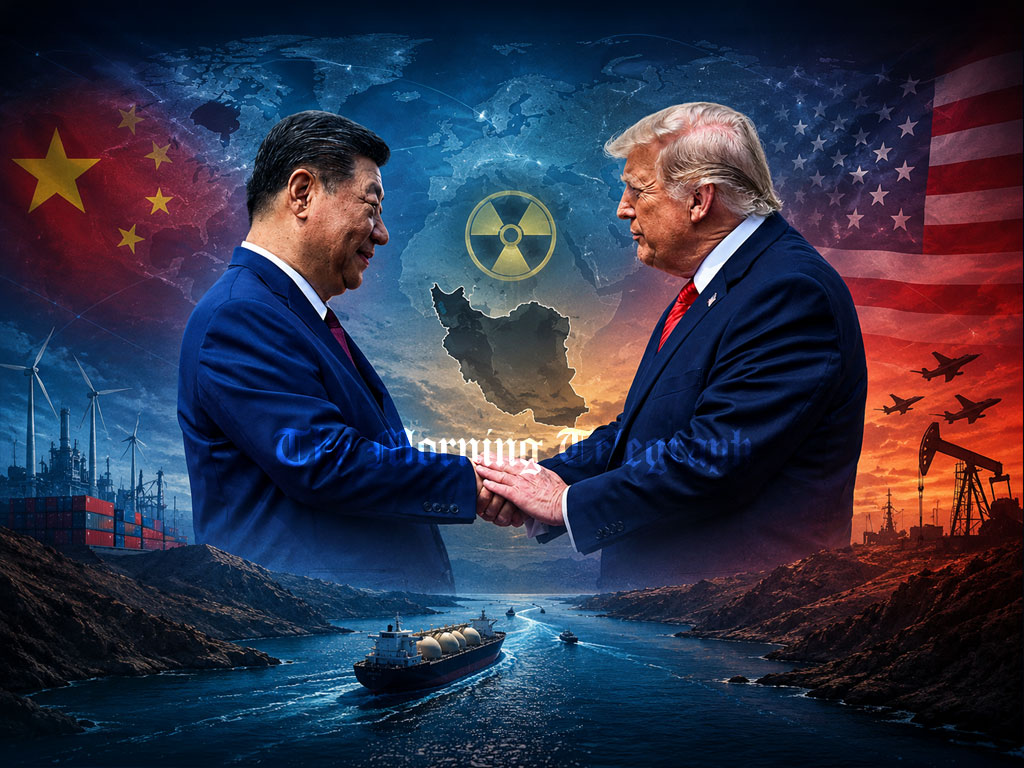
Trump-Xi Iran nuclear talks in Beijing focus on Tehran’s weapons threat, Hormuz security, trade ties and Middle East tensions.
Trump-Xi Iran nuclear talks produced rare common ground in Beijing, with US President Donald Trump and Chinese President Xi Jinping agreeing that Tehran must never be allowed to obtain nuclear weapons.
The agreement came during high-level talks on Thursday, as both leaders discussed Iran, the Strait of Hormuz, trade relations, energy security, fentanyl trafficking and wider geopolitical tensions in West Asia.
The meeting took place at a sensitive moment, with concerns growing over the fragile ceasefire involving Iran, Israel and the United States. There are also fears that renewed conflict could disrupt the Strait of Hormuz, one of the world’s most important energy shipping routes.

Trump And Xi Discuss Iran Nuclear Threat
According to a White House official cited by Reuters, both leaders agreed that Iran should never acquire nuclear weapons.
The agreement reflects rising international concern over escalating tensions in West Asia and uncertainty surrounding the region’s security environment.
Although Washington and Beijing often differ sharply on geopolitical issues, both governments appeared aligned on preventing further nuclear escalation involving Tehran.
The White House said Iran was one of the key issues discussed during the Beijing summit, alongside economic cooperation and regional stability.
Strait Of Hormuz Becomes Key Focus
The talks also focused heavily on the Strait of Hormuz, a strategic maritime corridor through which nearly one-fifth of global oil and natural gas supplies pass.
“The two sides agreed that the Strait of Hormuz must remain open to support the free flow of energy,” the White House said in its official summary of the meeting.
The waterway has become increasingly important amid regional tensions and fears that conflict could disrupt global energy supplies and push fuel prices higher.
According to CNN, Trump was expected to urge Xi to use China’s influence with Iran to help ensure that the strait remains open and operational.
China remains Iran’s largest oil buyer and maintains strong economic ties with Tehran.
China Rejects Hormuz Militarisation
A White House official quoted by CNN said Xi also expressed opposition to military escalation in the Strait of Hormuz.
The official said Xi made clear China’s opposition to the militarisation of the strait and any attempt to charge a toll for its use.
The statement reflects Beijing’s concern over energy security and uninterrupted maritime trade routes.
The official also claimed Xi showed interest in buying more American oil in the future to reduce China’s dependence on the strategic waterway.
However, the White House did not confirm whether China had agreed to take on a larger diplomatic role in resolving the wider Iran-related conflict.
Trade And Economic Cooperation Discussed
Beyond Iran and regional security, Trump and Xi also discussed ways to improve economic cooperation between the United States and China.
According to the White House, the talks included increasing Chinese purchases of American agricultural products, expanding Chinese investment in the United States and strengthening bilateral economic ties.
The White House later described the first day of talks between Trump and Xi as positive.
“President Trump had a good meeting with President Xi of China. The two sides discussed ways to enhance economic cooperation,” the White House statement said.
The summit follows years of trade tensions, tariffs and technology disputes between Washington and Beijing.
Taiwan Missing From White House Readout
Notably, the White House summary of the meeting did not mention Taiwan, despite Xi Jinping’s earlier warning that mishandling the issue could lead to “conflict” between China and the United States.
Taiwan remains one of the most sensitive issues in US-China relations, with Beijing viewing the island as part of its territory while Washington maintains strategic ties with Taipei.
The absence of Taiwan from the official White House statement has drawn attention among observers closely tracking the summit.
Why This Summit Matters
The Beijing summit is being watched around the world because relations between the United States and China directly affect international trade, energy markets, technology supply chains and geopolitical stability.
The discussions on Iran, energy security and economic cooperation suggest both countries are trying to stabilise ties despite ongoing competition and strategic rivalry.
The outcome of the summit could influence future diplomatic efforts in West Asia, global oil markets and the broader direction of US-China relations.