
By Marlon Dale Ferreira
A SriLankan Airlines Board Sub-Committee document now reveals that Capt. Daminda Rambukwella, the current Director General of the Civil Aviation Authority of Sri Lanka, was not treated as a failed trainee pilot, but as a victim of a grading and training-process dispute that led the airline to waive Rs. 8.7 million in A320 training costs.
The controversy surrounding current Civil Aviation Authority of Sri Lanka Director General Capt. Daminda Rambukwella has taken a dramatic new turn, after a SriLankan Airlines Board Sub-Committee document appears to shed fresh light on the disputed Airbus A320 Type Rating he obtained during his time as a Trainee Junior First Officer during a Cadet Pilot intake programme at the national carrier.
For months, allegations and questions have surrounded Rambukwella’s aviation training history, particularly relating to how he obtained an A320 Type Rating after joining SriLankan Airlines through a cadet pilot intake pathway as a Trainee Junior First Officer (TJFO), following his earlier service as a pilot in the Sri Lanka Air Force, where he had accumulated over 3,600 flying hours.

However, documents from training records to a copy of the airlines Board of Director meeting minutes, to a board paper submitted for approval in the possession of The Morning Telegraph suggest that the matter may not be as simple as critics have portrayed.
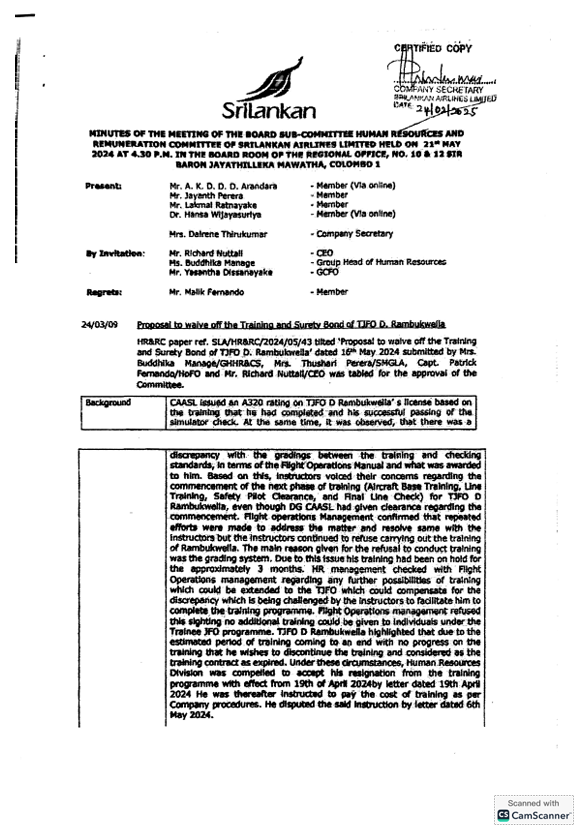
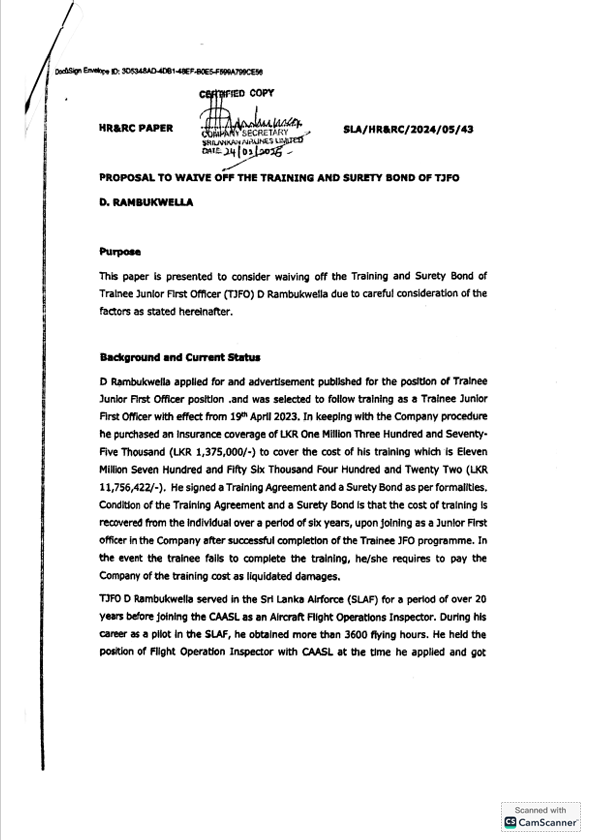
According to minutes of the Board Sub-Committee Human Resources and Remuneration Committee of SriLankan Airlines Limited, held on 21 May 2024, the airline considered a formal proposal titled “Proposal to waive off the Training and Surety Bond of TJFO D. Rambukwella”, dated 16 May 2024. The paper was submitted by senior management including Group Head of Human Resources Buddhika Manage, Senior Manager Group Legal Affairs Thushari Perera, Head of Flight Operations Capt. Patrick Fernando, and CEO Richard Nuttall.
The Core Question: Was Rambukwella Failed, or Was He Made a Victim?
At the heart of the controversy is one central question.
Was Daminda Rambukwella genuinely unable to meet the required training standard?
Or was he caught in a flawed internal process involving disputed grading criteria, instructor refusal, and a failure by Flight Operations Management to properly communicate changes to the relevant manuals?
The board paper appears to support the latter concern.
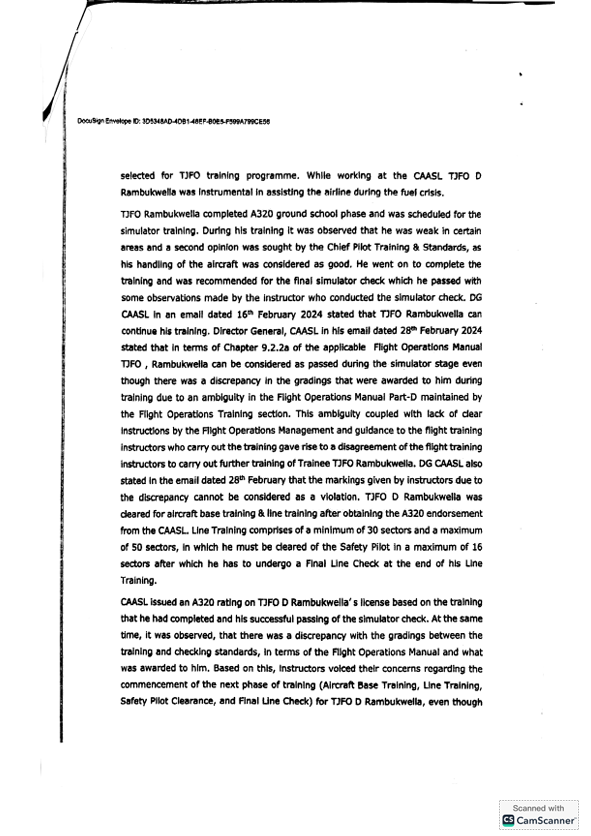
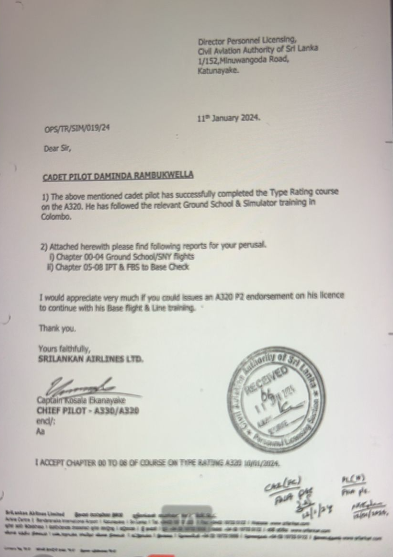
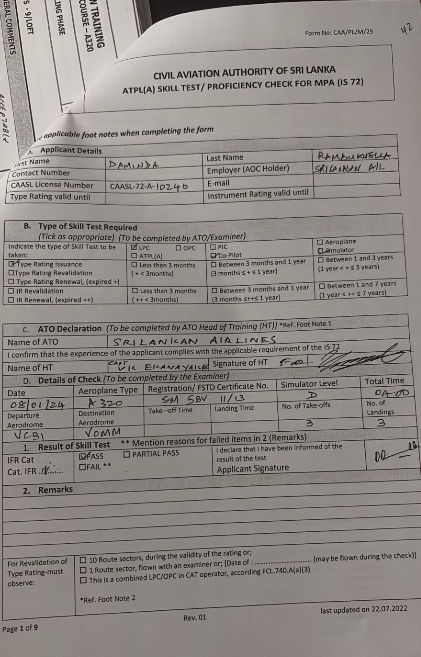
According to the minutes, the CAASL had issued an A320 rating on TJFO Rambukwella’s licence based on the training he had completed and his successful passing of the ground school and simulator check. However, a discrepancy was later observed between the gradings used in training and checking standards under the Flight Operations Manual and what had been awarded to him.
That discrepancy became the trigger point.
Instructors Refused to Continue Training
The document records that several instructors raised concerns regarding the commencement of the next phase of Rambukwella’s training, which included: Aircraft Base Training, Line Training, Safety Pilot Clearance and Final Line Check.
This was despite the fact that the Head of Flight Operations Capt. Patrick Fernando and the Director General of CAASL had reportedly given clearance for the next phase to commence.
According to the background section of the committee minutes, Flight Operations Management confirmed that repeated efforts had been made to resolve the matter with the instructors. However, the instructors continued to refuse to carry out Rambukwella’s training, with the main reason cited being the grading system.
The names of the instructors referred to in the wider controversy include senior airline captains such as Rajind Ranatunga, Kapila Gunasekara, Imad Azeez, Chaminda De Soyza, Lakshman Fernando, and Dushantha Jayaweera, who are said to have refused to conduct further line training on the basis that Rambukwella had not, in their view, properly passed the simulator training.
However, the board documentation now introduces a critical counterpoint: the airline’s own senior management later placed before the committee that there had been confusion over the marking criteria and that the trainee had little control over that process.
Training Put on Hold for Three Months
The matter did not move quickly.
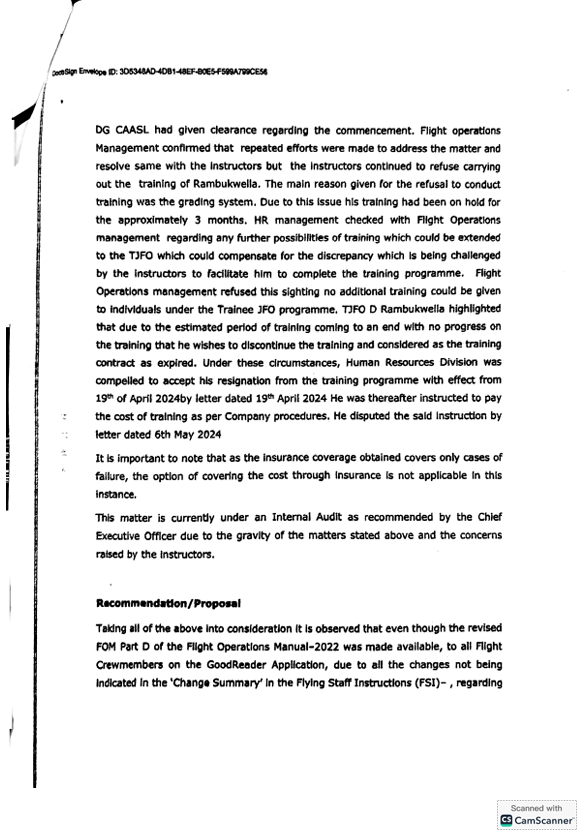
According to the minutes, Rambukwella’s training remained on hold for approximately three months. During this period, it is reliably learnt that he was mentally harassed, as on multiple occasions his training which was scheduled was cancelled at the last minute. Human Resources Management then checked with Flight Operations Management to determine whether further training could be extended to him to compensate for the disputed discrepancy challenged by the instructors.
Flight Operations Management refused, citing that no additional training could be given to individuals under the Trainee Cadet Pilot programme.
This left Rambukwella in a difficult position.
He had completed ground school, passed simulator training and evaluation, and had obtained the A320 Type Rating endorsement process. Yet he was unable to move forward because the instructors would not continue his line training.
Rambukwella Claims Contract Was Expiring
According to the committee minutes, Rambukwella had pointed out that the estimated training period was nearing its end with no meaningful progress being made. In those circumstances, he indicated that he wished to discontinue the training and considered the training contract to have expired. This position is said to have followed advice given to him by a very senior management pilot, who reportedly felt that even if Rambukwella continued with the national carrier, he was likely to face continued hostility or harassment from certain Flight Instructors.
Human Resources then accepted his resignation from the training programme with effect from 19 April 2024, by letter dated the same day.
He was thereafter instructed to pay the cost of training as per company procedure. Rambukwella disputed that instruction by letter dated 6 May 2024.
This became the key issue before the committee: should Rambukwella be made to pay the training bond, or should SriLankan Airlines absorb the cost because the situation arose due to internal process failures?
Rs. 11.7 Million Bond, Rs. 8.7 Million Already Spent
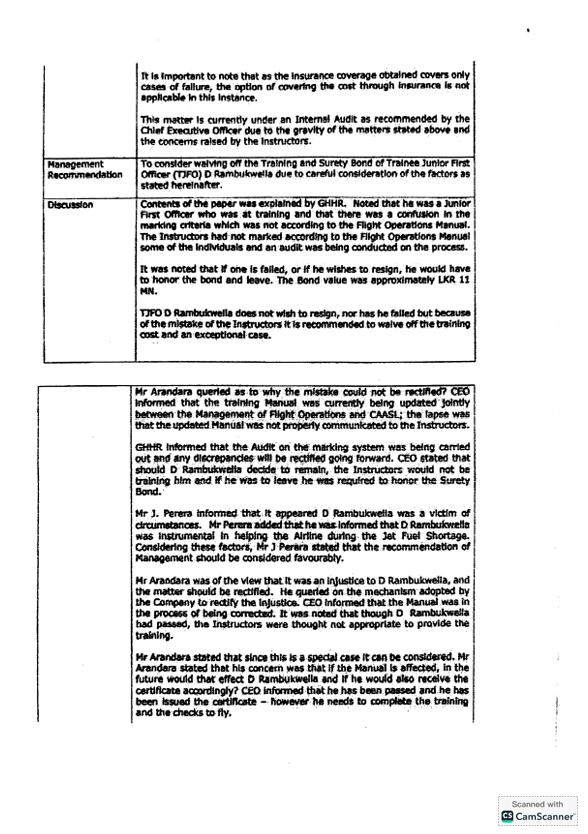
The committee minutes record that the full training cost was Rs. 11,756,422.
Out of that total, SriLankan Airlines had already spent Rs. 8,700,000 on Rambukwella’s partly completed training.
The management recommendation was to waive off the Training and Surety Bond of TJFO Rambukwella after considering the circumstances.
This is important because the decision was not framed as a favour or unexplained write-off. It was presented as a special case arising from internal discrepancies and a process in which the trainee was considered to have had very little control.
CEO: Manual Changes Were Not Properly Communicated
During the discussion, the minutes record that the contents of the paper were explained by Group Head of Human Resources Buddhika Manage.
It was noted that Rambukwella was a Junior First Officer under training and that there had been confusion in the marking criteria, which was said not to have been applied according to the Flight Operations Manual.
The minutes record that the instructors had not marked according to the Flight Operations Manual. It was also noted that an audit was being conducted on the process.
When queried as to why the mistake could not be rectified, CEO Richard Nuttall informed the committee that the training manual was being updated jointly between Flight Operations Management and CAASL. He further stated that the lapse was that the updated manual had not been properly communicated to the instructors.
That statement is central to the entire issue.
It suggests that Rambukwella’s problem may not have been his flying competency alone, but a breakdown in internal communication and training-standard implementation.
“Victim of Circumstances”
The strongest language in the committee discussion came when committee member Mr. Jayantha Perera reportedly stated that it appeared Rambukwella was “a victim of circumstances.”
Mr. Perera also noted that he had been informed Rambukwella was instrumental in helping the airline during the fuel shortage. Taking these factors into consideration, he stated that management’s recommendation should be considered favourably.
Another member, Mr. A.K.D.D.D Arandara, reportedly stated that it was an injustice to Rambukwella and that the matter should be rectified. He queried what mechanism the company would adopt to rectify the injustice.
The CEO responded that the manual was in the process of being corrected.
Passed, Certified, But Unable to Complete Final Training
One of the most revealing parts of the minutes is the clarification regarding TJFO Rambukwella’s training status.
The CEO informed the committee that TJFO Rambukwella had passed and had been issued the A320 Type Rating. However, he still needed to complete the remaining training and checks.
In other words, the board paper appears to distinguish between passing the simulator/type rating stage and completing line training required for absorption into the airline’s active flying cadre.
This distinction matters because public controversy has often blurred the issue into a simple claim that Rambukwella had failed.
The board record suggests a more complex position: he had passed certain stages, obtained the relevant rating, but was blocked from progressing because instructors refused to continue his training due to concerns over grading discrepancies.
The Board Sub-Committee’s Final Finding
The committee decision is perhaps the most important part of the document.
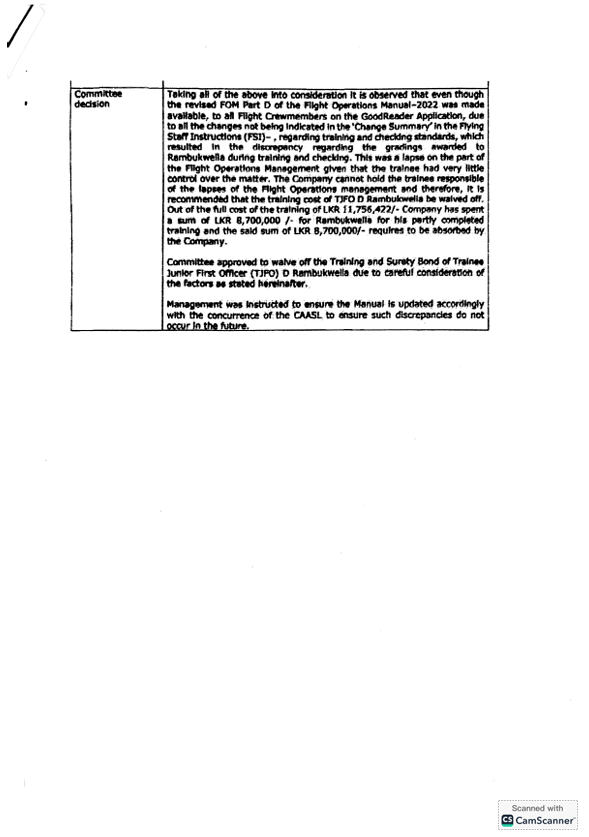
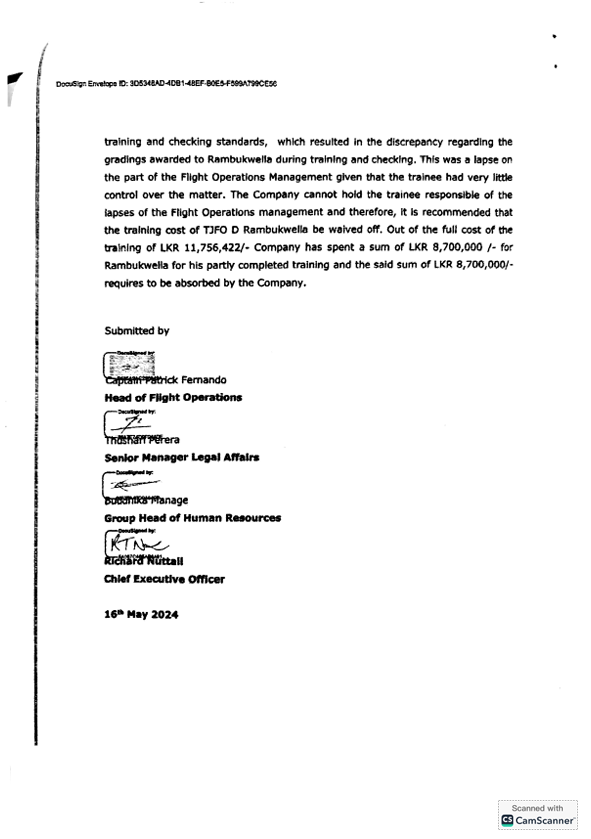
It states that, after taking all matters into consideration, the revised FOM Part D of the Flight Operations Manual 2022 had been made available to flight crew members through the GoodReader application. However, all changes had not been indicated in the Change Summary in the Flying Staff Instructions regarding training and checking standards.
This resulted in the discrepancy over the gradings awarded to Rambukwella during training and checking.
The committee then made the crucial observation:
This was a lapse on the part of Flight Operations Management, given that the trainee had very little control over the matter. Therefore, the company could not hold the trainee responsible for the lapses of Flight Operations Management.
That statement is the strongest documentary support for Rambukwella’s position.
Rs. 8.7 Million Training Cost Written Off
Based on that reasoning, the committee approved the waiver of Rambukwella’s Training and Surety Bond.
The minutes state that the company had spent Rs. 8,700,000 on his partly completed training and that the amount would have to be absorbed by the company.
Management was also instructed to ensure that the manual was updated with the concurrence of CAASL to prevent similar discrepancies in future.
Why This Matters Now
This story matters because Daminda Rambukwella is no longer merely a former trainee pilot caught in an internal airline dispute.
He is now the Director General of the Civil Aviation Authority of Sri Lanka, the country’s aviation regulator.
That makes the public interest obvious.
If allegations are levelled against him over his past A320 Type Rating, then the public has a right to know the full documented position, not only the accusations.
And the board paper now reveals a far more nuanced picture.
It shows that:
Rambukwella had been issued an A320 Type Rating after completing training and passing the simulator check.
Instructors later refused to continue his next phase of training due to concerns over grading standards.
His training was placed on hold for around three months.
Internal management acknowledged confusion in the marking criteria.
The CEO informed the committee that manual updates had not been properly communicated to instructors.
A member of the airline’s Board of Directors described Rambukwella as a victim of circumstances.
The Board of Directors found that Flight Operations Management had lapsed.
The company concluded that Rambukwella could not be held responsible for that lapse.
The Rs. 8.7 million spent on his training was waived and absorbed by the company.
The Rs. 8.7 Million Question Behind the A320 Type Rating Controversy
The controversy over Daminda Rambukwella’s A320 Type Rating has been presented in public debate as though it was a straightforward case of a trainee failing to meet standards.
But the SriLankan Airlines Board Sub-Committee minutes now suggest something much more complicated.
They point to an internal breakdown over grading criteria, instructor disagreement, manual communication failures, and a trainee left stranded between CAASL clearance and instructor refusal.
Whether critics accept it or not, the airline’s own internal committee concluded that Rambukwella was not responsible for the lapses of Flight Operations Management.
That finding now changes the tone of the controversy.
The real question is no longer simply whether Capt. Daminda Rambukwella completed every stage required to enter SriLankan Airlines’ flying cadre.
The bigger question is this:
Was he unfairly branded by a system that had itself failed to properly communicate, grade, and manage its own training standards?
And if SriLankan Airlines’ Board of Directors believed he was made a victim of that process, then the public debate around his A320 Type Rating may now need to be judged against the airline’s own written record, not merely against rumours, allegations, or selective claims.


This story though well written only has many holes and unanswered questions in it. I hope the Editor will publish the entire training record of this particular TJFO which is the root cause of the problem.
From what I am made to understand he could not cope up with the training and was marked unsuccessful in completing mandatory maneuvers and flying exercises. His multi-tasking ability was well below an average pilot commensurate with his level of experience compounded by very poor Situational Awareness while flying. He had failed many simulator sessions and the person responsible for permitting his continuation in the TJFO program should be held accountable for all that transpired subsequently and the financial loss to the airline which is public funds. I would like to point out there was another female Trainee Cadet pilot who was unsuccessful in one area of the Simulator Session, however she was promptly terminated and her training bond recovered in time. It is pertinent to ask why she was treated so badly having performed far better than the TJFO mentioned in this story. This is a travesty of Justice. I believe Sri Lankan Airlines has committed Insurance Fraud by claiming on the Training bond of the female cadet and letting the TJFO mentioned here go scot free.
There has to be a forensic audit of this entire sordid case as I believe two very senior Pilots in management are responsible for blatant lying not only to the Sri Lankan Airlines Board of directors, but also to the Civil Aviation Authority of Sri Lanka which as per law should result in an immediate suspension of their respective pilot license and an independent inquiry held after charges filed.
The two management pilots have relied on a remark made by an independent pilot examiner as he is notorious in passing failed candidates who do not meet the criteria set by the Sri Lankan Airlines training manual which remains unchanged since 2022. While having graded the TJFO unsuccessful in four occasions during the final evaluation he contradicts himself in the remarks as “Successful” evaluation. It is this one single contradictory remark, which gave the TJFO and the management pilots a leg to stand on.
The statement that the marking criteria was changed and the instructors did not know is a big fat lie.
At the end of the day the Taxpayer is out of pocket to the tune of 8. 7 million Rupees, an Airline that has committed Insurance Fraud and a former TJFO with a questionable A320 rating that this NPP government appointed to be the Director General/CEO of The Civil Aviation Authority of Sri Lanka who claims two salaries in the form of Government Pension and a hefty Salary and some allowances he is not entitled to claim.
ONLY IN SRI LANKA – A LAND LIKE NO OTHER!
I believe he is drawing his Government Pension and a Government salary with allowances simultaneously which is illegal. One cannot be drawing a Government pension and also draw a govenment salary both at the same time.
Auditor General Department and Finance Ministry over to you.