Photograph courtesy :- Rukmal Gamage
Saman Shanthapriya, the soldier in the Wellamulliwaikkaal photo, returns after 17 years as the human story behind the image is revealed.
Saman Shanthapriya became the face of one of Sri Lanka’s most powerful war photographs, but for years, few knew the story behind him.
The battlefields of Wellamulliwaikkaal, where Sri Lanka’s longest war came to an end, still remain in national memory as a chapter written in blood and grief.
Amid the fire, dust, loss, and sorrow, at a moment few expected, there was one story where humanity rose above everything else.
At the centre of that story stood Lance Corporal Saman Shanthapriya.
Many may not know his name.
But the world saw what he did.

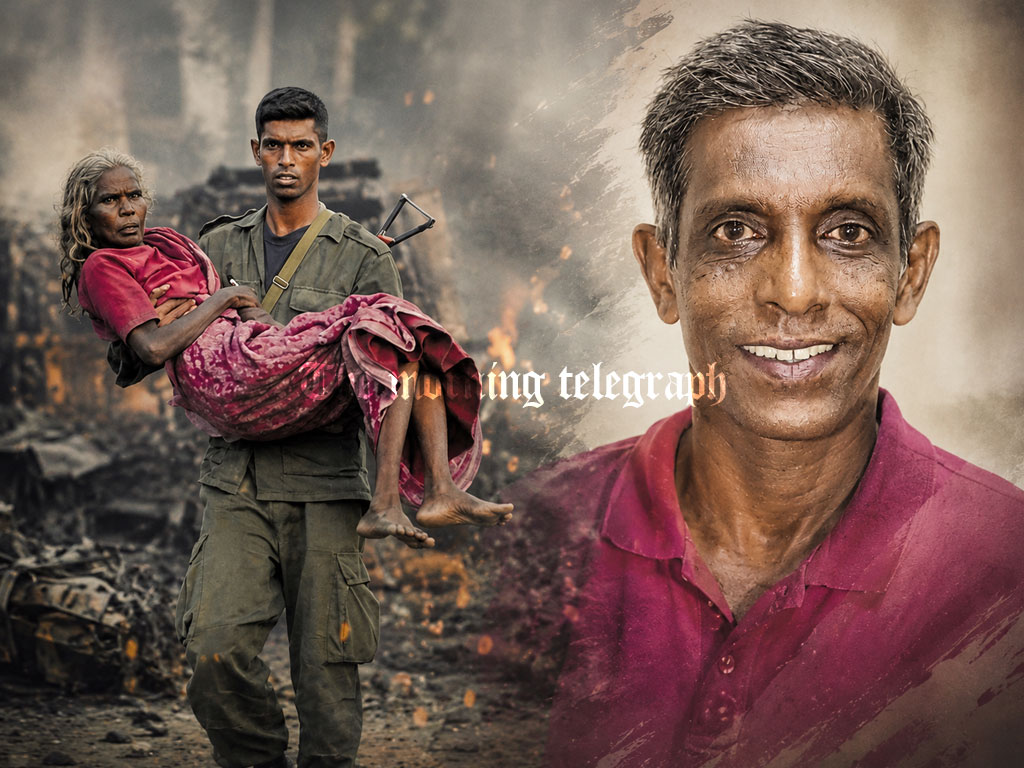
In the middle of war, through flames and fear, the image of a soldier carrying an elderly Tamil woman on his shoulder became more than a photograph.
It became a living symbol of humanity in the middle of conflict.
Born in Wanarawa, Weyangoda, Saman Shanthapriya came from a simple family.
Village life, school days, and ordinary moments with friends formed the foundation of his childhood.
But he did not carry an ordinary dream.
A scene he witnessed as a child changed the course of his life.
He saw the pride, discipline, and bearing of military soldiers deployed to protect a foreign leader.
Their uniforms, their role, and their sense of duty made a deep impression on him.
That day, he decided: “I too will one day serve this country.”
It was a simple thought.
But it became a life-changing decision.
When he turned eighteen, he made that childhood dream real.
He joined the Sri Lanka Army and was attached to the Sinha Regiment.
Military training was not merely a test of physical strength.
It tested the mind, courage, patience, and endurance.
In jungles, under rain, with little food and little sleep, he faced the harshness of military life.
At moments when many would have thought of giving up, he pushed forward.
That was how he became a soldier who advanced.
Life on the battlefield meant living with danger every day.
Every step could have been his last.
Shanthapriya knew this reality well.
He was often on the front line.
Because of that, he was also wounded.
A sniper attack changed his life.
A bullet entered his body, taking him close to death.
But he rose again.
That was not merely physical strength.
It was mental courage.
Then came May 2009.
The final days of the war were intense.
But it was not only a battle.
It was also a mission where lives had to be saved.
Many civilians fled.
But the elderly, weak, and sick had been left behind.
At such a moment, Shanthapriya saw an elderly woman hiding under a lorry.
She was trembling with fear.
She was trying to save her life.
There was gunfire.
There was fire.
There was death.
He had a decision to make.
Himself or her.
He chose her.
He ran towards her, lifted her, and carried her to safety.
At that moment, he was not only a soldier.
He was a human being.
That act was captured in a photograph.
The image was later published around the world.
Many saw it and expressed different opinions.
But one message was clear.
Even in war, humanity does not die.
The war ended.
But his life did not become grand.
He returned to ordinary life.
He worked as a labourer.
He lived simply.
The man the world had seen in that image was quietly living a humble life.
The following excerpt is from the Crime Watch SL Facebook page. Full ownership of the article belongs to the original owner.
The hero of the Wellamulliwaikkaal battlefield has appeared after 17 years.
Lance Corporal Saman Shanthapriya is not widely known by the public.
Many do not know his background or even what he looks like.
Only a few in the Army know the story of Corporal Shanthapriya.
The people of Weyangoda, Wanarawa, also know him, because he has lived in that village since childhood.
Even if people did not know the name Shanthapriya, there is proof that the world, not just Sri Lanka, knows his image.
Corporal Shanthapriya is so significant to the Army that his picture is displayed on the wall at the entrance of the Sri Lanka Army Headquarters in Battaramulla.
That picture shows a soldier carrying an elderly Tamil woman through the flames at Wellamulliwaikkaal seventeen years ago.
The man in that picture is Lance Corporal Saman Shanthapriya.
The photograph became exactly seventeen years old on May 19.
That is because the picture was taken on May 19, 2009, the day LTTE leader Velupillai Prabhakaran was killed.
Lance Corporal Shanthapriya knows the story behind the picture better than anyone.
We met him seventeen years after the end of the thirty-year war.
“It was May 19th. Many Tamil people who were held as hostages by the LTTE were returning to our side. We went to the cleared line to see if there were any people remaining. Because there were many elderly people who couldn’t walk left behind. We went looking for them. There was a place where a blast had occurred the previous day. That’s when I saw an elderly Tamil woman hiding under a lorry. Perhaps her family had left her behind. By then, there was firing happening behind that spot. I went and lifted that grandmother up. She was very scared. Because they had a wrong idea about us. I brought her and handed her over to our people. They treated the grandmother and gave her food.”
The photograph was taken by Lake House photographer Rukmal Gamage.
He is a war photographer.
From Mavil Aru, where the Fourth Eelam War began, to Wellamulliwaikkaal, where Prabhakaran was killed, he carried his camera through the war.
The world’s best war photographer is often considered to be American James Nachtwey.
But the pictures in Rukmal’s possession are deeply valuable to Sri Lanka.
Among them, the most powerful is the image of Corporal Shanthapriya carrying an elderly Tamil mother.
Through his camera lens, Rukmal captured how the Army rescued civilians at Wellamulliwaikkaal.
He saw Lance Corporal Shanthapriya walking through the flames towards the Tamil woman hiding under a lorry.
He quickly took several photographs of Shanthapriya rescuing her and walking towards him.
But Shanthapriya did not see this happen.
We wanted to know when Shanthapriya first saw his world-famous photograph.
“I didn’t see anyone taking my photo that day. To be honest, we didn’t have any attention on those things. After we won the war, we got leave. I had a friend in the Air Force. When I was at home, he brought me a newspaper saying there was a photo of me. That was about four or five days later. I wanted to find that photo but I couldn’t. It was much later that I was able to find the photo. During that time, I was immensely proud, and there was great recognition even in the village. They had put up a large cut-out of this picture in the village.”
The government called the Fourth Eelam War a humanitarian operation.
Despite that, the military was almost daily accused internationally of committing inhuman acts during the war.
But the Army answered those accusations with the picture taken by Rukmal of Lance Corporal Shanthapriya.
Shanthapriya’s village is Wanarawa, Weyangoda.
He joined the Sri Lanka Army in 1990.
From childhood, he had a strong desire to become a soldier.
That desire began because of a scene he witnessed when Queen Elizabeth of England visited Sri Lanka in the early 1980s.
At the time, Shanthapriya was a young child.
He saw a group of Army soldiers dressed in dark green uniforms and boots deployed to guard the Queen.
That day, he decided that he too would one day join the Army.
By the time he turned eighteen, the situation at home naturally pushed him towards the Army.
His mother was afraid of him staying at home.
During that time, “gunny bag” kidnappers were reportedly breaking into houses and taking away grown boys.
For Saman, the Army became the safest place.
So he chose it without hesitation.
Shanthapriya joined the Army as an ordinary soldier and was attached to the 7th Sinha Regiment.
He was first sent for duty to Batticaloa.
He was then sent to a battalion training course in Minneriya.
That training was extremely difficult because it had to be completed inside the jungle, amid many obstacles.
Although senior officers had promised that all soldiers would be given one month’s leave after training ended, that promise proved false.
The day after training ended, they were told to prepare to go directly to the Elephant Pass battlefield.
Angered by this, the soldiers in Shanthapriya’s group left all their weapons at camp and went home.
But no punishment followed because everyone’s leave was approved.
However, they lost the one-month leave they had expected.
The 7th Sinha Regiment, where Shanthapriya served, was almost always on the front line.
Wherever the war was, the 7th Sinha Regiment was there.
Among them, Shanthapriya was always a few steps ahead.
That was partly because he was stubborn and partly because he was tall.
At six and a half feet tall, he was often at the front when crossing streams and rivers.
Because of this, his life was always at risk.
Twice, he could not escape the bullets of terrorists.
The first time was a sniper attack.
He showed the permanent scars from that injury.
“I was new to the Army when I was hit by a sniper shot. That was at Elephant Pass, Aiyakachchi. There were no roads to get to where we were. The LTTE were all around us. We were taken there by choppers. Even food and drink were brought by helicopter and dropped into the lagoon from above. Even if vegetables were brought, they couldn’t be stored for long. Most of what we cooked and ate was like sprats and soya meat. Even if we were injured, we had to be taken out from above. They attacked us from all sides while we were in the middle. We answered them. The day the line was broken, I was hit by a sniper shot in the shoulder. I think it was aimed at my neck. But the target changed and it didn’t hit my neck. I was taken away by chopper. I have tubes inside my body even now. I still feel pain from time to time. Two fingers on my hand are numb.”
The sniper attack prevented Shanthapriya from fighting on the front line for five years.
For those five years, he was stationed at the Sinha Regiment Headquarters in Ambepussa.
With only a few months left until the end of the war, another bullet found Shanthapriya.
This happened at Puthumathalan, Mullaitivu.
That day too, he was fighting on the front line.
Shanthapriya and his men had been ordered to advance one hundred metres every day.
This was to allow the Army group coming behind them to move forward.
The war at the time was commanded by their Sinha Regiment commander, Army Commander Lieutenant General Sarath Fonseka.
The Sinha soldiers knew from experience that there was no escaping him.
As they advanced, they came under heavy gunfire.
Shanthapriya’s foot was injured, along with several other soldiers.
But he spent only about a week in hospital receiving treatment.
He had the chance to leave the war and stay home if he wanted.
But Shanthapriya did not want to go home like a coward at the final moment.
He wanted to return to the battlefield as soon as possible and fight the enemy.
That was how strongly he felt the need to save the country.
This time, he went back thinking that he did not care even if he died.
He left the safety of his three children in the hands of his wife.
Shanthapriya’s younger brother was also a war hero who fought on the front line.
Serving in the Gajaba Regiment, he lost one leg while fighting for the country.
Although both Shanthapriya and his brother served in the Army, they rarely had the chance to meet and speak to each other.
When Shanthapriya was on leave, his brother was on duty.
The two brothers only met properly after the war ended.
Having shed blood twice on the battlefield, Shanthapriya was entitled to the Deshaputra Medal.
But heavier than that medal is the Ranashura Medal hanging red on his chest.
That medal is awarded for acts of bravery.
Shanthapriya earned it when he went to capture an LTTE bunker while fellow soldiers were trapped by death.
Unafraid of death, he killed terrorists and rescued his fellow soldiers.
No matter how great his sacrifice was, when we met Shanthapriya, he was working as a paint baser to earn a living.
Shanthapriya, who placed his own life and even his family’s life second, had also lost his pension after retirement for no justifiable reason.
He had become disillusioned with the job he had loved like his own life for twenty-two years.
In the end, what remained were the calluses on his hands.
The photograph Rukmal took at Wellamulliwaikkaal in 2009 later became the reason for Shanthapriya’s life to change again.
Rukmal went looking for the soldier in his photograph.
The two heirs of the world-famous image met face to face again after seventeen years.
That day, Shanthapriya came to meet Rukmal covered in white powder, because he had been cutting putty at a house.
That meeting ended with justice being done for Shanthapriya.
The Deputy Chief of Staff of the Army and Regiment Commander of the Artillery, Major General Nilantha Premaratne, did his duty by restoring Shanthapriya’s lost pension.
Although Shanthapriya’s world-famous photograph is framed and displayed on the entrance wall of Army Headquarters, Corporal Shanthapriya has still not been allowed to see it.
Not because he does not want to see it.
But because he has not been given permission to go there.
In the near future, Rukmal is trying to do something more for Shanthapriya.
He wants to take Shanthapriya, together with his entire family, to see the photograph of himself hanging at Army Headquarters.
Even though Rukmal’s photograph is world-famous, few people know that the people behind it are soldier Shanthapriya and photographer Rukmal.
For years, neither name was properly mentioned.
Now, after seventeen years, those names are finally being spoken.
Saman Shanthapriya is not merely a name.
He represents humanity.
In the middle of war and death, he made a decision to save a life.
That is true heroism.
The reason people can live freely today is because of people like him.
It is the responsibility of the nation to remember them.