Property rights concerns grow as Malwana occupation raises fears over courts, contracts, investor confidence and Sri Lanka’s recovery.
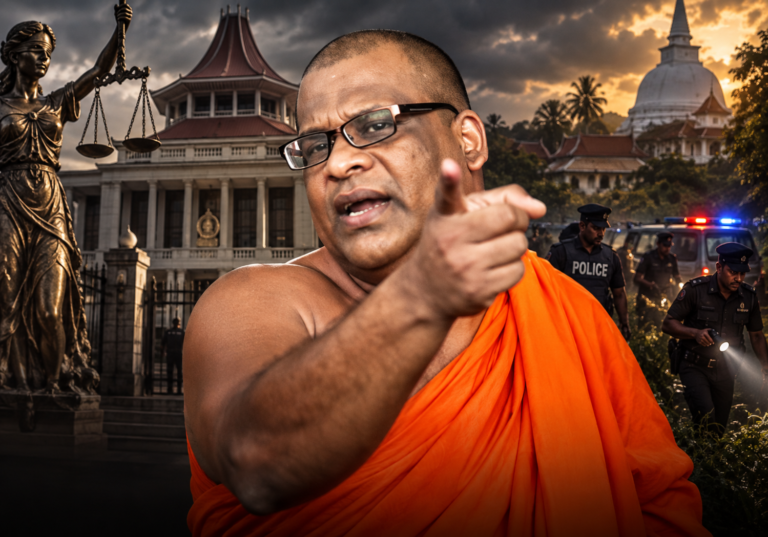
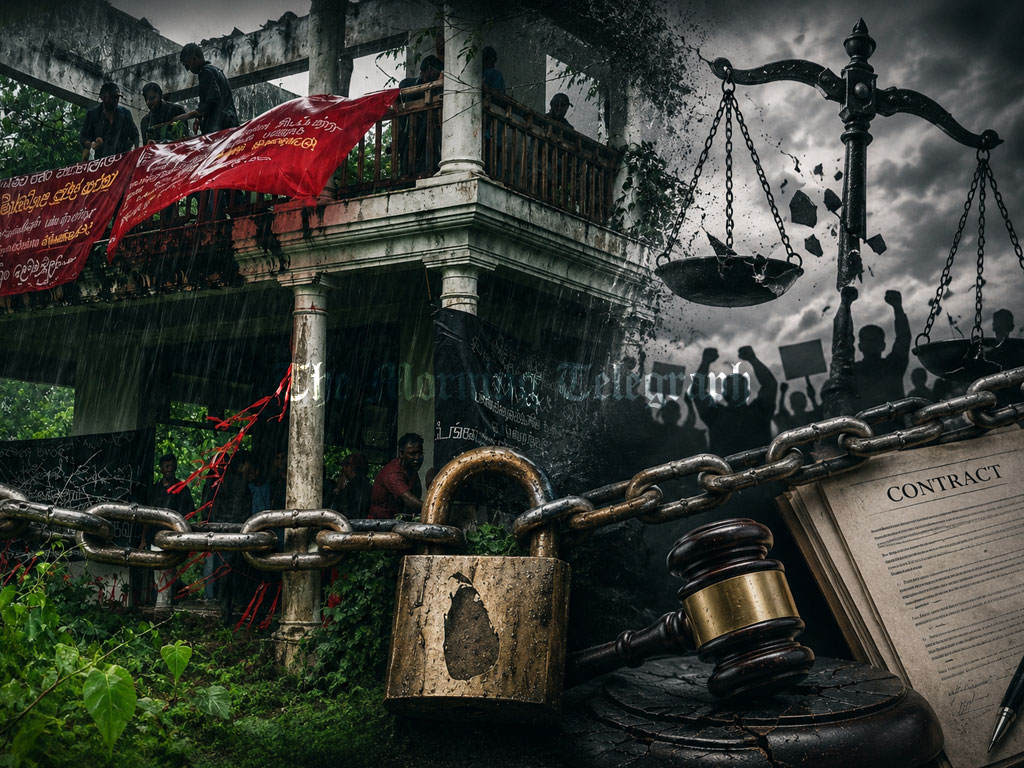
Property rights have become a major concern for Sri Lanka’s fragile recovery after the recent occupation of a Malwana property by student activists.
Sri Lanka’s recovery risks being derailed if extra-legal action begins to replace courts, contracts, and lawful property protections.
The recent occupation of a property in Malwana by a group of student activists does not send a positive signal to Sri Lanka’s already fragile investment climate. Beyond the immediate issue of law and order, it raises a deeper question: whether property, contracts, and institutional processes will be protected at a time when the country is trying to rebuild economic confidence.

Whatever the political background or disputed history linked to the property, the central issue is clear. A property under state protection and administration was forcefully occupied by an organized group making political and social demands. If such actions are tolerated or normalized, the consequences could extend far beyond this single case.
Property rights are one of the foundations of a modern economy. Investors, whether local or foreign, make long-term commitments only when they believe assets, contracts, and lawful ownership will be protected through institutions, not challenged through pressure, intimidation, or political mobilization.
The Legacy Of State Control And Expropriation
Sri Lanka’s post-independence economic history includes many episodes that weakened this confidence. During the 1960s and 1970s, repeated waves of nationalization and state acquisition transformed the structure of the economy.
Tea, rubber, and coconut estates were taken over under land reform. State ownership expanded into banking, insurance, transport, manufacturing, and other sectors.
In 1962, the petroleum distribution sector was expropriated, including assets belonging to American oil companies. In 1963, the United States suspended assistance to Ceylon under the Hickenlooper Amendment to the Foreign Assistance Act, making the country one of the first outside Cuba to face such action under that U.S. provision.
At the time, Sri Lanka, then Ceylon, still had important export industries, including graphite, plantations, and related commercial networks. Yet repeated interventions, expropriations, and politicization weakened the entrepreneurial and industrial classes that had emerged during the late colonial and early post-independence period.
Local capital formation suffered. Many business families migrated, reduced their operations, or became increasingly dependent on political patronage for survival.
That legacy remains visible. Nearly 80 percent of Sri Lankan land is estimated to be under state ownership, much of it underutilized or trapped inside bureaucratic systems that block productivity.
The state has an important role in regulation, redistribution, and social protection. However, excessive concentration of ownership and control has often produced inefficiency and politicization instead of broad-based prosperity.
The opening of the economy in 1977 was an attempt to reverse that course by encouraging private enterprise and liberalizing trade. It also introduced constitutional protection under Article 157 for foreign investment agreements approved by Parliament.
Yet the move away from the interventionist model of previous decades was gradual and incomplete. Significantly, the Business Acquisitions Act of 1971, which gave the state sweeping powers to expropriate private enterprise, remained in force until the final phase of President J.R. Jayewardene’s tenure nearly a decade later.
This showed how difficult it is to reverse measures that place coercive economic power in the hands of government once they become embedded in political culture.
Powers introduced as shortcuts for political purposes are rarely surrendered willingly by later administrations. Instead, they remain hanging over private enterprise like a sword of Damocles, conditioning business to remain close to power rather than operate with confidence inside a predictable legal framework.
The war years further pushed both the state and private sector towards short-term survival rather than long-term transformation.
Over the last three and a half decades, Sri Lanka’s record has remained mixed. Important privatization, deregulation, and private-sector participation measures were introduced. Sectors such as telecommunications, ports, plantations, apparel, tourism, and financial services benefited from varying degrees of liberalization and private initiative.
Yet reversals, arbitrary interventions, retrospective measures, and periodic state reassertion over private enterprise also continued. The result has been a business culture often marked by caution, short-termism, and closeness to political power rather than innovation, scale, and long-term productive risk.
That is why the Malwana incident matters.
The Present Confidence Test
Foreign investors usually take their signals from domestic business confidence. If local entrepreneurs themselves are uncertain about policy consistency, property protection, and the predictability of the legal system, foreign investors will naturally become cautious too.
When the current administration came to power, it initially caused concern among sections of the business and investment community because of its ideological origins and left-wing political associations.
However, its decision to continue the economic stabilization programme, cautiously pursue reforms in key sectors, deepen international economic engagement, and explore large-scale foreign investment encouraged many observers to adopt a cautious wait-and-see approach.
Sri Lanka today needs investment, technology, export growth, and employment generation.
It needs confidence not only from foreign investors but also from domestic entrepreneurs willing to take long-term risks in manufacturing, infrastructure, energy, logistics, and agriculture.
Economic stabilization alone will not create growth unless confidence gradually returns.
When Extra-Legal Action Becomes A Precedent
In this context, any occupation of property by activist groups outside the legal framework, regardless of the background of the owners involved, sends a troubling signal to investors.
It raises questions about the state’s willingness or ability to uphold institutional order.
Investors do not look only at economic statistics or policy speeches. They observe behavior, precedent, and the consistency with which governments enforce the rule of law.
What becomes especially damaging is the perception that informal or extra-legal action may be tolerated, encouraged, or selectively ignored for wider political purposes.
Once societies drift toward forms of “frontier justice,” where organized groups assert claims outside established legal processes, institutional credibility begins to weaken.
Even when such actions are initially seen as politically useful or symbolic, they can create precedents that become difficult to control.
This risk is especially serious during economic hardship. Sri Lanka remains socially fragile after years of crisis, inflation, reduced living standards, and declining public trust.
Movements tolerated for tactical reasons can later evolve into wider challenges to institutional authority.
A Recovery Still At Risk
Sri Lanka has long had a left-leaning political culture, and many in the political class have historically viewed private capital with suspicion.
Yet no modern economy can function effectively without respect for lawful ownership, enforceable contracts, and confidence in institutions.
These are practical requirements for economic organization in any advanced society.
Capitalism itself is rarely elegant in practice. Markets can appear unequal, disruptive, and uncomfortable. But no country has achieved sustained prosperity without creating conditions where enterprise, investment, and productive risk-taking are protected inside a stable legal framework.
Sri Lanka has achieved a degree of macroeconomic stabilization after its worst post-independence economic crisis.
But stabilization is only the beginning.
If property rights appear conditional, if the rule of law appears uncertain, or if organized groups are allowed to assert authority outside legal institutions, capital, both domestic and foreign, will remain cautious.
The sooner Sri Lanka recognizes this reality, the better its chances of achieving durable economic recovery and long-term prosperity.