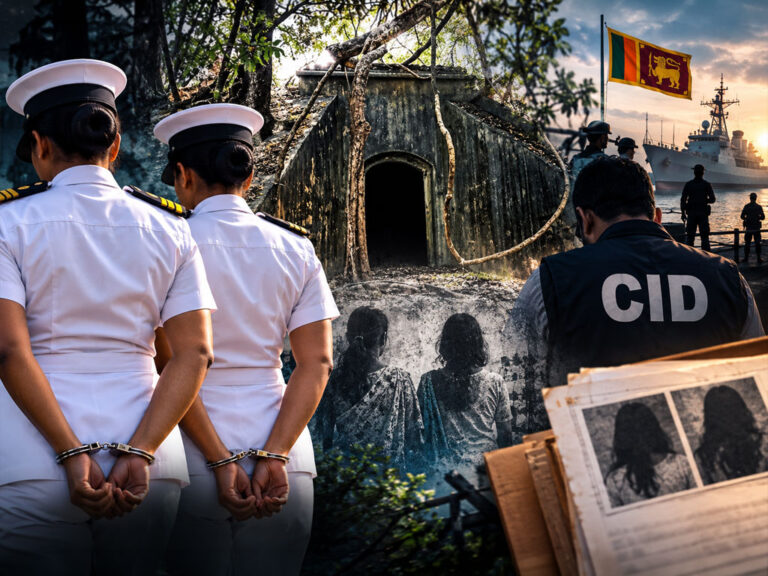
Sinhalese expelled from North during LTTE ethnic cleansing still face unresolved land, resettlement, and justice issues decades later.
The Sinhalese expelled from North during Sri Lanka’s war remain at the centre of a painful and often suppressed question: who will deliver justice to them, and when?
A Tamil person can live and settle in any part of Sri Lanka without difficulty. But can a Sinhalese person settle freely in the North-East? If not, then in their own country, who is truly suffering from racism, the Sinhalese or the Tamils?
This is the other side of a highly sensitive tragedy in Sri Lankan history. It is a reality that is 100% true, yet often deliberately ignored by mainstream media. This analysis traces the real roots of an ethnic cleansing that was scientifically and officially confirmed, but internationally sidelined when examining the history of Sri Lanka’s war against LTTE terrorism.
To understand why the claim that “only minorities are discriminated against in Sri Lanka” is a complete political fabrication, history must be reread through the suffering of Sinhalese and Muslim people, communities that were brutally battered by war and political games, losing even their fundamental rights and ancestral lands.

The dark past: systematic ethnic cleansing
The LTTE carried out a systematic programme to turn the Northern and Eastern Provinces into a mono-ethnic enclave restricted to one race. In that process, Sinhalese and Muslim civilians were inhumanely targeted.
Expulsion of Muslims from the North in October 1990
In October 1990, the LTTE ordered more than 75,000 Muslims living in Jaffna, Mannar, Mullaitivu, Kilinochchi, and Vavuniya districts to leave the entire Northern Province within 48 hours. In some areas, the time given was reportedly only two hours.
The victims were allowed to take only Rs. 150 and the clothes they were wearing. Their gold jewellery, money, homes, and property were looted by the terrorists.
This tragedy has been recorded in reports by Amnesty International, Human Rights Watch, and the University Teachers for Human Rights in Jaffna.
Killing and expulsion of Sinhalese people
From the early 1980s, brutal massacres were carried out to terrorize and drive away Sinhalese residents living in so-called border villages.
In November 1984, LTTE terrorists attacked Dollar Farm and Ken Farm, two Sinhalese agricultural villages in the Mullaitivu District. They brutally hacked and killed 62 Sinhalese residents, including women and children, and completely destroyed the villages.
In 1985, terrorists stormed the sacred city of Anuradhapura and shot dead 146 Sinhalese devotees and civilians at Sri Maha Bodhi.
In August 1990, more than 140 Muslims were inhumanely killed while praying inside mosques in the Kaththankudi and Eravur areas.
Official statistics and ancestral heritage
These communities were not temporary residents. They had lived in those areas for generations, engaged in agriculture, fishing, trade, transport, government service, and other livelihoods.
According to the last official Census of Population and Housing held before the war intensified in 1981, the Sinhalese population in the Northern Province was as follows:
- Vavuniya District recorded 15,876 Sinhalese residents, amounting to 16.5% of the district population.
- Mannar District recorded 6,859 Sinhalese residents, amounting to 8.4%.
- Jaffna District, including Kilinochchi, recorded 4,615 Sinhalese residents, amounting to 0.6%.
- Mullaitivu District recorded 3,992 Sinhalese residents, amounting to 5.1%.
- Altogether, the Northern Province had 31,342 Sinhalese residents, representing 2.9% of the province.
With natural population growth from 1981 to 1989, this number would have exceeded 35,000, or approximately 7,000 to 8,000 families. By 1990, the LTTE had expelled almost the entire population, reducing the Sinhalese presence in the Northern Province to nearly 0%.
Areas where Sinhalese permanently lived in the North
In the Vavuniya District, which had the largest Sinhalese population, communities lived in areas such as Mameduwa and Bogaswewa, ancient tank villages where Sinhalese farming families had lived for generations.
They also lived in the northern section of Padaviya, particularly villages along the northern border of the Padaviya colonization scheme.
In Nedunkeni and Chettikulam, Sinhalese and Tamils lived and farmed together in mixed communities.
In Vavuniya town, Sinhalese families had settled permanently as merchants, railway workers, bus transport workers, and service providers.
In Mannar District, Sinhalese families lived in Mannar town and Thalaimannar. Many worked in railway, port, and customs services around Thalaimannar Pier, which once functioned as a bridge between India and Sri Lanka. Fishing communities from the south also lived there.
In the Murunkan and Madhu areas, people lived around Madhu Church and the Murunkan pottery factory.
In Mullaitivu District, Kokkilai and Nayaru were famous Sinhalese fishing villages. Fishermen who stayed there for most of the year later became permanent residents.
Dollar Farm and Ken Farm, later linked to Welioya, were large-scale agricultural colonies on the Mullaitivu border. In 1984, 62 residents were massacred and expelled from these areas.
In Jaffna and Kilinochchi districts, Sinhalese businessmen, especially bakery owners and cloth merchants, lived in Jaffna town. Teachers at Maha Vidyalaya, bank employees, and government workers also lived there permanently with their families.
In Kankesanthurai, there were separate housing schemes for Sinhalese workers employed at the then Ceylon Cement Corporation factory and for their families.
In Iranamadu, Kilinochchi, people worked in irrigation and farming colonies connected to the Iranamadu tank.
The present reality as of 2026
Although 17 years have passed since the end of the war, from 2009 to 2026, the problems faced by these displaced communities have still not been fully resolved.
There are no officially functioning welfare camps today. However, the people who were victimized then are now divided into two broad groups, living amid serious economic and legal difficulties.
Some have resettled in the Northern Province. These include communities in Bogaswewa villages 1, 2, 3, and 4, Namalgama, Salambakulam, and Nandamithragama in the Vavuniya South Divisional Secretariat area.
Others live in Janakapura, Kalyaniyapura, Ehetugaswewa, and Kiriibbanwewa in the Welioya border area of Mullaitivu.
A limited number have restarted businesses in Jaffna and Vavuniya towns.
Another group has chosen permanent settlement in areas of the South. These include Padaviya, Kebitigollewa, Medawachchiya, and Rambewa in Anuradhapura.
Others are in Welikanda, Aralaganvila, and Dimbulagala in Polonnaruwa, as well as in Kurunegala, Puttalam, Gampaha, and Matara districts.
Main challenges they face
These communities continue to face serious infrastructure deficiencies, including incomplete houses, poorly developed roads, and shortages of drinking water.
They also face environmental threats, especially severe elephant attacks and a high vulnerability to chronic kidney disease, or CKDu, which is common in the North Central and Northern Province border regions.
Another challenge is generational change. Many young people of the second and third generations, born and raised in camps or resettlement areas, are reluctant to return to original villages in the North that they have never seen.
The Land Kachcheri process and state policy
The main formal legal mechanism used by the government to restore land rights to displaced people is the Land Kachcheri process.
The Department of the Commissioner General of Land implements four special relief measures for residents who lost land and documents due to the war.
The first step is calling applications and collecting information. The relevant Divisional Secretariat collects data on old villages by calling for applications.
The second step is the initial examination of documents and evidence. As relief for those who lost deeds or permits during the war, old voter registers, dry ration lists, Grama Niladhari reports, and even verbal testimonies from neighbours are accepted to prove ownership.
The third step is field inspection and surveying. Government surveyors re-measure and demarcate the relevant land parcels and determine boundaries.
The fourth step is issuing new permits or grants. This includes new land permits under the Land Development Ordinance or symbolic grants such as Swarnabhoomi and Jayabhoomi deeds.
Special state policies currently in effect
Special land circulars such as 2011/04 and 2013/01 directly empower Divisional Secretaries to expedite the resolution of problems faced by those who lost land due to war.
Under the alternative land policy, if another person is now residing on a Sinhalese person’s original land, the original owner is provided financial assistance to build a house and obtain alternative land in the same area or nearby.
Another policy involves the release of reserves, including the return of land taken over by security forces in High-Security Zones to civilians.
Main practical obstacles and challenges
Several practical obstacles continue to delay justice.
One major issue is forest conservation boundaries. Some Sinhalese villages that remained deserted for three decades, especially on the Mullaitivu and Vavuniya borders, have now been declared reserves under the Forest or Wildlife Departments.
Political obstacles also remain. Some provincial political authorities are reluctant to resettle Sinhalese people in the North, making it difficult for officials to act independently.
Fraudulent deeds have created further legal complications. In some cases, individuals have prepared false deeds, forcibly occupied land, or sold land while the original owners were absent.
Insufficient funds also remain a major problem, as the government has limited resources to develop infrastructure such as electricity, water, and roads on alternative lands provided to displaced families.
The international community’s one-sided position
The LLRC Report of 2011, appointed by the Sri Lankan government, particularly Chapter 6 on land issues and displacement, as well as the Mahanaama Tilakaratna Commission reports, clearly state that all displaced persons — Sinhalese, Tamil, and Muslim should be treated equally.
Government dry ration registers and even international reports by UNHCR and IDMC confirm this reality.
But the behaviour of the international community has raised serious questions.
Certain powerful Tamil diaspora organizations abroad, using economic and political influence, have acted to promote only the narrative that suits them at diplomatic levels in Western countries.
Although the UNHRC and some NGOs have applied strong pressure to release military-held lands in the North to civilians, they have remained largely silent on the ancestral land rights and fair compensation owed to Sinhalese and Muslim civilians expelled by LTTE terrorism.
There has also been a distortion of the timeline. International actors often focus only on events that occurred in the final stages of the war in 2009, while deliberately ignoring the massacres and ethnic cleansing carried out by the LTTE in the 1980s and 1990s as mere events of the past.
For genuine reconciliation to take place in Sri Lanka, both the world and local authorities must stand equally for the human rights and land rights of all civilians Sinhalese, Tamil, and Muslim who suffered because of the terrorist war.
Justice cannot be limited to one side.
History must not be buried for political gain. It is the duty of all Sri Lankans to raise their voices for brotherly people who were forcibly driven out from the North and who are still fighting for their rights.