By Roy Denish
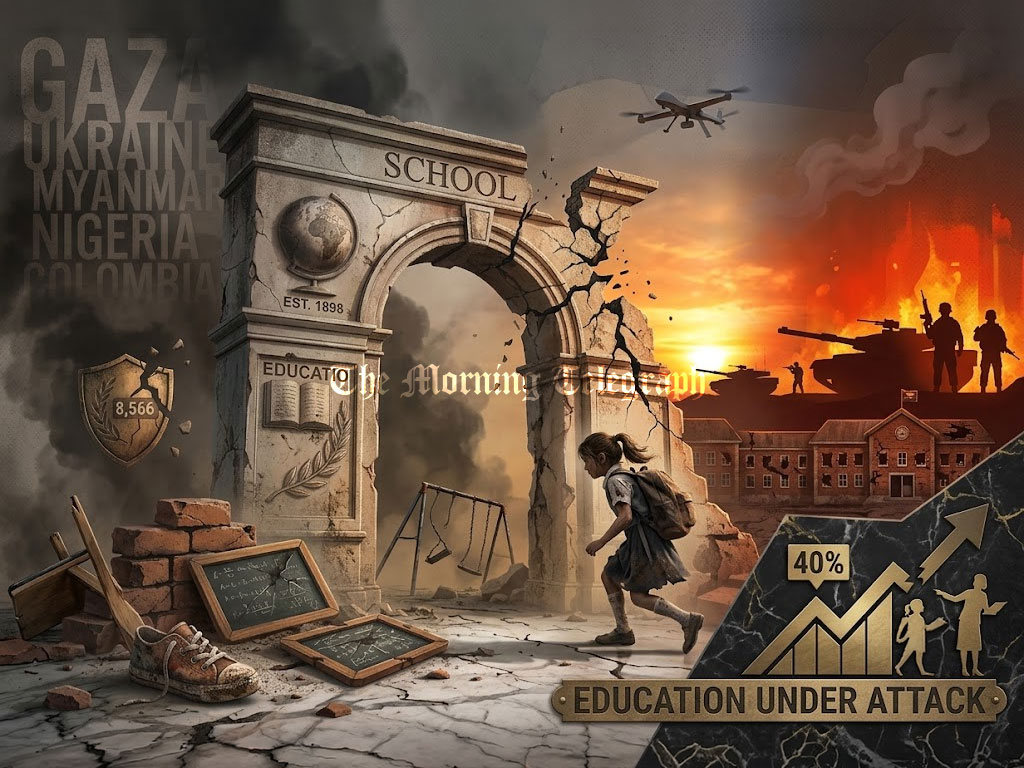
Schools should be places of learning, not battlefields. A new global report reveals a shocking 40% surge in attacks on educational institutions, with thousands of students and teachers killed, injured, abducted, or displaced as violence increasingly targets classrooms around the world.
COLOMBO, Sri Lanka — A devastating global surge in violence against educational communities has driven attacks on schools and universities up by more than 40 percent, according to a flagship report released by the Global Coalition to Protect Education from Attack.
The report, titled Education Under Attack 2026, documents a stark regression in the global norms that protect learning environments. Analysts link the crisis to expanding global instability and a proliferation of conflicts to levels not seen since World War II.

Researchers recorded at least 8,566 attacks on education and cases of military use globally over a two-year period spanning 2024 and 2025. The human toll of the violence includes more than 10,600 students, teachers, professors, and academic personnel who were killed, injured, abducted, or arrested.
While the coalition deeply profiled 28 countries facing systematic warfare or severe instability, incidents were documented in a total of 83 nations. Notably, 55 of the affected countries were not engaged in active armed conflict, highlighting that educational institutions are increasingly targeted by criminal, political, or ideological violence outside traditional war zones. Sri Lanka is among the nations where such non-conflict or isolated threats to educational spaces were tracked, reflecting a broader trend where academic freedom and institutional safety face societal, political, or localized pressures even outside formal combat areas.
The widespread use of heavy explosives and drone-borne munitions heavily damaged infrastructure and forced mass closures globally. By the end of 2025, nearly all schools in the Gaza Strip were damaged or destroyed, while Ukraine experienced over 900 distinct attacks on schools.
The highest frequency of infrastructure and institutional attacks occurred in Palestine, Ukraine, Colombia, the Democratic Republic of the Congo, Ethiopia, and Haiti. Conversely, the highest numbers of civilian casualties and abductions among students and staff were concentrated in Myanmar, Nigeria, Yemen, and Cameroon. In Nigeria alone, over 700 students and staff were kidnapped, including targeted raids on girls’ boarding schools.
The report also highlights a sharp increase in the military occupation of learning spaces. Reports of military forces or non-state armed groups occupying educational facilities nearly doubled, rising by 91 percent to 1,912 recorded cases. Using schools as barracks, weapon depots, or defensive positions not only halts learning but transforms civilian infrastructure into military targets, fundamentally eroding local security.
Furthermore, women and girls were deliberately targeted due to their gender in at least 11 countries. This included conflict-related sexual violence, the systematic bombing of girls’ schools, and state-enforced bans on female education, notably in Afghanistan, where learning centers for girls above grade six remained closed and female educators faced ongoing detention.
The primary international instrument designed to counter this crisis remains the Safe Schools Declaration, an inter-governmental political commitment drafted to restrict the military use of schools and protect academic communities during wartime.
To reverse the current trend, coalition advocates and humanitarian organizations are calling for immediate state-level interventions. These include strengthening domestic legislation to formally criminalize attacks on educational facilities, embedding declaration guidelines into national military doctrines, and enforcing strict, legally binding prohibitions against armed forces occupying active or temporarily closed schools. The coalition also urged nations to invest in localized early warning monitoring systems and to resist international aid cuts to humanitarian protection sectors.