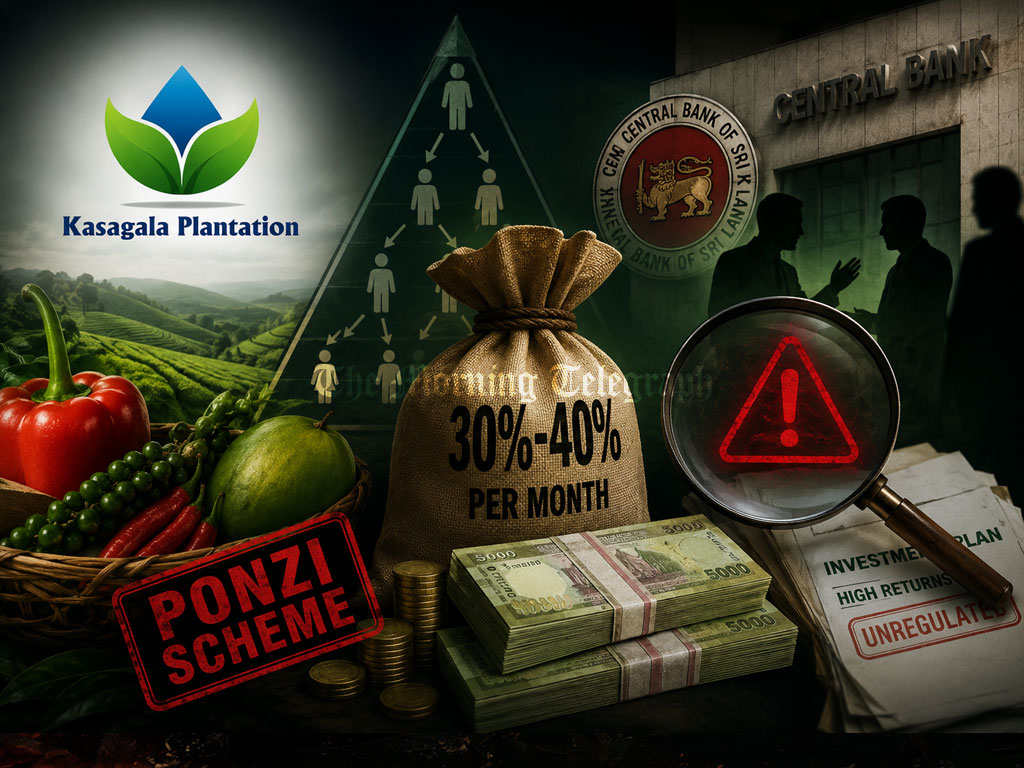
Kasagala Agri-Ponzi Scam faces scrutiny after CBSL warnings, extraordinary return promises, and questions over state media promotion.
Kasagala Agri-Ponzi Scam allegations have sparked growing concern in Sri Lanka, as questions mount over investor protection, financial regulation, and the promotion of unregulated investment schemes amid the country’s fragile economic recovery.
Macroeconomic Conditions and the Search for Higher Returns
Following Sri Lanka’s severe economic crisis in 2022, inflation surged to 60.8% before declining to 5.5% by May 2026 under reforms linked to the International Monetary Fund (IMF). At the same time, the Central Bank of Sri Lanka (CBSL) reduced policy interest rates, causing fixed deposit returns at commercial banks to fall into single digits, generally between 8% and 10%.
Against this backdrop, many middle-class savers facing rising living costs began searching for alternative investment opportunities outside the traditional banking sector.
Taking advantage of this environment, a growing number of unregulated agricultural investment schemes have emerged across the country. One of the most controversial in recent months has been the Kasagala Group of Companies, led by Malwaththa’s Ranjith Nandana Peris, together with its subsidiary, Kasagala Green Plantation.

Questions Over Agricultural Profit Claims
The companies claim to cultivate export-oriented crops including bell peppers, pepper, TJC mangoes, and snake chili, while promising investors returns ranging from 30% to 40% per month, equivalent to more than 120% annually.
Critics argue that such claims run contrary to basic economic principles.
If a company were genuinely capable of generating stable annual profits exceeding 40% through agricultural production, it could theoretically secure financing through commercial banks at interest rates between 8% and 10% and retain the remaining profit margin. Instead, opponents note that substantial resources appear to be directed toward marketing campaigns and public fundraising efforts.
According to these critics, the business model resembles a classic Ponzi structure, where returns paid to earlier participants are funded using capital contributed by newer investors rather than profits generated through productive activity.
Internal Documents Raise Further Concerns
One of the most frequently cited pieces of evidence comes from an internal Kasagala document identified as “Dash Board New,” dated October 1, 2025.
According to the document, sales executives recruited on six-month contracts were assigned monthly fundraising targets ranging from Rs. 1 million to Rs. 3 million.
Particular attention has been drawn to the commission structure offered for attracting investor funds.
The document reportedly outlines commissions of 5% for six-month plans, 8% for one-year plans, and 10% for both two-year and three-year investment plans.
Critics argue that a genuine agricultural enterprise would be unlikely to allocate as much as 10% of incoming capital solely to commissions. They contend that the aggressive focus on continuously attracting new investors suggests a dependence on fresh capital inflows to sustain operations.
Central Bank Dispute Over Regulatory Status
The controversy intensified after a statement made on June 8, 2026, by a director of Kasagala during an appearance on a national television channel.
During the broadcast, the director reportedly claimed that the institution was regulated directly by the Central Bank of Sri Lanka.
However, under the Finance Business Act (FBA) No. 42 of 2011, accepting deposits and conducting financial business without authorization from the Central Bank constitutes a punishable offence.
No private institution is permitted to independently manage public deposits outside the regulatory framework established by the Central Bank.
As a result, the CBSL issued an official statement on June 12, 2026, declaring that Kasagala’s claims regarding regulation were false and misleading. The Central Bank also announced the commencement of legal investigations into the matter.
Similarities to Earlier Investment Schemes
Observers have also drawn comparisons between the Kasagala operation and agricultural investment projects previously promoted by former Sri Lankan cricketer Kumar Dharmasena.
Those projects attracted investors through crop-based ventures involving products such as agarwood and vanilla. The Central Bank was eventually compelled to issue public warnings and regulatory statements regarding those schemes as well.
Critics argue that the strategy of building credibility through prominent personalities while exploiting regulatory grey areas appears similar to the model now being attributed to the Kasagala Group, albeit on a larger scale.
State Media Promotion Under Scrutiny
Perhaps the most contentious aspect of the controversy concerns the role played by sections of the media, particularly state-owned broadcasters.
The Kasagala Group reportedly promoted its operations through sponsored appearances on both private television networks and state-funded programs, including National Television’s “Nuga Sevana” and Independent Television Network’s (ITN) “Pini Viyana.”
This has prompted questions regarding the responsibility of publicly funded media institutions.
Critics ask how organizations operating under an administration promoting the “Clean Sri Lanka” initiative could provide airtime to financial ventures whose legal status and regulatory standing remained in dispute.
They argue that media institutions have a duty to verify the legality and Central Bank registration of any financial operation before presenting it to the public as an investment opportunity.
With many viewers assuming that businesses featured on national television have undergone some form of vetting, concerns have grown over the potential impact on ordinary investors.
The Central Bank has already issued warnings to media executives regarding the promotion of unauthorized financial schemes, increasing pressure on broadcasters to exercise greater diligence.
Kasagala Green Plantation has therefore become a focal point in a broader debate about financial regulation, investor protection, media accountability, and economic recovery. Critics maintain that capital which could otherwise support productive small and medium-sized enterprises is being diverted into speculative schemes that generate little real economic value.
They argue that accelerating the Central Bank investigation and strengthening the regulatory authority of the Securities and Exchange Commission (SEC) over agri-investment ventures may be necessary to prevent similar controversies in the future.
Until stronger safeguards are in place, consumer advocates continue to emphasize one message: “Be Scam Proof” is more than a slogan—it may be the most effective defense available to protect hard-earned savings.