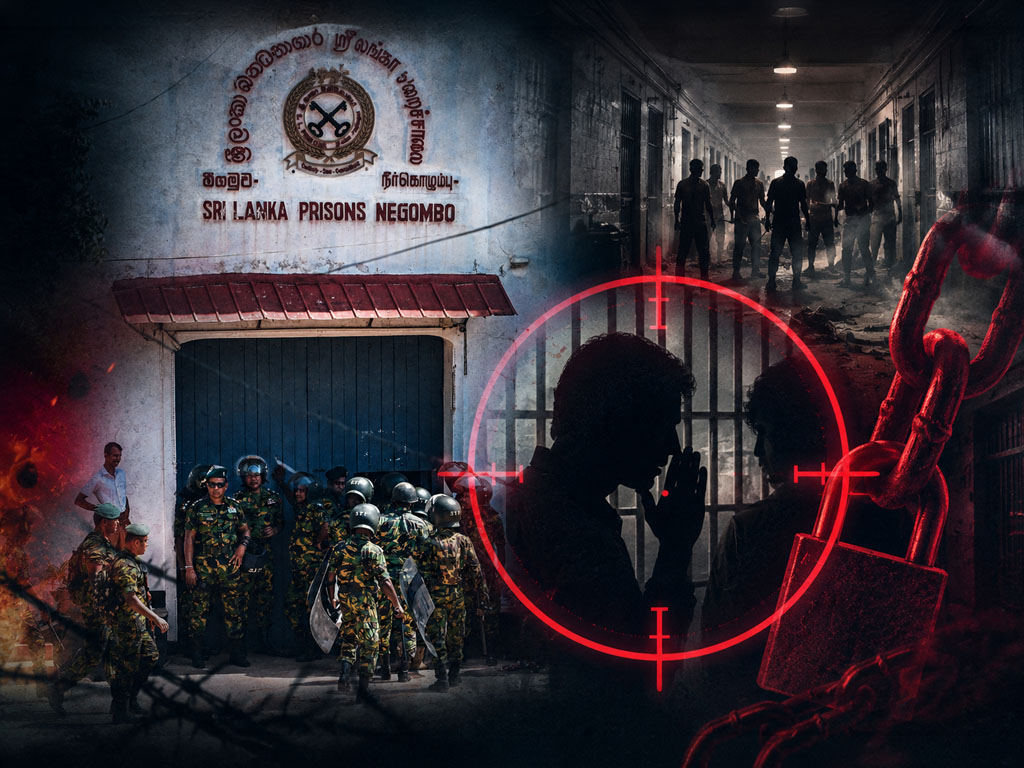
Negombo Prison unrest allegedly began with attacks on inmate informants who supplied intelligence about drugs and illegal prison activity.
The Negombo Prison unrest allegedly began as a coordinated attack on inmates who supplied authorities with intelligence about drugs and other illegal activities inside the facility.
The Criminal Investigation Department disclosed this preliminary finding during proceedings before the Negombo Magistrate’s Court. Prisoners who provide such information are reportedly known inside the institution as “Room Parties.”
Investigators believe those informants became the first targets of violence that later escalated into a deadly prison-wide confrontation.

Negombo Prison Unrest Began After Minor Dispute
The chain of events reportedly began on July 3, 2026, with an altercation involving Suspect No. 4423, Suresh Pushpakumara, also known as Katuwellegama Suresh.
The high-profile Ward A1 inmate allegedly argued with a trainee prison officer over his allocated exercise time.
Following a written complaint, prison authorities transferred him on July 4 to an external cell in Ward L as a disciplinary measure.
On July 5, the situation escalated during lunch distribution. According to the CID, inmates launched a coordinated assault against prisoners identified as “Room Party” informants.
Violence erupted again on the morning of July 6. Initial accounts presented to court said 10 Prison Police officers and 21 inmates died during the clashes.
However, official casualty breakdowns later varied while maintaining a total death toll of 27.
Justice Minister Harshana Nanayakkara confirmed the preliminary theory while addressing Parliament.
“The inmates who provided information about drug-related activities became the first targets. That is one reason that we believe that this may have been a conflict connected to narcotics and organised criminal groups.”
The CID believes inmates connected to drug-trafficking operations systematically targeted the informants. Investigators are examining whether the violence aimed to dismantle the prison’s internal intelligence network.
Inmates Seized Control and Breached Armoury
At the time, Negombo Prison held 2,417 inmates across 16 wards. The population included 162 convicted prisoners and 2,255 remand suspects.
Only 161 staff members managed the facility.
Investigators told court that inmates destroyed CCTV cameras and a body scanner as violence spread. This apparently disabled important security and monitoring systems.
The rioters also breached the prison armoury and seized firearms.
Several Prison Police officers reportedly became trapped because they were unfamiliar with available escape routes. Attackers then beat some officers to death.
Inmates eventually gained control of the complex and prevented police from entering.
Authorities deployed 89 Prison Police officers from Colombo, along with Special Task Force personnel. Security forces later used tear gas and fired warning shots to regain control.
Conflicting Figures Surround Death Toll
Authorities have confirmed that 27 people died in the Negombo Prison unrest. However, reported figures for each category have differed.
Accounts placed the number of dead prison officers between seven and 10. Reported inmate deaths ranged from 19 to 21.
Another 23 prison officers and 54 inmates suffered injuries. Several remained in critical condition.
Authorities transferred some of the seriously injured victims to the Colombo National Hospital for further treatment.
After regaining control, officials recovered 60 firearms containing live ammunition. They also found 271 rounds of T-56 and 9mm ammunition.
The CID said authorities handed all 60 firearms to the court’s production room for use as evidence.
Investigators continue examining how inmates entered the armoury and gained access to the weapons.
Multiple Investigations Examine Deadly Violence
Several agencies are now investigating the incident.
The CID continues its inquiry through the courts, while Negombo Police and the Colombo Crime Division conduct parallel investigations.
The Cabinet also appointed a three-member independent committee chaired by retired Supreme Court Judge Priyantha Fernando.
Meanwhile, the Human Rights Commission of Sri Lanka has opened a separate investigation.
The CID has recorded statements from 287 people, including members of the prison staff.
Investigators plan to charge identified suspects with murder and offences under the Firearms Act and Public Property Act.
A court order has also authorised investigators to record statements from inmates transferred to prisons across the island after the violence.
Justice Minister Harshana Nanayakkara visited Negombo Prison following the clashes. He accepted responsibility because the prison system falls under his ministry.
He described the deaths as a tragedy that “could not be justified” and promised reforms intended to prevent another such incident.
Prisons Acting Commissioner General Prasad Hemantha Kumara said officials had received no prior intelligence warning of the attack.
However, he acknowledged allegations that some inmates had consumed narcotic tablets. Authorities are examining whether those substances contributed to altered behaviour during the unrest.
CID Ordered to Submit Progress Report
The court has directed the CID to submit a progress report on its investigation.
Investigators must also prepare to call evidence concerning deaths where authorities have not yet completed inquests.
A comprehensive report on the Negombo Prison unrest is expected before the court in the coming weeks.
The inquiry must now determine whether the attacks grew spontaneously from the initial dispute or formed part of a planned operation linked to narcotics and organised criminal networks.