Cockroach Janta Party protests have mobilised Indian students over exam leaks, ministerial accountability and the treatment of Sonam Wangchuk.
The Cockroach Janta Party protests have transformed anger over India’s examination system into a major youth-led challenge to Prime Minister Narendra Modi’s administration.
What began as an online protest identity has drawn thousands of students and activists into the streets. Demonstrators are demanding accountability over repeated examination leaks, including controversy surrounding the national medical entrance examination.
The movement’s immediate demand has centred on the resignation of Education Minister Dharmendra Pradhan. Some protesters have also broadened their criticism towards the Modi Government, arguing that the crisis reflects deeper institutional failures.

Exam Leaks Ignite Anger Across India
The crisis developed after major competitive examinations faced allegations of leaked question papers, cancellations and administrative misconduct.
India’s medical entrance examination carries enormous importance because it determines access to undergraduate medical education. Reports said the 2026 examination required a re-test following a leak, while protests also cited irregularities affecting other examinations.
Campaigners say millions of students have suffered from uncertainty, financial losses and psychological pressure. Protest leaders have also linked examination failures to more than 20 reported student suicides, although responsibility in each individual case requires careful assessment.
The movement gained further momentum when prominent activist Sonam Wangchuk joined the campaign and began a hunger strike on June 28.
Authorities transferred Wangchuk to Safdarjung Hospital after his health deteriorated during the 21st day of his fast. Police said medical recommendations and a Delhi High Court direction prompted the intervention, while supporters described his removal as forcible.
Wangchuk had demanded Pradhan’s resignation and action over examination leaks. His hospitalisation intensified public attention and strengthened the movement’s claim that authorities were suppressing peaceful dissent.
How the “Cockroach” Name Became a Protest Symbol
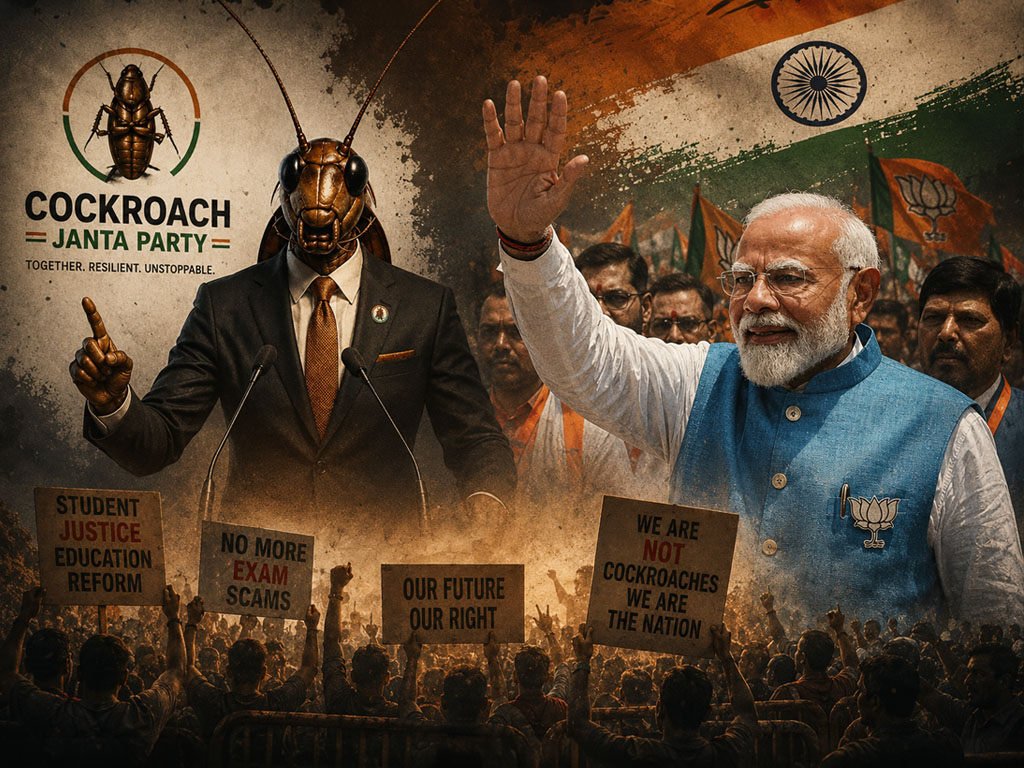
The Cockroach Janta Party, commonly shortened to CJP, turned a derogatory comparison into a political identity.
Contemporary reporting traces the name to a controversial judicial remark comparing unemployed young activists to cockroaches. Protesters reclaimed the term and transformed it into a symbol of survival and resistance.
The original article’s claim that ruling-party supporters created the label is not established by the reporting reviewed.
By adopting the name, protesters argue that they cannot be eliminated through insults, barricades or police pressure. The cockroach has therefore become a metaphor for persistence within a movement driven largely by students and young jobseekers.
CJP founder Abhijeet Dipke has emerged as one of the movement’s visible organisers. He later ended his own hunger strike following a personal appeal from Wangchuk.
Cockroach Janta Party Protests Spread
The movement established its main protest site at Delhi’s Jantar Mantar before organising a march towards Parliament.
Police used barricades, batons and tear gas to stop demonstrators during the July 20 march. Protesters continued in smaller groups despite restrictions, while authorities maintained a heavy security presence.
Related demonstrations and solidarity events also appeared outside Delhi. Students and CJP supporters held a torch march in Sikar, while wider reporting described growing support from activists, opposition politicians and public figures.
Government representatives have largely defended their handling of the unrest. However, Health Minister J.P. Nadda met movement representatives, offering the first clear sign of dialogue between the protesters and senior officials.
The confrontation also challenges India’s international image as the world’s largest democracy. Critics argue that aggressive policing of student-led demonstrations conflicts with the Government’s efforts to present India as a global democratic leader.
Sonam Wangchuk Adds a Ladakh Dimension
Wangchuk’s involvement gives the education campaign a wider political significance.
The environmentalist and education reformer comes from Ladakh, a strategically sensitive Himalayan region bordering China. He has previously campaigned for constitutional safeguards, greater autonomy and environmental protection for the territory.
However, claims that the protest will provide a direct strategic advantage to China remain political analysis rather than an established fact.
The stronger conclusion is that Wangchuk’s participation links student anger over examinations with wider concerns about government accountability, regional representation and democratic dissent.
Echoes of Sri Lanka’s Aragalaya
The Cockroach Janta Party protests carry similarities to Sri Lanka’s 2022 Aragalaya, particularly in their youth leadership and rapid growth beyond the original grievance.
Sri Lanka’s movement began amid shortages of electricity, fuel, cooking gas and other essentials. It later developed into a nationwide demand for the President’s departure.
India’s movement started with examination leaks and calls for one minister’s resignation. Police intervention and government resistance have since broadened criticism towards the political leadership.
However, the two crises differ significantly.
Sri Lanka’s uprising emerged during a complete economic collapse and eventually forced the head of state from office. India retains a far larger economy, stronger central institutions and a powerful security apparatus.
Therefore, removing the entire Government would present a far greater challenge than it did during Sri Lanka’s 2022 crisis.
Still, Sri Lanka’s experience offers one lesson. Replacing individual leaders rarely resolves structural failures without deeper institutional reform.
For India’s protesters, lasting change would require transparent examinations, independent investigations, accountable administrators and safeguards that prevent future leaks.
The strength of the “cockroach” symbol lies in its promise of endurance. The movement’s supporters say they will continue returning until the authorities address the failures that placed millions of students’ futures at risk.