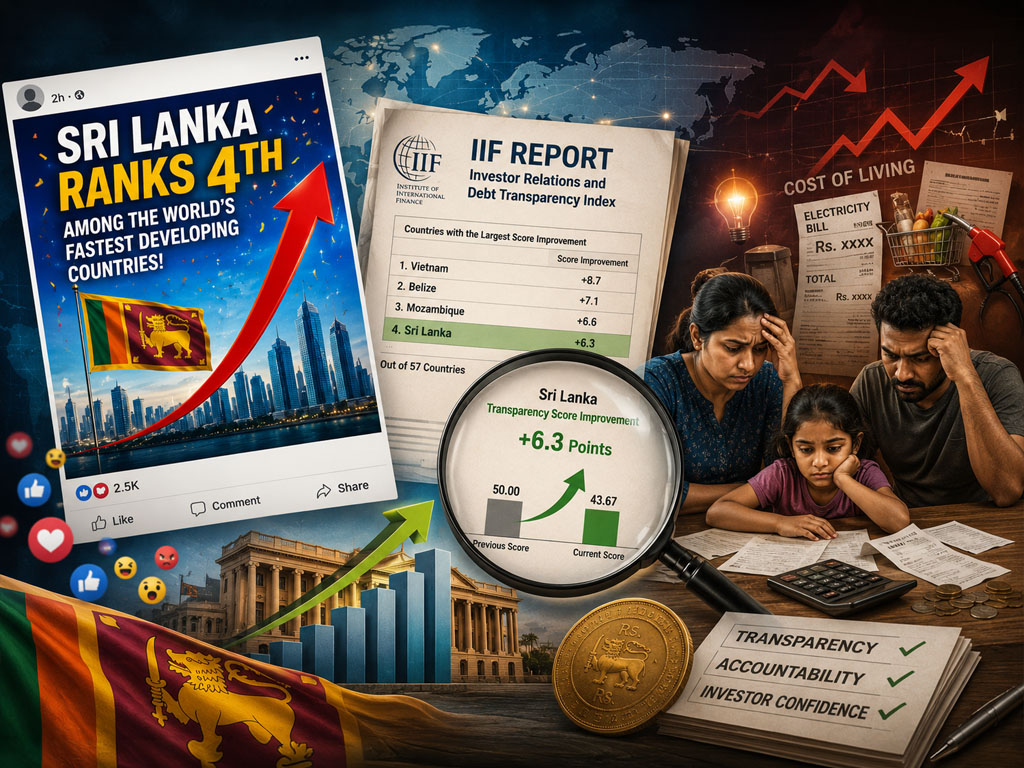
EDITORIAL NOTE :- Like you, we long for the day when headlines like ‘Sri Lanka is the 4th Fastest Developing Country‘ are no longer just headlines, but our reality. Yet, until that day comes, we carry a quiet but sacred duty: to share what is real, not just what is comforting. This article is our humble attempt to inform, not to discourage. Because we believe truth, even when it stings, is the soil in which lasting hope grows.
A viral social media post claimed that Sri Lanka had become the world’s fourth-fastest developing country. It carried a bold red arrow, polished graphics and exactly the kind of message many Sri Lankans wanted to believe.
The post appeared repeatedly on Facebook and quickly generated excitement. After years of economic hardship, rising living costs and heavy electricity bills, the suggestion that Sri Lanka had suddenly climbed into the world’s top four felt reassuring.
However, it also raised an obvious question.
How could Sri Lanka become the fourth-fastest developing country while many families still struggle with basic daily expenses?
To find the answer, the original report published by the Institute of International Finance was examined. The report’s actual conclusion was very different from the interpretation promoted online.
Get Breaking News First
on WhatsApp

What the IIF Report Actually Said
Sri Lanka was not ranked as the world’s fourth-fastest developing country.
The Institute of International Finance instead identified Sri Lanka as one of four countries recording the largest improvement in investor relations and debt transparency scores.
The assessment measured how clearly governments shared debt information with international investors. It did not measure overall development, economic growth, public prosperity or improvements in living standards.
Among the 57 countries assessed, Sri Lanka recorded the fourth-largest score gain. Vietnam, Belize and Mozambique ranked ahead of it.
Therefore, the ranking recognised progress in financial openness rather than rapid national development.
A simple example helps explain the difference.
When someone applies for a loan, the lender is more likely to trust that person when they openly disclose their existing debts, income and financial obligations. Sri Lanka has taken a similar approach with international investors.
Following the 2022 economic collapse, the country made a stronger effort to publish debt information and communicate its financial position more transparently.
As a result, Sri Lanka’s transparency score improved by 6.3 points, moving from 50 to 43.67.
That is a positive achievement. However, it does not mean Sri Lanka became the world’s fourth-fastest developing economy.
Why the Misleading Headline Worked
A social media post saying that Sri Lanka recorded one of the highest improvements in the Investor Relations and Debt Transparency Index would attract limited attention.
Many people would not immediately understand what the index measured. Some might not click on the post at all.
Content creators therefore simplified the finding into a far more dramatic claim: “Sri Lanka is the fourth-fastest developing country in the world.”
The rewritten claim was easy to understand, emotionally satisfying and highly shareable. It was also inaccurate.
The reaction reveals something important about the national mood.
Sri Lankans desperately want the country to recover. After years of economic pressure, any sign of rapid improvement creates genuine hope.
That hope is powerful, but it also makes people vulnerable to headlines designed to produce excitement rather than explain reality.
Progress Is Real, but So Are the Challenges
Sri Lanka has gained a degree of economic stability. Improved debt transparency can strengthen investor confidence and support the country’s financial recovery.
However, these gains should not be confused with complete economic transformation.
Living in the illusion that Sri Lanka has conquered the world overnight does not help the country. A more honest understanding of where the nation stands is far more valuable.
Recognising genuine progress matters. So does acknowledging the distance still left to travel.
The viral headline made people feel good because it reflected what they hoped was true.
The original report offered a less dramatic but more useful message: Sri Lanka has improved the way it presents its debt information to the world.
In an age where attractive graphics and emotional claims spread within seconds, every image deserves a second look. Sometimes the most important story is not the headline that made us feel good, but the truth hidden behind it.