Sri Lanka coal controversy over disputed shipments collides with an asset declaration debate, raising difficult questions about public transparency.
The Sri Lanka coal controversy is unfolding alongside another politically sensitive debate over asset declarations, creating an uncomfortable question for a government elected on an anti-corruption platform.
One controversy concerns enormous alleged losses linked to coal supplied for the Lakvijaya Power Plant at Norochcholai.
The other concerns proposed amendments to the Anti-Corruption Act that triggered warnings over how publicly available asset declarations could be accessed, used and published.
There is currently no evidence proving that these two controversies are connected.
No document establishes that proposed changes to the asset declaration system were designed to conceal anything connected to coal procurement. Nor is there evidence that money allegedly associated with the coal transactions was hidden through assets affected by the proposed amendment.
That distinction matters.
Yet political accountability does not end where criminal evidence begins. When questions involving billions of rupees emerge at the same time that the rules governing public scrutiny of wealth are being reconsidered, the public is entitled to ask why.
Get
Breaking News
First
on WhatsApp
Follow The Morning Telegraph for instant alerts, top stories and exclusive updates delivered straight to your phone.

How Much Has the Sri Lanka Coal Controversy Cost?
Questions surrounding the quality and financial impact of imported coal have intensified throughout 2026.
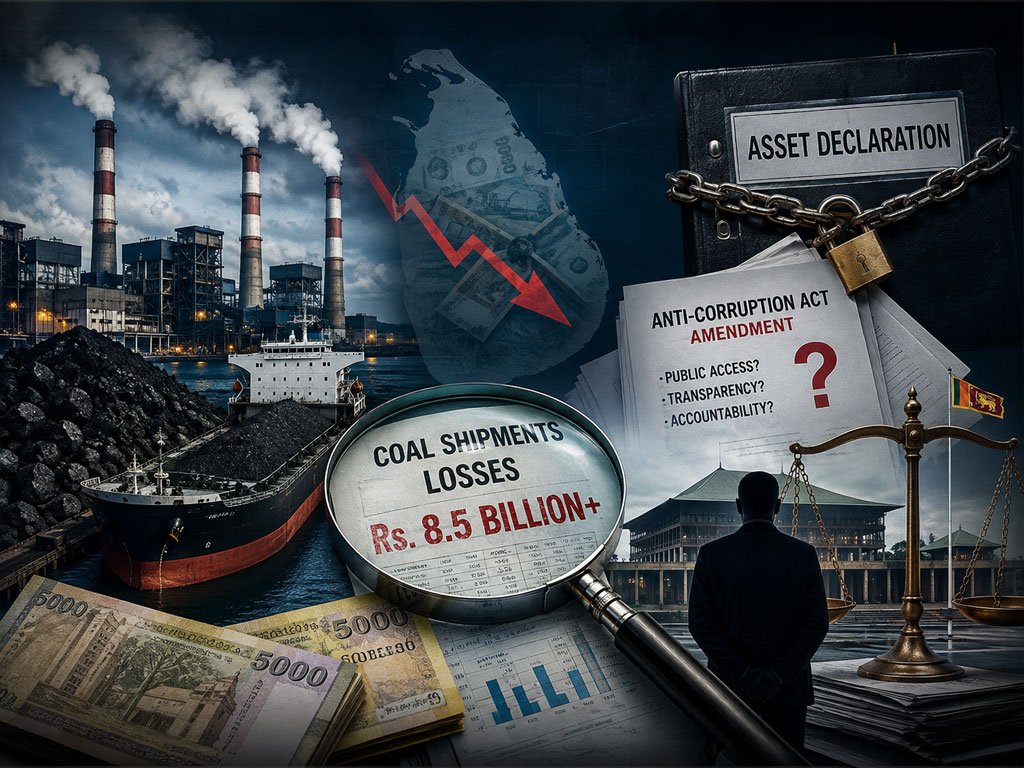
At a Joint Opposition seminar in March, Solar Energy Procurement Constructors Association President Shyam Pathiraja presented calculations claiming Sri Lanka had suffered losses of Rs. 8.497 billion from nine shipments of inferior-quality coal. The individual estimates ranged from Rs. 362 million to Rs. 1.558 billion per shipment.
Those calculations remain allegations rather than a final audited determination of the State’s total loss.
What is established, however, is that the Government itself imposed substantial penalties because coal supplied under the relevant term contract failed required specifications.
Deputy Energy Minister Arkam Ilyas announced in May that approximately US$27 million in penalties had been imposed on the first 15 shipments under a 19-consignment contract. Officials said laboratory testing had identified lower Gross Calorific Value levels than specified.
The Government had also withheld more than US$37 million from suppliers at one stage, including US$22 million in fines and US$15 million from a performance bond. Ilyas acknowledged that losses had occurred but said the final amount had yet to be determined.
That alone demands answers.
If penalties running into tens of millions of dollars were necessary, what was the true operational impact of the coal?
Did lower calorific value require additional coal to produce the expected electricity output?
Did reduced performance increase reliance on more expensive generation sources?
What additional wear, maintenance or efficiency costs, if any, arose at Lakvijaya?
And who monitored the contract while shipment after shipment continued to arrive?
The controversy has since moved beyond political debate. A Special Presidential Commission is examining coal transactions, while former State Minister D.V. Chanaka appeared before the Commission on August 6 and raised allegations concerning tenders and delays.
That makes complete disclosure increasingly important.
Then Came the Asset Declaration Amendment
While scrutiny of coal procurement intensified, the Government confronted a separate controversy over amendments to Sri Lanka’s Anti-Corruption Act.
Transparency International Sri Lanka warned this week that the Anti-Corruption Amendment Bill gazetted on July 24 could undermine one of the most important transparency reforms introduced under the 2023 law.
TISL’s central concern was not simply whether citizens could technically view asset declarations.
It argued that proposed restrictions on how publicly available information could be used would weaken meaningful scrutiny. The organisation also objected to wider discretion to redact information on privacy grounds without sufficiently clear criteria.
Public access currently forms an important part of Sri Lanka’s asset declaration system. CIABOC has already published redacted declarations for public inspection under the Anti-Corruption Act.
The Government subsequently responded to the criticism.
Leader of the House Bimal Rathnayake told Parliament on August 6 that the Government had decided not to restrict public access to asset and liability declarations belonging to elected representatives. He said proposed privacy safeguards would instead address concerns surrounding non-political officials and their family information.
That is an important distinction.
It also means claims that the Government has already decided to hide politicians’ assets would be inaccurate.
But another question remains.
Why did an amendment capable of creating such serious concerns over public scrutiny emerge in the first place?
Coal Billions on One Side, Transparency Rules on the Other
Consider how the sequence looks to an ordinary taxpayer.
First come claims that billions were lost because coal did not meet the required quality.
Then the Government itself confirms tens of millions of dollars in penalties.
Investigations deepen.
Questions emerge over procurement, laboratory testing, contractual responsibility and the consequences for electricity generation.
At roughly the same time, an amendment appears that Transparency International warns could restrict the meaningful use of asset declarations.
Does this establish a cover-up?
No.
There is no credible evidence presently connecting the asset declaration amendments to the coal transactions.
There is no evidence that the amendment was drafted to protect anyone associated with coal procurement.
There is no established evidence showing that commissions from the coal transactions were concealed in assets that the Government sought to shield.
To report any of those claims as fact would therefore be irresponsible.
But the absence of proof of a connection does not eliminate the political problem created by timing, perception and inadequate disclosure.
A government that campaigns on transparency carries a higher burden when controversies emerge.
If There Is Nothing to Hide, Publish Everything
The Government has an opportunity to remove much of the speculation.
Publish the relevant coal contracts.
Publish the technical specifications.
Release the laboratory findings where legally permissible.
Explain every deduction and penalty.
Identify the officials responsible for authorising, monitoring and accepting shipments.
Explain whether any quality report was challenged, revised or overridden.
Disclose intermediaries and beneficial ownership linked to contracting entities where the law permits.
Then allow investigators and Parliament to determine whether wrongdoing occurred.
The same principle should apply to asset declarations.
Sri Lanka does not need transparency that exists merely because a document can technically be downloaded.
The public must be able to use lawful information to identify potential conflicts, question unexplained wealth and hold elected representatives accountable.
CIABOC itself continues to operate and expand a centralised electronic asset declaration framework under the Anti-Corruption Act.
Therefore, strengthening privacy protection for ordinary officials does not necessarily require weakening scrutiny of politicians.
The two objectives can coexist.
The Real Test Is Public Trust
The Sri Lanka coal controversy is ultimately about more than the quality of fuel delivered to one power plant.
It is about whether institutions can show taxpayers where public money went, who made decisions and whether anyone should be held responsible.
The asset declaration debate raises the same fundamental principle from another direction.
Transparency is most valuable when governments are under pressure, not when there is nothing controversial to examine.
Sri Lanka has spent years demanding stronger anti-corruption institutions. The 2023 Anti-Corruption Act made CIABOC the central authority for asset and liability declarations and expanded the framework for public accountability.
Weakening the practical value of that transparency would therefore create understandable suspicion.
At the same time, claiming that the coal controversy and asset amendment are connected without evidence would undermine legitimate scrutiny by replacing investigation with speculation.
The Government can resolve both problems through disclosure.
If billions may have been lost, show the country exactly how.
If the Government protected public money through penalties, publish the calculations.
If officials acted correctly, place the evidence before the public.
If somebody interfered with procurement or testing, investigate and prosecute where evidence supports it.
And if the asset declaration amendments have nothing to do with protecting political interests, draft them so clearly that such an interpretation becomes impossible.
That leaves one question at the heart of the debate:
At a moment when Sri Lanka needs greater transparency to discover whether billions were lost, why should the public accept anything that makes scrutiny of those exercising power more difficult?
That question does not accuse anyone of corruption.
But until the coal transactions are fully accounted for and the protection of meaningful public access to politicians’ asset declarations is unmistakable, it is a question Sri Lankans have every reason to continue asking.