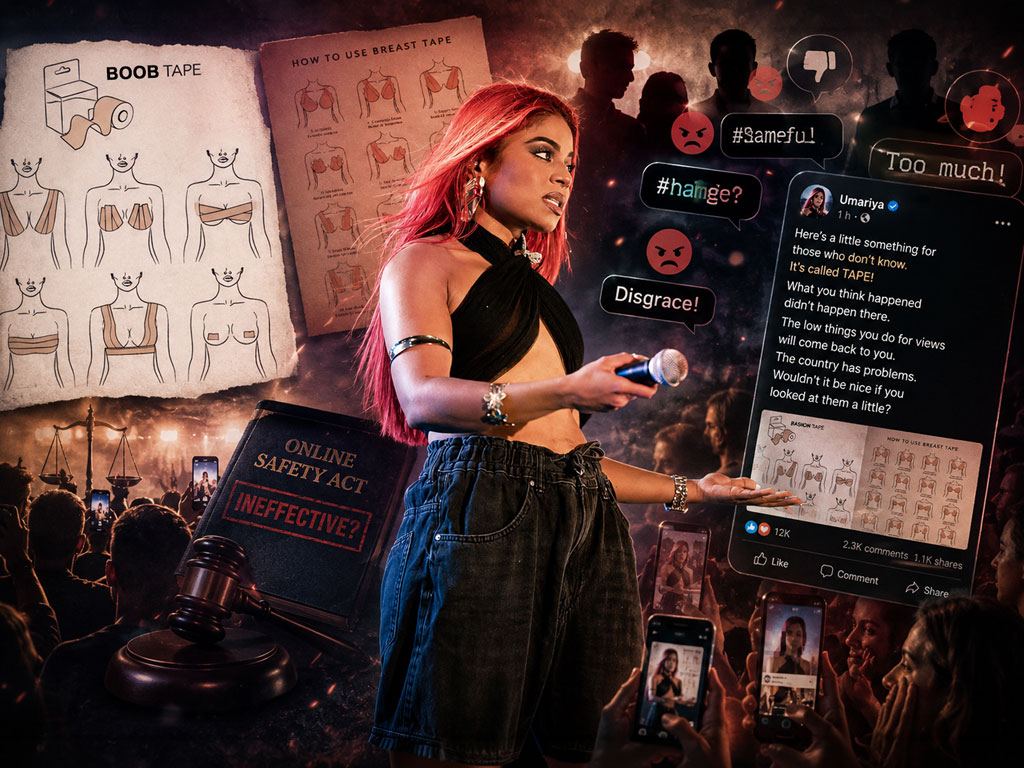
Umariya fashion tape controversy sparks debate over visual illusion, celebrity culture, cyber harassment, moral policing and online accountability.
The Umariya fashion tape controversy has pushed Sri Lanka’s debate over female artists, celebrity culture, moral policing and online harassment back into the digital spotlight.
At its centre is singer Umariya Sinhawansa and the reaction to an outfit she wore during an outdoor concert. Images circulated widely on social media, with some users interpreting what they saw as a wardrobe malfunction.
Umariya rejected that interpretation.
However, the controversy also opens a wider discussion about fashion illusion, celebrity marketing, audience psychology and the speed with which digital platforms turn visual ambiguity into scandal.
This is therefore more than a debate over clothing. It is also about how celebrities are viewed, how audiences react and how online attention can transform uncertainty into outrage.
Get Breaking News First
on WhatsApp

Desire, Celebrity and the Power of Visual Mystery
Popular culture has always relied partly on suggestion.
An audience often responds more strongly to what appears partially hidden than to what is fully revealed. Mystery encourages curiosity, while ambiguity gives viewers space to create their own interpretation.
This commentary argues that celebrity culture frequently operates within that psychological space.
Fashion, photography, stage design and visual presentation can all create an impression without literally showing what an audience thinks it sees.
Whether the performer is male or female, celebrity depends partly on managing distance between the public persona and the private individual.
The result is a relationship built around image, imagination and attention.
That does not automatically mean every controversial fashion choice represents a calculated publicity strategy. However, modern entertainment culture clearly understands the commercial value of visual discussion.
Once an image becomes controversial, the audience itself helps distribute it.
Umariya Fashion Tape and the Technology of Illusion
The technical element at the centre of the controversy is fashion tape.
Such products, sometimes colloquially called “boob tape,” allow performers and fashion models to secure clothing that uses plunging necklines, unusual cuts or skin-toned material.
Combined with fabric that closely matches the wearer’s complexion, the result can create what fashion designers describe as a nude illusion.
That visual effect is precisely what can cause confusion in photographs or compressed social-media videos.
At first glance, viewers may believe they are seeing exposed skin when they are actually seeing carefully secured fabric.
The supplied account links this broader fashion technique to styles that developed internationally and later became highly visible through celebrity red carpets and figures such as Kim Kardashian.
The important point is not whether Sri Lankan viewers understood the technique.
It is that the visual ambiguity became the controversy.
When Controversy Becomes Marketing
Celebrity culture also depends heavily on visibility.
In today’s attention economy, being discussed can be almost as commercially valuable as being praised.
Negative attention can therefore generate enormous reach.
A controversial image moves through Facebook pages, gossip websites, TikTok clips, WhatsApp groups and entertainment channels at a speed conventional advertising rarely achieves.
That does not prove the Umariya fashion tape controversy was deliberately manufactured.
However, once controversy exists, celebrities can use the resulting attention to regain control of the narrative.
This is where Umariya’s response becomes particularly interesting.
Umariya Responds and Turns the Narrative Around
Umariya responded through her official Facebook account and included illustrations explaining how fashion tape functions.
She wrote:
“Here’s a little something for those who don’t know. It’s called TAPE! What you think happened didn’t happen there. The low things you do for views will come back to you. The country has problems. Wouldn’t it be nice if you looked at them a little?”
The response rejected claims of a wardrobe malfunction and directly criticised those who circulated the images for views.
But the episode also produces an interesting contradiction.
If skin-toned material and fashion tape are designed partly to make clothing supports disappear visually, then the audience may initially perceive exactly the illusion the styling creates.
The question is therefore whether viewers simply misunderstood the outfit or responded predictably to a deliberate fashion illusion.
That does not justify harassment.
Nor does it give gossip pages permission to falsely claim a wardrobe malfunction.
But it demonstrates how easily fashion illusion, social-media sensationalism and audience perception can collide.
Moral Policing and Pressure Between Women
Another important part of the controversy concerns the gendered nature of online criticism.
Umariya addressed female critics directly, writing:
“I know there are uncomfortable people. But uncomfortable aunties… I pray your daughters don’t get bullied by old unhappy women like you.”
The remark highlights a recurring feature of Sri Lankan social-media culture.
Women often face moral judgments not only from men but also from other women over clothing, appearance, relationships and public behaviour.
One interpretation is that social expectations become self-enforcing. Women raised under restrictive cultural standards may sometimes reproduce those standards against younger women whose choices appear freer.
However, reducing every criticism to jealousy would itself oversimplify the issue.
People can disagree with fashion choices.
The line is crossed when disagreement becomes humiliation, body-shaming, fabricated claims or organised cyber harassment.
Similar debates have surfaced around women attending Lanka Comic Con and around public figures such as Dewani Jayathilaka and Bhagya Aberathna, who have also faced intense online scrutiny.
Online Safety Law and the Question of Protection
The controversy also raises questions about whether Sri Lanka’s digital laws actually protect people from online abuse.
The Online Safety Act has generated significant debate since its introduction.
Critics and human-rights organisations have argued that such legislation risks being used against journalists, activists and political critics rather than focusing effectively on harassment, fraud and abuse faced by ordinary citizens.
The Umariya fashion tape episode illustrates that wider concern from another angle.
A woman can face thousands of abusive posts, altered narratives and potentially defamatory claims in a matter of hours.
Yet legal remedies can appear distant, slow or difficult to access.
As a result, celebrities often defend themselves directly through social media. Ordinary users without large followings or public influence may have even fewer options.
That gap between legislation and practical protection deserves examination.
More Than a Wardrobe Controversy
Ultimately, the controversy surrounding Umariya Sinhawansa should not be reduced to whether part of an outfit was visible or whether viewers understood fashion tape.
It exposes something larger.
Modern celebrity operates through image. Fashion can create visual illusion. Social media rewards outrage. Gossip pages monetise curiosity. Meanwhile, audiences often judge women far more harshly than men for comparable expressions of personal style.
At the same time, celebrities who deliberately work within visual ambiguity should understand that audiences may interpret those images differently.
The answer is not moral policing.
It is greater visual literacy, responsible journalism and a clearer distinction between legitimate commentary and harassment.
The controversy therefore sits at the intersection of celebrity marketing, fashion technology, audience psychology, gender expectations and digital accountability.
And that may explain why a small strip of fashion tape generated a conversation far larger than the outfit itself.