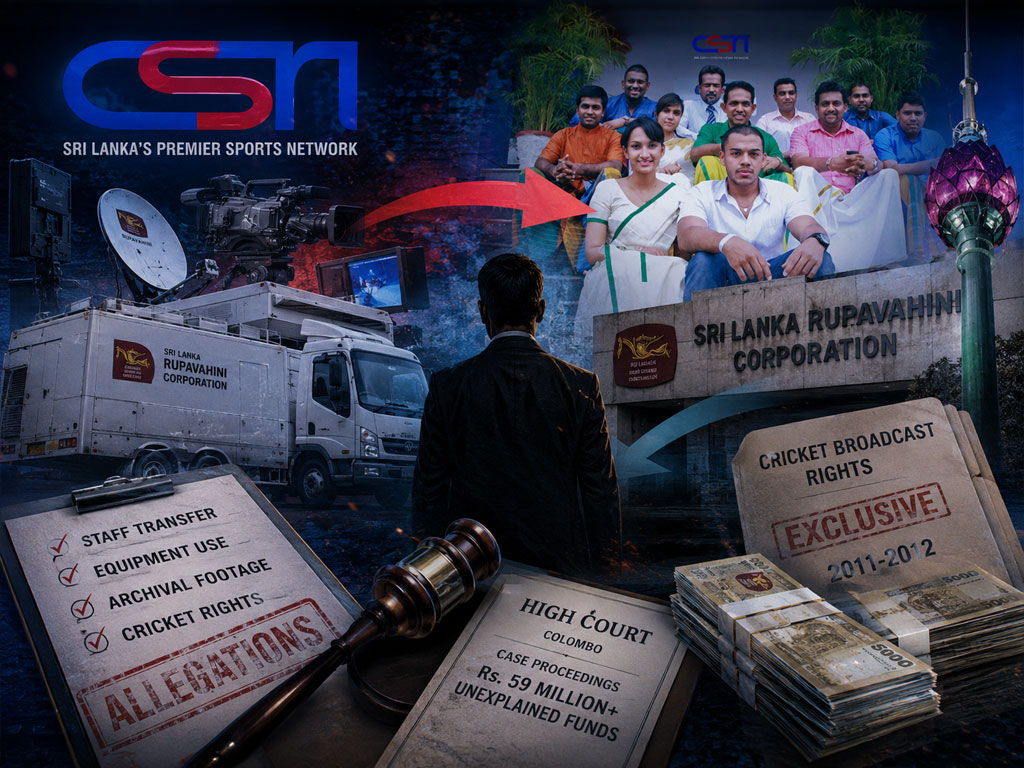
Carlton Sports Network faces scrutiny over allegations that public broadcasting staff, equipment, archives and cricket rights aided its rise.
The Carlton Sports Network controversy has become a striking example of how public broadcasting assets were allegedly redirected toward a private television operation in Sri Lanka.
State-led investigations cited in the supplied material examined whether CSN, which later relaunched as Matha TV, benefited significantly from resources linked to the state-owned Sri Lanka Rupavahini Corporation.
Investigators looked at the alleged movement of specialised staff, production equipment, archival material and commercial opportunities from the public broadcaster to the private network.
The allegations raise a broader question about whether publicly funded broadcasting infrastructure was used to strengthen a commercially operated television station.
Get Breaking News First
on WhatsApp

Carlton Sports Network and the Movement of State Expertise
One of the most significant allegations concerns human resources.
CSN reportedly recruited experienced personnel from SLRC’s Sports Section. They included camera operators, editors, directors and other technical specialists with extensive broadcasting experience.
The supplied material also identifies former SLRC executives and sports administrators as important links in the movement of expertise from Rupavahini to CSN.
Investigators additionally examined claims involving state-owned production equipment.
Outside broadcast vehicles, professional cameras and editing systems belonging to SLRC were reportedly used for sporting events carried under the CSN banner.
If established, those claims would raise questions over whether public assets effectively supported a private broadcaster’s operations.
The use of archival material created another area of concern.
CSN reportedly maintained that it paid commercial rates for Rupavahini footage. However, auditors questioned the conditions under which large quantities of valuable sports archives were transferred.
Those archives represented years of publicly accumulated broadcasting material and carried considerable potential commercial value.
Cricket Rights Became the Biggest Dispute
The most consequential controversy involved cricket broadcasting rights.
SLRC had historically occupied a dominant position in televising international cricket in Sri Lanka.
However, the investigation cited in the supplied material alleges that Rupavahini was prevented from bidding for national cricket telecast rights during 2011 and 2012.
That decision allegedly created an opportunity for Carlton Sports Network, then only around 15 months old, to obtain exclusive broadcasting rights for three years without competition.
If proven, such an arrangement would represent more than an ordinary business decision.
It would raise serious questions about whether officials within a state institution allowed one of its most valuable commercial opportunities to pass to a private broadcaster.
Cricket broadcasting carried not only public interest but also significant advertising and revenue potential.
The issue therefore sits at the centre of the wider debate over whether public resources and commercial advantages were diverted away from the state broadcaster.
License Cancellation and Criminal Proceedings
The controversy later moved beyond administrative questions.
The Ministry of Mass Media cancelled CSN’s transmission licence following what authorities described as serious irregularities and breaches of broadcasting requirements.
The financial side of the network also became the subject of criminal proceedings.
According to the supplied material, the Colombo High Court rejected preliminary objections raised by the defence and allowed a criminal trial involving more than Rs. 59 million in allegedly unexplained funds connected to the financing of the station to proceed.
The defendants reportedly include Yoshitha Rajapaksa and several others.
Those remain allegations to be determined through the judicial process.
The Carlton Sports Network controversy therefore presents two separate but connected questions.
What happened to the state personnel, equipment, archives and commercial opportunities allegedly used to help establish the private broadcaster?
And where did the money used to finance that operation originate?
Those questions extend far beyond the history of one television network.
They concern public-sector accountability, broadcasting regulation and whether publicly owned assets can be protected from political or commercial capture.