Namal Rajapaksa government criticism targets taxes, farming, infrastructure and the 22nd Amendment while defending major Rajapaksa-era projects.
Namal Rajapaksa government criticism intensified in Lunugamvehera, where the SLPP National Organizer accused the current administration of embracing major development projects it once attacked.
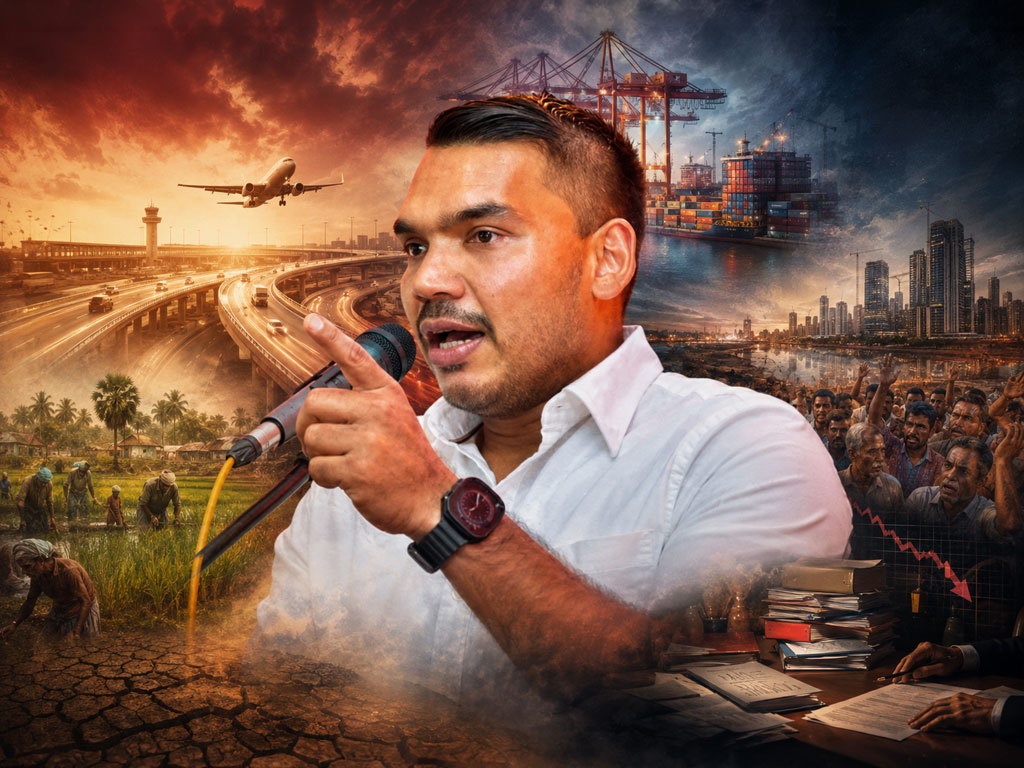
The Parliamentarian said he was pleased that critics of projects including Hambantota Port, the expressway, Mattala Airport, Uma Oya and Colombo Port City were now acknowledging their economic importance.
Addressing a political meeting in Lunugamvehera, Rajapaksa reflected on conditions in Hambantota before 2005 and defended infrastructure developed during governments led by Mahinda Rajapaksa.
He recalled criticism that the expressway had been built merely to transport “sour fish” for Mahinda Rajapaksa.
“I saw yesterday, the day before yesterday, and on Monday, vehicles lining up to transport sour fish. Isn’t that right?” he said.
However, Rajapaksa argued that high fuel prices were now placing fishermen under severe financial pressure.
He claimed fishermen could no longer earn adequate returns from their catches and also pointed to declining water levels in tanks.

Namal Rajapaksa Government Criticism Turns to Agriculture
Rajapaksa accused the Government of failing to implement an adequate programme to address these pressures over the past two years.
He said authorities had instead concentrated on attacking the opposition and the Rajapaksa family.
“At the very least, within two years, they should have cleaned the tanks in Lunugamvehera, Hambantota District, Monaragala, Wellawaya, and Buttala,” he said.
He argued that properly maintained tanks could provide some relief even when rainfall is limited.
Rajapaksa then turned to the difficulties facing paddy and chena farmers.
He claimed traditional chena farmers were finding it increasingly difficult to obtain permission to cultivate land they had used for decades.
According to Rajapaksa, previous arrangements allowed permissions to be issued through Divisional and District Committees for different areas.
He alleged that the Government now clears forest areas according to its own priorities while denying farmers access to land they have cultivated for 10, 15, 20, 30, 40 or even 50 years.
“This is the truth,” he told the gathering.
He also criticised imports during local harvesting periods.
Rajapaksa said rice, vegetables and fruits were being imported while Sri Lankan farmers were attempting to sell their produce.
He argued that such policies denied farmers a fair opportunity in the domestic market.
The SLPP politician also raised the issue of graduate employment.
He said young graduates had sought jobs because employment had been promised during the election campaign.
However, he claimed the Government was now turning them away.
Rajapaksa mocked what he described as growing public frustration.
“Normally, it’s the people who get tired of the government,” he said. “Oh, this government, the government is getting tired of the people.”
Taxes, Fuel and Coal Come Under Attack
Rajapaksa also attacked the Government over taxation, electricity tariffs and fuel prices.
He accused the administration of placing what he described as “unlimited taxes” on ordinary people from the beginning of its term.
“Even if you earn a daily income, an unlimited tax hits you,” he said.
He also criticised increases in electricity charges and fuel prices.
The Government has linked some cost pressures to international developments, including conflict affecting global markets.
Rajapaksa rejected that explanation and instead raised allegations concerning coal imports.
He claimed that 15 ships carrying substandard coal had entered the country and questioned what legal action had been taken against the company involved.
These claims were made by Rajapaksa during his political address and are not presented here as independently established findings.
He then made further allegations involving the release of containers from the port and criticised the appointment of the Presidential Secretary.
Rajapaksa alleged that the official had previously faced questions connected to container releases.
He claimed that reports concerning those matters had reached the President before the appointment.
“From the day that person became the Presidential Secretary, containers are being released from the port,” Rajapaksa alleged.
He offered no judicial finding during the speech establishing wrongdoing by the official.
Rajapaksa Raises Finance Secretary Allegations
Rajapaksa also criticised the Finance Secretary and referred to an incident in which money had allegedly been deposited into an incorrect account.
He said authorities later claimed that a hacker had gained access.
Rajapaksa also referred to the death of the person who reportedly lodged the complaint regarding the incident.
He used the matter to ridicule what he described as administrative failures.
“Depositing money into the wrong account. Like little children. Releasing containers from the port,” he said.
He again criticised rice imports during harvesting periods and accused the Government of repeatedly making mistakes while ordinary citizens bore higher taxes.
Rajapaksa alleged that the administration was attempting to place the financial burden arising from what he described as fraud and corruption on the public.
These remain political allegations made in his speech.
He argued that taxpayers ultimately carry the cost whenever public money is lost or mishandled.
Rajapaksa then moved to the proposed 22nd Amendment and criticised the Government’s response to opponents of the measure.
He claimed that criticism had extended to organisations such as the Bar Association and even the Maha Nayaka Theras.
According to Rajapaksa, people who oppose the amendment are being unfairly portrayed as wrongdoers.
“If the government has an agenda, a desire to extend one person’s tenure, that’s the government’s business,” he said.
However, he argued that citizens would judge the administration primarily on whether it reduces living costs, provides employment and creates conditions in which people can live more comfortably.
Government Told to Listen to Villages
Rajapaksa also criticised the administration’s relationship with the media and public.
He referred to occasions when journalists questioning officials were allegedly asked which media organisation they represented.
He again compared the Government’s response to the behaviour of “little children.”
Rajapaksa said the SLPP had begun travelling from village to village and meeting residents.
According to him, those gatherings now attract not only traditional SLPP supporters but also people who previously voted for other parties.
He noted that President Anura Kumara Dissanayake was also visiting villages and said such engagement was positive.
However, Rajapaksa urged the President to listen to the concerns raised rather than simply hold meetings.
“Listen to what is being said. Provide solutions to the problems,” he said.
“The government has a responsibility to provide solutions to the people’s problems.”
Rajapaksa urged supporters in Lunugamvehera to rebuild their political organisation.
He described the area as one where parents, young people and families had historically supported Mahinda Rajapaksa.
Mattala, Hambantota Port and Port City Defended
The strongest theme in the Namal Rajapaksa government criticism was his defence of large infrastructure projects associated with previous Rajapaksa administrations.
He recalled strong criticism directed at Mattala Rajapaksa International Airport when it was developed.
Rajapaksa said the same political forces were now presenting Mattala, Hambantota Port and Colombo Port City as attractive locations for future investment.
He also recalled earlier criticism of Colombo Port City.
According to Rajapaksa, opponents had once claimed that building the project would require damaging Sigiriya.
He referred to claims that there was a rock obstructing Hambantota Port and criticism directed at the Uma Oya development.
“They said there is a hole in Uma Oya. In the end, they stopped it through protests,” he said.
Rajapaksa argued that those who resisted the projects were now publicly recognising their value.
“We are happy on one hand that those who stopped the country’s development are now, through their own words, saying the projects they criticized and accused are good,” he said.
He added that he welcomed what he described as an acknowledgement that the port, expressway, airport, Uma Oya and Port City had become important economic assets.
“I am happy that those who once criticized the port, the expressway, the airport, and Uma Oya, those who criticized Port City, have now made those projects their savior,” Rajapaksa said.
He said those same projects were now being described as economic centres capable of attracting investment and supporting national development.
SLPP Urged to Rebuild Its Political Base
Rajapaksa concluded by calling on SLPP supporters to reorganise at village level.
He acknowledged that many supporters had become distant from the party during the previous period and urged activists to reconnect with them.
“Let us unite, let us join hands,” he said.
Rajapaksa promised political leadership to rebuild the movement as what he described as a strong political force.
At the same time, he delivered a direct message to the Government.
“Please, please stop the lies now! Stop the lies! Stop the deception!” he said.
He argued that the administration had made promises to citizens and now had a responsibility to deliver them.
Rajapaksa said that responsibility extended beyond immediate economic problems.
He called on the Government to stabilise the country economically, socially and politically while responding directly to the concerns of ordinary communities.
His Lunugamvehera address therefore combined a defence of Rajapaksa-era infrastructure with attacks on current policies covering agriculture, taxation, imports, employment, energy costs and constitutional reform.
At its core, Rajapaksa’s argument was that projects once condemned by political opponents are increasingly being recognised as valuable national assets.
Whether voters accept that interpretation will form part of the wider political contest over Sri Lanka’s economic direction and the legacy of its large-scale infrastructure programme.