By Dwayne Ferreira.
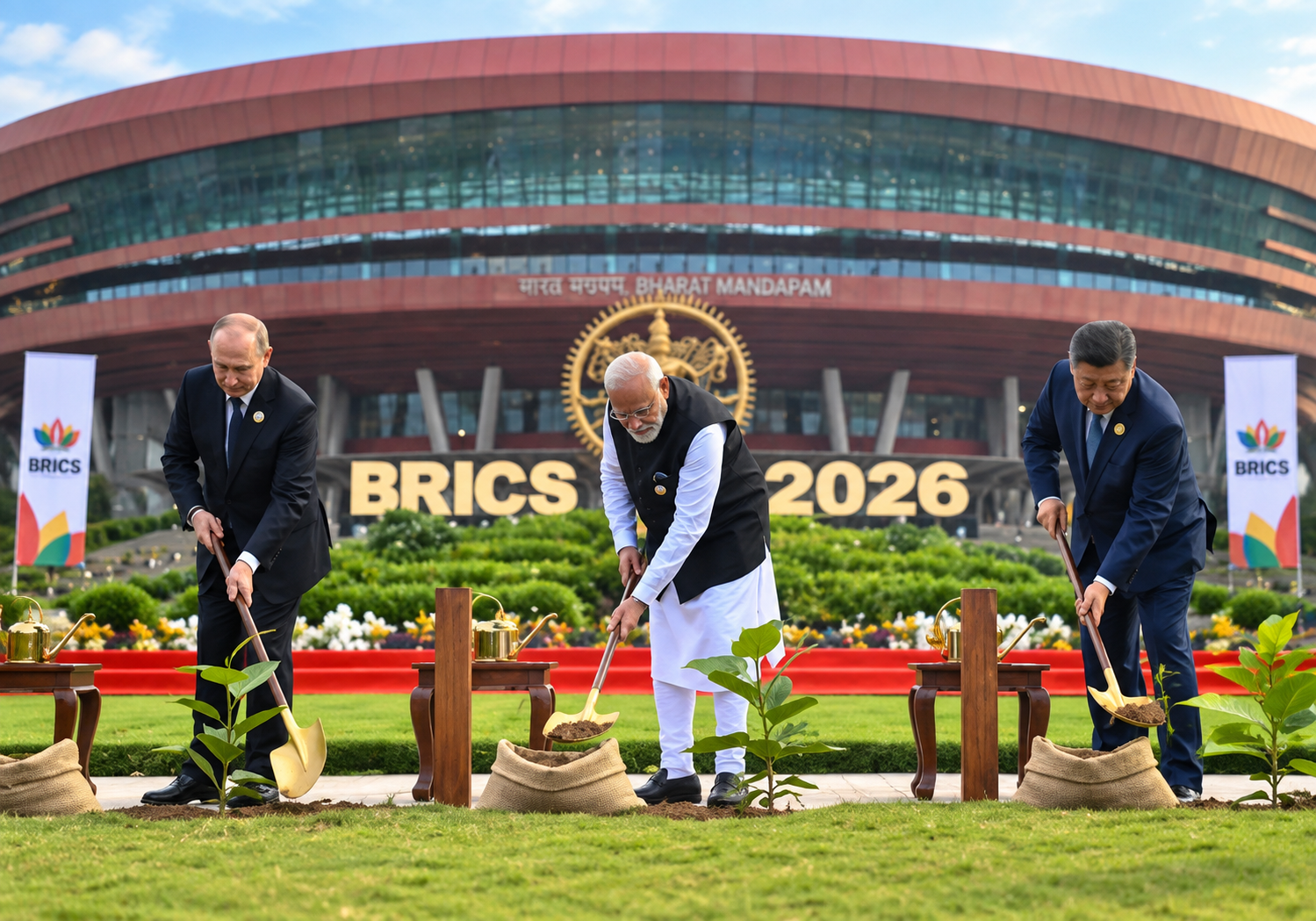
Modi Xi Putin BRICS imagery takes centre stage in New Delhi as the three leaders join a symbolic tree-planting ceremony.
NEW DELHI – Indian Prime Minister Narendra Modi, Chinese President Xi Jinping and Russian President Vladimir Putin came together in a striking display of diplomatic symbolism at the BRICS Summit in New Delhi on Saturday, taking part in a tree-planting ceremony as some of the world’s most influential leaders gathered in the Indian capital.
The three leaders were photographed side by side during the ceremonial event at the 18th BRICS Summit, hosted by India at Bharat Mandapam on September 12 and 13.

While the planting of a tree was largely symbolic, the image carried considerably greater geopolitical significance, bringing together the leaders of India, China and Russia at a time when international alliances, trade relationships and global security arrangements are undergoing major changes.
The summit is being held under the theme “Building for Resilience, Innovation, Cooperation and Sustainability,” with BRICS leaders pledging to strengthen cooperation across political, economic and people-to-people spheres.
A Powerful Diplomatic Image
The appearance of Modi, Xi and Putin together is particularly notable because India maintains distinct and sometimes complicated relationships with both China and Russia.
Xi’s visit is his first to India in seven years and comes as New Delhi and Beijing attempt to repair relations damaged by the deadly 2020 military confrontation along their disputed Himalayan border. Modi and Xi held bilateral discussions on the sidelines of the summit, agreeing on the importance of expanding business and transport links while maintaining peace along the border.
Relations between the two Asian powers have gradually improved since late 2024, although substantial military deployments remain along their roughly 3,800-kilometre frontier.
China-India economic ties, meanwhile, remain enormous. Bilateral trade reached a record $155.6 billion in 2025, although India’s significant trade deficit with China continues to be a major concern for New Delhi.
Putin Joins India and China on BRICS Stage
Putin’s presence also highlights India’s longstanding relationship with Russia.
Modi and Putin met separately on the margins of the summit, discussing cooperation spanning politics, trade, defence, energy, space and the movement of skilled workers. Indian officials said the two leaders also reviewed wider cooperation through BRICS.
The meeting comes as India continues to balance its traditional relationship with Moscow against its growing strategic partnerships with the United States and other Western nations.
That balancing act has increasingly become one of the defining characteristics of Indian foreign policy.
BRICS Seeks Bigger Global Role
The gathering in New Delhi comes as the expanded BRICS grouping seeks a greater voice in international decision-making.
The bloc has grown considerably beyond its original membership of Brazil, Russia, India, China and South Africa, bringing additional emerging economies into a grouping that increasingly presents itself as a platform for the Global South.
At Saturday’s summit, members called for reforms to international institutions and greater representation for developing countries while discussing conflicts in the Middle East, Ukraine, international trade and sanctions.
Modi argued that developing nations should move from being simply “rule-takers” in the international system towards becoming “rule-shapers,” while calling for changes to institutions including the United Nations Security Council and international financial bodies.
China, meanwhile, has pushed BRICS towards a larger role in shaping an increasingly multipolar international order, while India has generally sought to position the organisation as a bridge between developing nations and the West rather than an explicitly anti-Western alliance.
More Than a Tree-Planting Ceremony
Against that backdrop, the photograph of Modi standing between Putin and Xi during the tree-planting ceremony is likely to become one of the defining images of the New Delhi summit.
On the surface, it shows three leaders watering newly planted trees.
Beyond the ceremony, however, the image captures three major powers whose political decisions influence billions of people, enormous sections of the global economy and some of the most consequential diplomatic relationships in the world.
For India in particular, the moment reinforces New Delhi’s effort to maintain strategic relationships across competing global power centres while presenting itself as an increasingly influential voice for the Global South.
At a summit dominated by discussions about the future balance of global power, one simple photograph may ultimately tell much of the story.