Iranian ships near Sri Lanka draw scrutiny as 21 vessels are reportedly under US sanctions amid heightened tensions between Washington and Tehran.
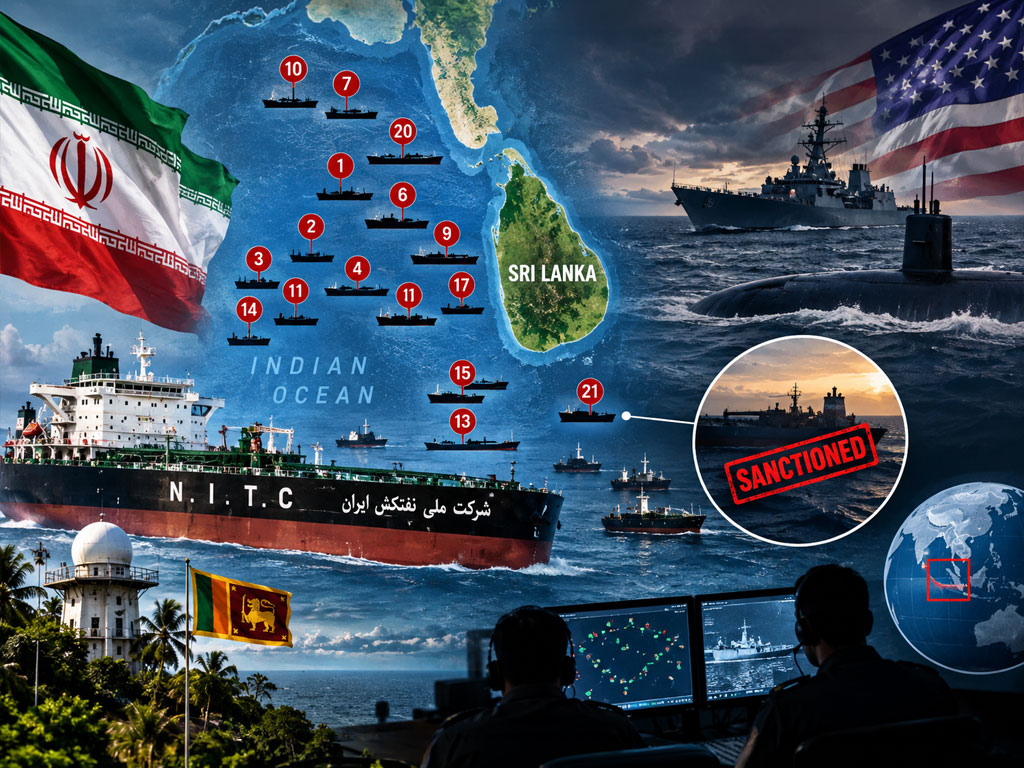
The presence of Iranian ships near Sri Lanka has drawn fresh attention after an investigation reportedly identified 21 Iranian vessels in international waters close to the island, all allegedly under United States sanctions.
The development comes amid the military conflict between the United States and Iran, which has continued for more than seven months. The conflict has kept the Middle East under intense international scrutiny. It has also unexpectedly placed Sri Lanka near a sensitive point in the wider geopolitical crisis.
Sri Lanka was drawn directly into the consequences of the conflict on March 4, 2026.
That day, the Iranian Navy warship IRIS Dena sank after a torpedo attack by a United States Navy submarine in international waters off Galle. Sri Lankan authorities recovered 87 bodies and rescued 32 sailors following the attack.
Against that backdrop, reports that several Iranian vessels have gathered in international waters near Sri Lanka have attracted considerable attention.

47 Ships Identified in International Waters
Foreign Affairs Minister Vijitha Herath said authorities had identified 47 vessels operating in international waters close to Sri Lanka.
He disclosed the information at the Cabinet decisions media briefing on September 8.
Herath said the vessels were more than 24 nautical miles away and remained outside Sri Lanka’s territorial waters. The group included several Iranian vessels as well as merchant and cargo ships.
The Minister stressed that none had entered Sri Lankan territorial waters.
The Sri Lanka Navy has been monitoring the situation.
US Questions Colombo Over Iranian Ships Near Sri Lanka
The United States Embassy in Colombo also contacted Sri Lanka’s Ministry of Foreign Affairs about the Iranian vessels.
Herath said the Embassy asked whether Sri Lankan authorities knew about the vessels and whether officials were monitoring them.
“The United States Embassy made a notification to the Sri Lanka Ministry of Foreign Affairs that there are several Iranian ships, whether we are aware of it and whether we are monitoring it. A notification was made to the Ministry of Defence as well as to the Ministry of Ports. Through that, we are on an observation. Those ships are located beyond our sea boundary,” the Minister explained.
Independent reporting confirms that the US Embassy contacted the Foreign Ministry and that the Defence and Ports Ministries were subsequently informed.
21 Iranian Vessels Identified
According to an investigation by BBC Sinhala and BBC Verify, 21 Iranian vessels were identified in international waters near Sri Lanka at about 3:30 GMT on September 15.
An examination using MarineTraffic.com reportedly located the vessels in international waters stretching from areas off Matara and Galle through Colombo and towards Negombo.
BBC Sinhala and BBC Verify identified the vessels as Stream, Halti, Dream II, Sea Cliff, Snow, Helm, Diamond II, Deep Sea, Dino I, Herby, Sevin, Amber, Henna, Huge, Dore, Sonia I, Felicity, Dune, Hero II, Daisy and Shiba.
The investigation reported that these Iranian vessels had been positioned in waters near Sri Lanka since July.
According to the MarineTraffic information cited in the investigation, all 21 vessels were subject to United States sanctions.
The vessels reportedly include oil tankers and cargo ships.
The presence of Iranian ships near Sri Lanka is therefore attracting attention not simply because of their nationality, but also because of the sanctions regime surrounding them.
Sri Lanka Says No Facilities Were Requested
Herath said no vessel had requested facilities or assistance from Sri Lanka. The government had also not provided facilities to any of them.
“The ships being spoken of are not only Iranian ships. We have identified 47 ships. All these ships are located beyond our sea boundary. On the other side, 24 nautical miles beyond the international sea boundary. Among the ships there are also several ships belonging to Iran. None of them are within our sea boundary.”
The Minister also pointed to commercial vessels operating in international waters near other countries, including Thailand, Malaysia and Indonesia.
“As the government of Lanka, we have not provided any facility for any of this. Also, no request has been made from their side from us,” Herath said.
He added that no request had been made under international maritime law seeking assistance from Sri Lanka.
“Our Navy is also on an observation regarding it. Other than that, no intervention has been made as a government regarding this,” he said.
Herath’s central position, that the ships remain outside Sri Lankan territorial waters and have neither requested nor received assistance, is consistent with other reports of his September 8 remarks.
Sri Lanka Urged to Handle Situation Carefully
Dr. Hasitha Kandaudahewa, a researcher and consultant on international relations, told BBC Sinhala that Sri Lanka must approach the situation carefully as a sovereign state.
“America has officially made an inquiry from Sri Lanka regarding the Iranian ships in the sea near Sri Lanka. That is whether these ships are under Sri Lanka’s protection.”
He said Sri Lanka had responded that the vessels remained in international waters and had made no request for protection or emergency assistance.
“Also, that Lanka is monitoring this situation. Here, as a non-aligned country, Sri Lanka has to act thoughtfully,” he said.
The issue comes only months after the IRIS Dena attack dramatically brought the US-Iran conflict close to Sri Lanka’s southern coastline.
IRIS Bushehr Remains in Trincomalee
Following the March 4 sinking of IRIS Dena, another Iranian Navy vessel, IRIS Bushehr, came under Sri Lankan control on humanitarian grounds.
The vessel has remained in Trincomalee since March 9.
Sri Lanka initially accommodated Iranian naval personnel connected to the incident. Reports later confirmed that hundreds of Iranian sailors, including IRIS Dena survivors and personnel from the second vessel, were repatriated.
The original report states that 208 Iranian naval personnel from IRIS Bushehr were initially kept at the Navy camp in Welisara before later returning to Iran by air.
However, Parliament was recently told that 13 Iranian naval personnel remained aboard IRIS Bushehr to protect and maintain the vessel.
MP Rauff Hakeem told Parliament on September 11 that Iran had requested the transfer of the 13 sailors serving aboard the ship. According to Hakeem, the Ministry of Defence had so far approved replacements for only three.
Hakeem compared the situation with India.
He said the Indian government had permitted the transfer of around 30 Iranian naval personnel serving aboard an Iranian vessel there, allowing them to return home.
The MP urged the Sri Lankan government to act promptly, noting that the sailors’ families were awaiting their return.
Deputy Minister of Foreign Affairs and Foreign Employment Arun Hemachandra responded that authorities had focused on the sailors’ safety and welfare from the beginning.
He said officials were working with the Ministry of Defence and other relevant institutions to resolve the outstanding issues.
Maritime Obligations Could Become Important
Dr. Kandaudahewa said Sri Lanka’s position could become more complicated if a vessel formally sought emergency assistance.
“As a sovereign state and as a country that has signed the international maritime convention, there is a possibility of a problem coming to Sri Lanka here,” he said.
He argued that Sri Lanka would have responsibilities in a non-military humanitarian situation.
“It was such an occasion that protection was provided to Iran’s ‘IRIS Bushehr’ ship last March,” he said.
He added that if a vessel within an area where Sri Lanka has applicable maritime responsibilities declares an emergency and seeks help, Sri Lanka may have to provide assistance in accordance with international maritime law.
Sri Lanka’s response to the IRIS Dena sinking demonstrated this distinction. Although the ship was outside territorial waters, Sri Lanka deployed rescue assets after receiving the distress call.
Iranian Embassy Did Not Respond to BBC Sinhala
BBC Sinhala said it repeatedly attempted to obtain further information from the Iranian Embassy in Colombo between September 9 and September 17.
According to the report, the service contacted the Embassy four times by email and five times by telephone.
It said no response had been received by the publication date.
Separately, the Iranian Embassy told the Daily Mirror on September 10 that it had learned about reported US concerns over the vessels through Sri Lankan media.
US State Department Responds
BBC Sinhala also sought a response from the US State Department concerning the Iranian vessels.
According to the report, the State Department said Washington remained closely focused on several areas, including what it described as Iran’s illegal fuel trade.
“The United States will continue to disrupt, expose, and degrade the Iranian regime’s destabilizing activities, including support to Iranian military and destructive weapons proliferation activities, procurement conspiracies, malicious cyber operations, and illegal fuel trade. We request the international community to join with us to hold individuals and organizations connected to these actions accountable,” the State Department responded.
That statement represents the US government’s position on Iranian activities.
When BBC Sinhala asked whether Washington had contacted Sri Lanka specifically about the vessels, the State Department declined to discuss private diplomatic conversations.
The Sri Lankan government, however, has publicly confirmed that the US Embassy in Colombo raised the issue with the Foreign Ministry.
Sanctions Create a Diplomatic Challenge
Asked whether the vessels could affect relations between Washington and Colombo, Dr. Kandaudahewa said Sri Lanka would have to navigate several competing considerations.
“The United States of America has made a request from Sri Lanka not to allow these ships to enter the country’s sea belt. Because international sanctions have been imposed on these ships,” he said.
He argued that Sri Lanka must consider international conventions, practical diplomatic relations and customary international relations.
Therefore, he expects Sri Lanka to continue primarily monitoring the ships.
“But if in some way an emergency assistance request is made, Sri Lanka will respond to it in accordance with the international maritime convention,” he said.
The comments illustrate the delicate position created by Iranian ships near Sri Lanka as Colombo attempts to maintain its maritime obligations while navigating relations with both Washington and Tehran.
US-Iran Conflict Extends to Shipping
The wider military conflict between the United States and Iran has also affected fuel and merchant shipping.
The original report states that following an alleged Iranian attempt to attack two US warships on September 4, United States Central Command announced attacks against eight Iranian fuel-transport vessels across September 5 and September 8.
According to the account, US forces attacked three Iranian vessels on September 5 and another five on September 8, with one vessel completely sunk.
The report presents those details as statements attributed to US Central Command.
The March attack on IRIS Dena had already demonstrated how far the conflict could extend geographically. Reuters and Associated Press reporting confirmed that a US submarine sank the Iranian warship in international waters off southern Sri Lanka.
International Law and Sri Lanka’s Strategic Location
International law makes the vessels’ exact location particularly important.
Under the United Nations Convention on the Law of the Sea, a coastal state’s territorial sea may extend up to 12 nautical miles from its baseline. Foreign Minister Herath has stressed that the vessels currently being monitored remain outside Sri Lanka’s territorial waters.
Sri Lanka’s geographical position also places it beside one of the world’s major maritime routes.
The original report states that nearly half of global container traffic and almost two-thirds of global fuel transportation pass along the international maritime route close to Sri Lanka.
It also cites information published through ResearchGate stating that more than 60,000 ships use the international sea route near Sri Lanka annually.
Under UNCLOS, ships enjoy freedom of navigation on the high seas, subject to the applicable provisions of international law.
For Sri Lanka, the challenge is therefore not simply the presence of ships beyond its territorial waters.
The government must balance sovereignty, neutrality, maritime law, humanitarian responsibilities and diplomatic relations while a major military conflict unfolds across sea lanes close to the island.
For now, Colombo says it is monitoring the situation and has provided no facilities to the vessels concerned. But with 21 Iranian vessels reportedly identified near the island and linked to US sanctions, the waters surrounding Sri Lanka have become another sensitive point in the wider confrontation between Washington and Tehran.