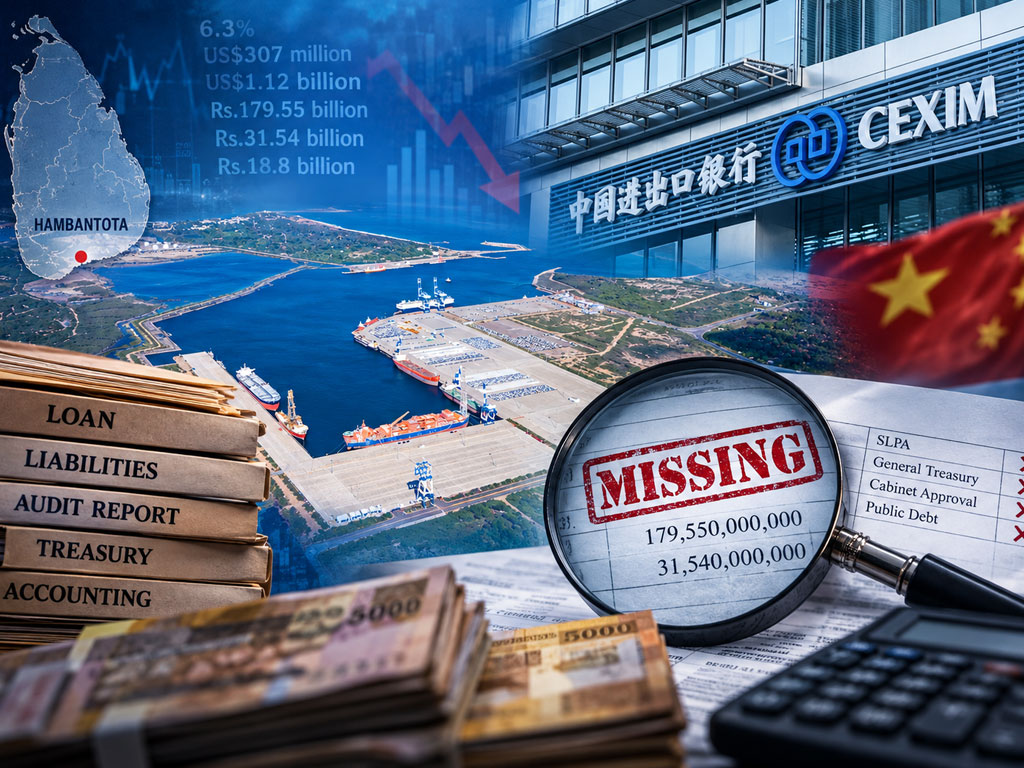
Hambantota Port debt raises questions after Rs.179.55 billion in loan liabilities was reportedly removed from SLPA financial accounts.
Sri Lanka’s Hambantota Port debt controversy extends far beyond the disputed 99-year lease to a Chinese operator. At its centre lies an extraordinary accounting issue involving billions of rupees in port-related liabilities.
According to the investigative material, those liabilities disappeared from official accounts without the required institutional approvals. The episode raises serious questions about public accountability, sovereign debt reporting and the protection of taxpayers.
Sri Lanka pursued the Hambantota project despite successive feasibility studies by internationally recognised consultants warning that the proposed port would duplicate capacity already available at Colombo Port.

Nevertheless, Sri Lanka proceeded with Phase I. It obtained a US$307 million loan from China’s Exim Bank at an interest rate of 6.3 percent. Those financing terms were considerably more expensive than conventional concessional borrowing.
The port subsequently failed to generate the revenues originally anticipated. According to the investigative material, annual losses reached approximately Rs.18.8 billion.
That placed increasing pressure on the General Treasury. Revenues from other profitable maritime operations were reportedly used to sustain the struggling project and prevent its liabilities from becoming an even greater state burden.
Hambantota Port Debt Disappears From SLPA Accounts
The most serious revelation emerged during a wider government auditing process.
Investigators found that Rs.179.55 billion in Hambantota-related loan liabilities had been removed from the financial statements of the Sri Lanka Ports Authority (SLPA).
According to the material, the removal occurred without concurrence from the General Treasury and without Cabinet approval.
Consequently, the liability entered an extraordinary institutional limbo. It had disappeared from SLPA’s books, while the Treasury had not formally incorporated it into its own accounts.
Official Auditor General reporting has separately documented a similar accounting problem. A 2021 SLPA audit states that Rs.147.746 billion in Hambantota loan and interest balances remaining in SLPA’s accounts as of November 30, 2017 had been written off without Treasury concurrence or Cabinet approval. The audit said the amount consequently had not been included in government accounts.
The accounting problem extended further.
A Rs.31.54 billion foreign-exchange conversion loss associated with the Chinese credit facilities was also removed from the accounts. This meant official records did not fully reflect the economic burden created by the project. The Auditor General’s report records a cumulative foreign-exchange conversion loss of Rs.31.545 billion being written off alongside the loan amount.
Questions Over Treasury Responsibility
Parliamentary oversight subsequently exposed serious weaknesses in coordination between government institutions.
A July 2017 Cabinet memorandum envisaged the Treasury taking responsibility for servicing the Hambantota loans. However, the intended transfer of responsibility apparently did not produce corresponding accounting action.
Another crucial issue concerned the US$1.12 billion associated with the 99-year port agreement with China Merchants Port Holdings.
Instead of retiring the underlying construction debt, the proceeds were reportedly absorbed into general government expenditure. The original liabilities therefore remained a burden while becoming difficult to identify through SLPA’s accounts.
Official SLPA material confirms the concession agreement had a 99-year term and an agreed investment value of US$1.12 billion.
Questions Reach Beyond Hambantota Port
The implications of the Hambantota Port debt issue extend beyond the port itself.
Once previously unrecognised liabilities came into focus, questions emerged about the accuracy of Sri Lanka’s public-debt statistics, fiscal projections and debt-sustainability calculations.
The episode demonstrates that sovereign debt is not simply about how much a country borrows.
Where authorities record liabilities matters. So does which institution assumes responsibility for them. Equally important is whether Parliament and the public receive an accurate picture of the state’s financial obligations.
For Sri Lankan taxpayers, the Hambantota controversy therefore represents more than a troubled infrastructure investment.
It leaves a fundamental question demanding an accountable answer: how could liabilities worth billions of rupees move between institutions, or disappear from one institution’s accounts, without a transparent and legally accountable accounting trail?