By Roy Denish.
Shiranthi Rajapaksa’s Singapore medical trip and circulating shopping images have triggered satire amid an ongoing FCID inquiry.
From reported illness and hospital treatment in Colombo to medical examinations in Singapore and photographs said to show a shopping excursion, the story surrounding former First Lady Shiranthi Rajapaksa has provided fertile ground for Sri Lanka’s political satirists.
Perhaps they have even discovered a new branch of medicine: FCID-to-Changi therapy.
Rajapaksa left Sri Lanka for Singapore in the early hours of September 16 after receiving treatment at a private hospital in Colombo. Reports subsequently said she was undergoing medical examinations at Singapore’s Mount Elizabeth Hospital. She has also been instructed to appear before the Financial Crimes Investigation Division on September 24 in connection with the Siriliya Saviya investigation.

Then came the photographs.
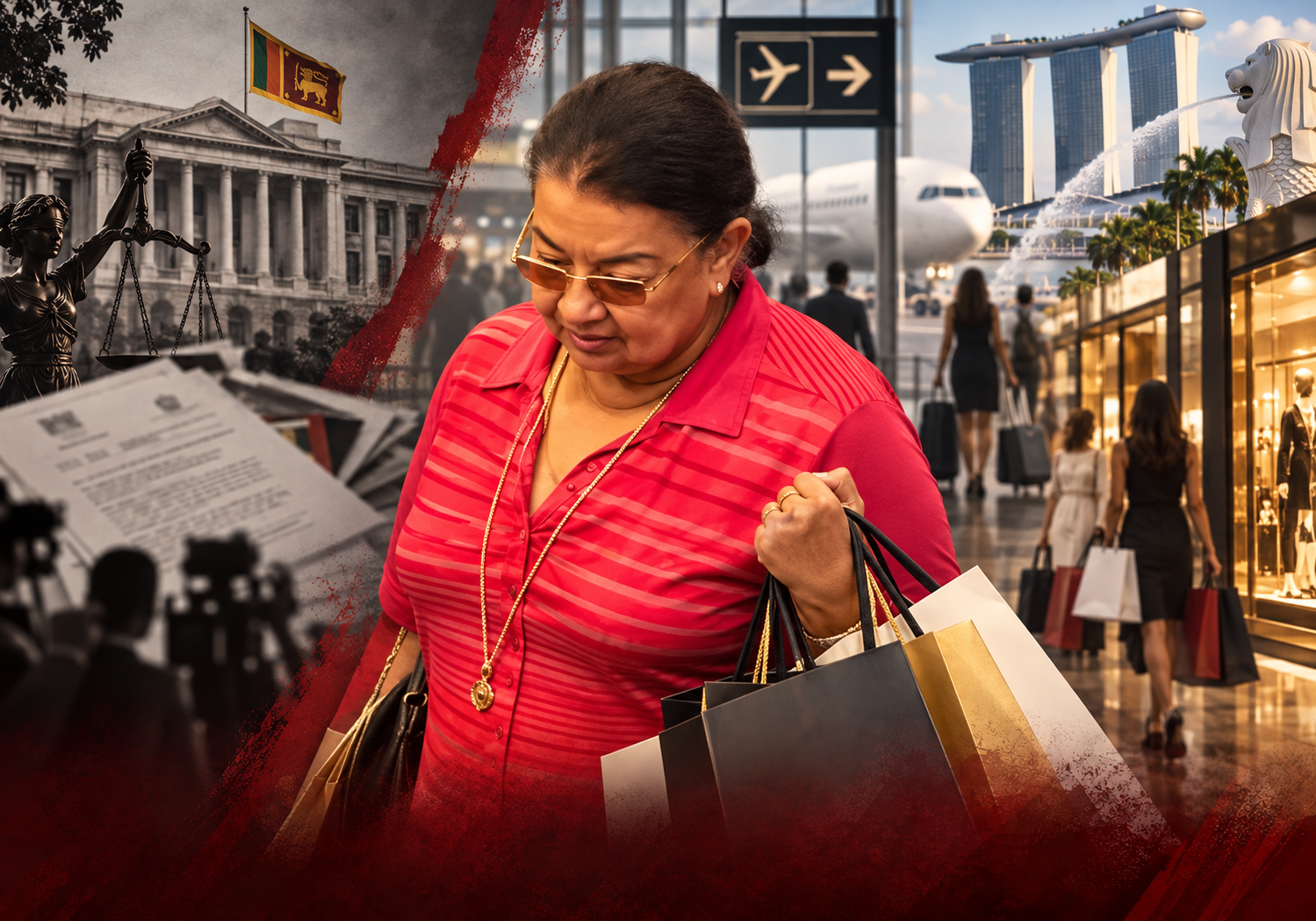
Images circulated on social media purporting to show Rajapaksa shopping in Singapore, prompting commentary about the apparent contrast between reports of illness in Colombo and her alleged activities overseas.
That contrast has inevitably produced satire.
And suddenly, there was Orchard Road.
Luxury malls. Designer stores. Shopping bags. Long corridors built for the committed shopper.
If the circulating photographs are authentic and accurately presented, Sri Lanka’s medical establishment may want to study what social media has jokingly diagnosed as the FCID Recovery Method.
The prescription, according to the satirical version, could hardly be simpler:
One FCID notice → medical concern.
One Singapore Airlines ticket → international specialist treatment.
One Orchard Road excursion → advanced rehabilitation.
One luxury handbag display → cardiovascular enthusiasm restored.
For ordinary Sri Lankans, recovery from a serious medical episode can involve medication, rest, follow-up consultations and carefully managed physical activity.
Singapore, of course, is also home to some of Asia’s best-known private hospitals, and travelling there for specialist medical examinations is neither unusual nor evidence that someone was not genuinely ill.
That inconvenient fact should not be lost amid the jokes.
When Medical Claims Become Political Theatre
The satire nevertheless reflects a broader feature of Sri Lankan politics: once medical treatment, overseas travel and a criminal investigation collide in the same news cycle, every photograph becomes evidence in the court of public opinion.
In this case, established reporting confirms that Rajapaksa travelled to Singapore for medical purposes after receiving treatment in Colombo. Reports also state that she was served or informed of an FCID notice around the time of her departure, requiring her to appear on September 24.
Her family has disputed suggestions that she knowingly left the country after previously receiving the summons, saying the notice reached her only at the airport as she prepared to board.
The online shopping photographs add another layer, but photographs alone cannot establish a person’s medical condition, treatment history or physical capacity.
Walking through a shopping centre does not establish that someone was never ill. Neither does travelling overseas for treatment prove the seriousness of an illness.
That distinction matters.
Still, satire has never required a cardiology degree.
So, in the spirit of political humour, perhaps Sri Lanka’s next imaginary national health initiative should be called:
OPERATION ORCHARD ROAD
Forget the treadmill.
Forget physiotherapy.
Simply prescribe a return ticket to Singapore, medically supervised mall walking and controlled exposure to designer handbags.
Possible side effects may include increased shopping stamina, improved enthusiasm and an uncontrollable urge to examine seasonal collections.
What the Evidence Actually Shows
Behind the humour lies a serious distinction between what has been reported and what remains speculation.
Rajapaksa’s treatment in Colombo, her departure for Singapore, reported examinations at Mount Elizabeth Hospital and the FCID requirement that she appear on September 24 have all been reported by Sri Lankan media.
Claims about precisely how sick she was, what medical procedures she required, how strenuous any alleged shopping excursion was, or whether her overseas activities contradicted her diagnosis cannot be established from photographs circulating online.
Nor does any of this prove that an illness was fabricated or that medical treatment was used to avoid an investigation.
Medical conditions are matters for qualified doctors and documented medical evidence, not political gossip or photographs stripped of clinical context.
The legitimate public question is therefore narrower.
If photographs circulating from Singapore are authentic, what do they actually demonstrate?
Perhaps very little medically.
Politically, however, they demonstrate something Sri Lanka has known for decades: when politicians, investigations and overseas medical trips intersect, satire is rarely far behind.
And on this occasion, Orchard Road has somehow found itself in the middle of it.