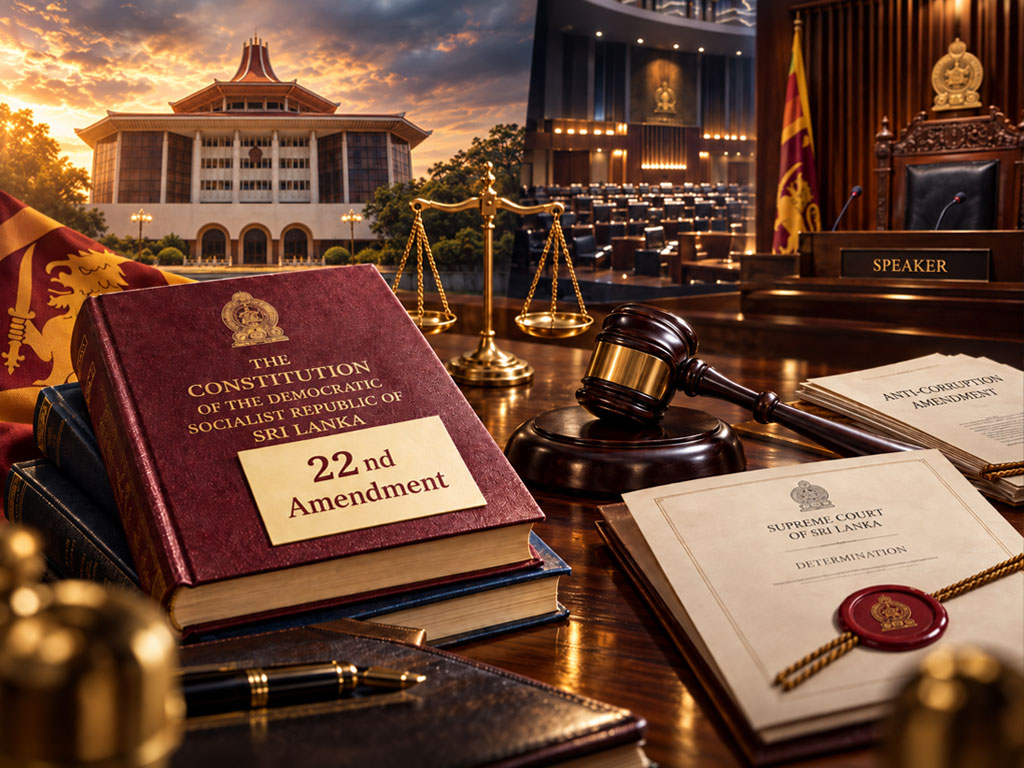
The 22nd Amendment Supreme Court determination has reached the Speaker and is due to be presented to Parliament on September 22.
COLOMBO — The Supreme Court’s confidential determination on the proposed 22nd Amendment to the Constitution has reached the Speaker’s Office and is due to be announced to Parliament on Tuesday, September 22, clearing the way for a two-day debate on the controversial judicial reform package later in the week.
The determination relates to petitions challenging the constitutionality of legislation that seeks to extend the retirement ages of Supreme Court and Court of Appeal judges and increase the maximum number of judges serving in the Court of Appeal. Until the Speaker formally announces the determination in Parliament, its conclusions remain confidential.
The Supreme Court’s determination on petitions challenging the Anti-Corruption (Amendment) Bill has also been sent to the Speaker, according to reporting on Sunday. Earlier this month, the Supreme Court concluded hearings on 15 petitions challenging that Bill and said its determination would be communicated to the Speaker and the President.

22nd Amendment heads towards Parliament debate
The 22nd Amendment Bill proposes to raise the mandatory retirement age of Supreme Court judges from 65 to 67 years and Court of Appeal judges from 63 to 65 years. It would also amend Article 137 of the Constitution to increase the maximum number of Court of Appeal judges from 19 to 24.
A further provision states that the Chief Justice would retire either upon reaching 67 or after completing six years from the date of appointment as Chief Justice, whichever occurs first.
The Bill was presented to Parliament for its First Reading on August 18 and referred to the Sectoral Oversight Committee on Governance, Justice and Civil Protection. Under the constitutional procedure, parties were then entitled to challenge the Bill before the Supreme Court.
A five-member Supreme Court bench comprising Chief Justice Preethi Padman Surasena and Justices Achala Wengappuli, Arjuna Obeysekera, Sampath Abeykoon and Gihan Kulatunga concluded hearings on the challenges on September 2 and said its determination would subsequently be communicated confidentially to the Speaker.
Parliament’s Committee on Parliamentary Business has scheduled the 22nd Amendment and the related Judicature (Amendment) Bill for debate on September 24 and 25. The Speaker’s announcement of the Supreme Court determination on Tuesday is therefore expected to clarify the constitutional requirements that must be met before the Bill can proceed.
The precise requirements will depend on what the Court has determined. Because the determination remains confidential until it is announced in Parliament, it would be premature to state whether the Bill can proceed with the constitutionally required parliamentary majority alone or whether any provision would additionally require approval at a referendum.
Government cites 1.1 million-case backlog
The Government has argued that extending judicial retirement ages forms part of a broader effort to improve court efficiency and address a backlog of approximately 1.1 million pending cases across Sri Lanka’s judicial system. Justice and National Integration Minister Harshana Nanayakkara has said retaining experienced judicial officers is one component of a wider reform programme.
Nanayakkara has also said that reforms extend beyond retirement ages and include attempts to address delays involving the Government Analyst’s Department, strengthen the Attorney General’s Department and improve staffing throughout the justice system.
The 22nd Amendment deals specifically with the superior courts, while the separate Judicature (Amendment) Bill proposes changes affecting High Court judges, District Judges, Magistrates and other judicial officers. Parliament has confirmed that both pieces of legislation form part of the current judicial reform package.
BASL raises judicial independence concerns
The proposal has nevertheless faced significant opposition from sections of the legal profession.
The Bar Association of Sri Lanka has opposed the proposed extension of judicial retirement ages and has argued that the change could affect judicial independence. BASL representatives met President Anura Kumara Dissanayake in August to present their concerns, but no agreement was reached between the two sides.
BASL subsequently filed a Special Determination petition challenging the constitutionality of the 22nd Amendment and sought a ruling that the Bill would require both a two-thirds parliamentary majority and approval at a referendum. That was a position advanced by the petitioner; whether the Supreme Court accepted it will become clear only when the Speaker announces the Court’s determination.
President Dissanayake, meanwhile, has defended the proposal, telling BASL representatives that the move was intended to serve the national interest rather than benefit any particular individual or group. The Government has continued to argue that retaining experienced judges forms part of its broader programme to improve the administration of justice.
Anti-Corruption Bill determination also received
The Supreme Court has separately considered challenges to the Anti-Corruption (Amendment) Bill, which proposes changes to the Anti-Corruption Act No. 9 of 2023.
Fifteen Special Determination petitions were filed challenging that legislation. A three-member bench comprising Justices Shiran Gooneratne, Mahinda Samayawardhena and Sampath Wijeratne concluded oral hearings on September 4 and directed that written submissions be filed thereafter.
Petitioners included former Minister Prof. G.L. Peiris, Transparency International Sri Lanka and other organisations. Among the arguments advanced was that certain proposed provisions could interfere with judicial power or fundamental rights, while the Attorney General’s Department defended the constitutionality of the Bill. Those were competing submissions before the Court rather than established findings.
The Court subsequently indicated that its confidential determination would be forwarded to the Speaker and the President, and the Speaker’s Office has now reportedly received it.
Tuesday’s announcement on the 22nd Amendment will therefore mark the next crucial procedural stage before Parliament begins its scheduled debate on September 24. Until the Speaker reads the Supreme Court determination to the House, the constitutional conditions attached to the proposed amendment remain officially undisclosed.