By Dwayne Ferreira
Sri Lanka’s UN address calls for climate justice, debt reform, Gaza aid, responsible AI and a more representative multilateral system.
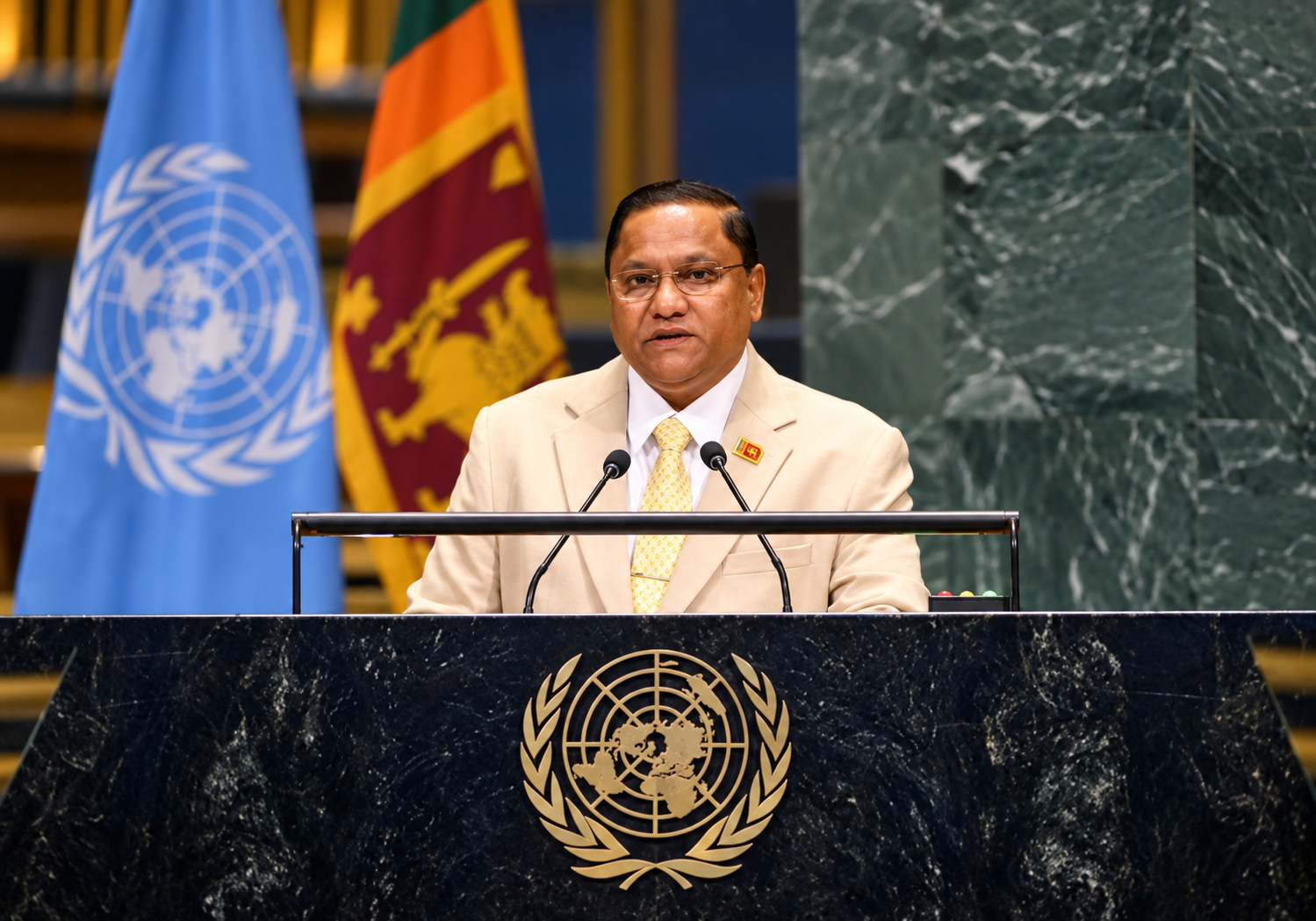
NEW YORK — Sri Lanka has used its national address to the 81st United Nations General Assembly to call for stronger multilateral cooperation, climate justice, reform of the international financial system and a more representative United Nations, while also setting out Colombo’s positions on Gaza, artificial intelligence, debt, reconciliation and nuclear disarmament.
Foreign Minister Vijitha Herath, delivering Sri Lanka’s national statement in New York on September 28, argued that international institutions are struggling to respond quickly enough to conflict, humanitarian emergencies, climate disasters, inequality and rapidly developing technologies.

The 2026 General Assembly is being held under the theme “Restoring trust, managing transformation: A United Nations that delivers for all.”
Herath’s speech was therefore considerably broader than a conventional foreign-policy statement. It attempted to position Sri Lanka as a developing state calling for reforms to a global system that Colombo says does not always distribute economic risk, technological opportunity or climate responsibility equitably.
Climate Justice: Those Who Pollute Least Suffer Most
Climate change occupied a major part of Sri Lanka’s presentation.
Herath argued that countries responsible for relatively small shares of historic global emissions are nevertheless experiencing some of the most severe consequences.
He referred to the devastating impact of Cyclone Ditwah, which affected more than two million people in Sri Lanka and caused major loss of life, livelihoods and infrastructure.
Sri Lanka reiterated its targets of obtaining 70 percent of its energy from renewable sources by 2030 and reaching carbon neutrality by 2050.
The climate message also extends to sea-level rise.
At a separate UN high-level meeting on September 24, Sri Lanka called for simpler and more predictable climate finance for vulnerable developing countries, climate-resilient agriculture and stronger sea-level monitoring using satellite systems, tide gauges and multi-hazard early-warning networks.
For an Indian Ocean island, those concerns are not abstract. Rising seas, coastal erosion, extreme weather and damage to agriculture can have direct consequences for settlements, tourism, fisheries and food security.
Sri Lanka Calls for Fairer Global Debt Architecture
The address also placed Sri Lanka’s recent economic experience within a wider debate about developing-country debt.
Herath said the country had restored a measure of macroeconomic stability following the 2022 economic crisis, but remained exposed to debt pressures and external shocks.
Sri Lanka therefore renewed its demand for reform of the international financial system and fairer rules governing debt and development finance.
The Government also referred to the global financing shortfall facing developing countries attempting to meet the Sustainable Development Goals by 2030.
For Sri Lanka, the issue is particularly significant after a sovereign default, debt restructuring and years of fiscal adjustment.
The argument being presented internationally is that poorer and middle-income countries cannot be expected to meet development and climate targets if a disproportionate share of their resources is consumed by debt servicing or if climate financing arrives predominantly as additional loans.
Gaza and the Middle East
Herath also addressed the continuing conflict in West Asia, an issue with direct consequences for Sri Lanka because of its dependence on imported energy and its large migrant-worker population in the region.
Sri Lanka called for compliance with the UN Security Council’s ceasefire framework and unobstructed humanitarian assistance for civilians in Gaza, while calling for reconstruction to become an urgent international priority.
The Government reaffirmed its support for an independent Palestinian state alongside Israel based on pre-1967 borders.
Herath said instability in West Asia has security, economic and social consequences for Sri Lanka because of the country’s location in the Indian Ocean and the large number of Sri Lankans employed across the region.
That connection has become increasingly visible through higher energy prices and threats to regional shipping.
UN Reform and The Voice of Smaller States
One of the central messages of the address concerned the future of the United Nations itself.
Sri Lanka backed the UN80 Initiative, arguing that the organisation should become more representative, effective and responsive to contemporary global realities.
Herath argued that smaller developing countries regard the UN as important precisely because it provides states with vastly different levels of economic and military power a formal voice in the international system.
His argument, however, was that support for multilateralism should not prevent countries from recognising where the current system has failed to deliver effectively.
The position echoes a broader debate at this year’s General Assembly. Secretary-General António Guterres, who is completing his final year in office, has himself called for reform of UN institutions that were largely designed around the balance of power that existed after the Second World War.
AI and the Digital Divide
Sri Lanka also entered the growing international debate over artificial intelligence.
Herath said emerging technology should be developed and used consistently with international law while ensuring that developing countries receive meaningful technology transfers and equitable access.
Sri Lanka has developed national ethical guidelines for artificial intelligence, according to the Minister.
The Government’s broader argument is that technological transformation should not create another global divide in which advanced economies and major technology companies determine the rules while developing states become passive users.
Reconciliation and Domestic Institutions
Herath also addressed Sri Lanka’s post-war reconciliation process.
He acknowledged that although the armed conflict ended 17 years ago, its consequences and unresolved grievances remain.
The Government said it was strengthening domestic institutions, rejecting racism and religious extremism and pursuing national unity and reconciliation.
He also referred to investigations and prosecutions relating to corruption and said they should proceed without political interference.
These statements are significant because Sri Lanka’s domestic accountability mechanisms and post-war reconciliation record remain subjects of international scrutiny.
Nuclear Disarmament and Peacekeeping
Sri Lanka also highlighted its long history in UN peacekeeping, saying that more than 21,000 Sri Lankan personnel have served in UN missions since 1957.
Herath reaffirmed Colombo’s support for nuclear disarmament and said Sri Lanka continued to regard the complete and verifiable elimination of nuclear weapons as the only ultimate guarantee against their use.
He also emphasised Sri Lanka’s longstanding interest in maintaining the Indian Ocean as a peaceful maritime space governed by international law.
A Broader Message from Colombo
The central theme running through the address was that international transformation cannot benefit only states with greater financial, technological or geopolitical power.
Sri Lanka’s position was that reforms should reduce rather than widen differences between the Global North and Global South, between technologically advanced and developing states, and between countries capable of absorbing global shocks and those most vulnerable to them.
At a General Assembly taking place amid war, energy disruption, climate pressures, growing debt concerns and rapid advances in AI, Sri Lanka’s message was essentially that multilateralism remains necessary — but the institutions supporting it must change if smaller and developing states are to retain confidence in the system.
These versions are considerably stronger than the short breaking-news pieces because they explain what has actually changed, why it matters and what happens next, rather than simply repeating the announcement.