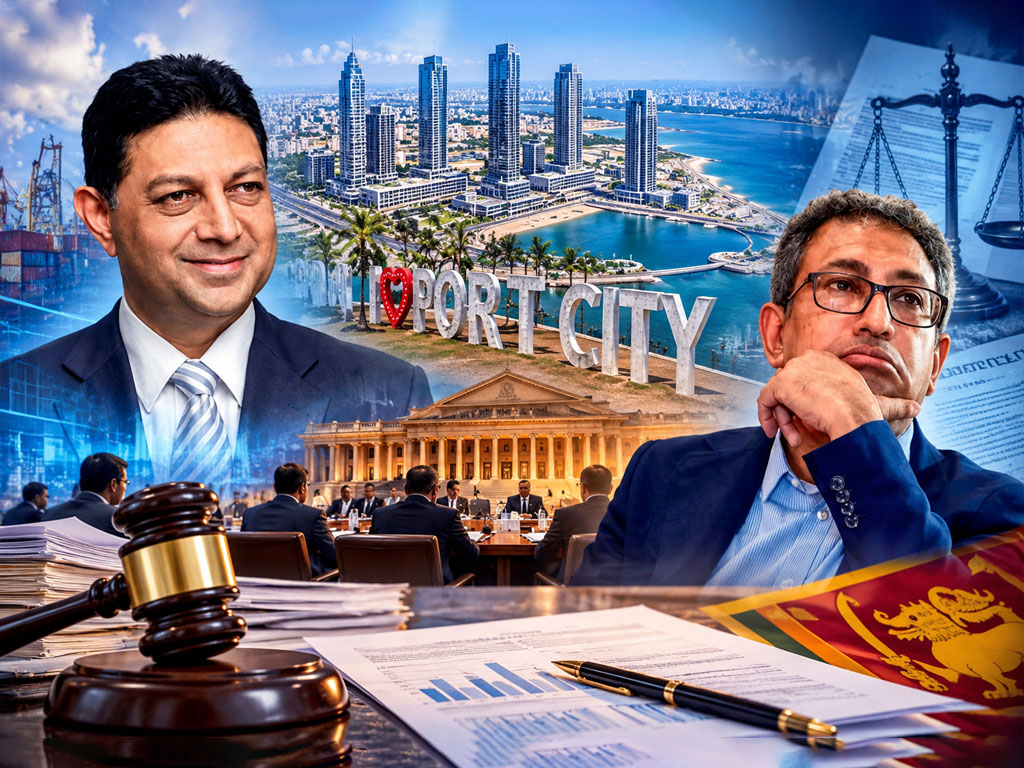
Colombo Port City legal oversight faces scrutiny as COPF prepares to question the Commission over legal governance and public finance concerns.
A Formal Response to Dr. Harsha de Silva
Recent media disclosures have triggered debate over an allegedly irregular appointment within the administrative structure of the Colombo Port City. Amid the controversy, the apparent silence of Committee on Public Finance (COPF) Chairman Dr. Harsha de Silva prompted journalistic scrutiny, including allegations that the matter might be overlooked because the COPF Chairman and the Chairman of the Port City Commission share an alma mater.
De Silva has now responded, rejecting any suggestion that COPF acted to justify an inappropriate appointment to the Commission’s legal operations.
Sources cited in the original report also state that the Port City’s senior management, including its Chairman, has been summoned to appear before COPF next week. De Silva, responding to an investigative article published by the Hari Deshaya website, said the Commission was expected before the committee in the coming weeks.

Before examining the wider implications, his statement is reproduced in full:
“As Chairman of the COPF I reject the accusation that our committee has acted in any way to justify an inappropriate appointment to the Port City Commission as its head of legal operations. While it is not within the scope of our committee to examine the staff recruitment process of the PCC, which is entirely their responsibility, it is certainly within the scope of the COPF, the examination of procedures on how various fiscal incentives are proposed and approved for investments in the jurisdiction as such incentives have a direct bearing on public finance.
“A recent matter of concern was how certain real estate companies were advertising various incentives to purchase apartments inside the Port City without first obtaining parliamentary approval for same. After the committee raised objections the PCC halted the said companies from advertising until approval was granted. Another matter, perhaps two years ago, was the committee’s refusal to accept a gazette issued by the PCC declaring a list of items that could be purchased duty free, once again without parliamentary approval. A long debate that ensued with regard to the powers of the PCC finally resulted in the said gazette being rescinded and the exit of its then head of legal operations. There have been other instances where the COPF had made observations that led to amending regulations.
“All the above were matters related to public finance. Therefore, while the COPF has no control on who should head legal affairs at the PCC, our committee expects persons with requisite knowledge and experience are placed at responsible positions so that matters related to public finance are handled appropriately.
“In any case the PCC is expected to be present at our committee’s hearings in the next couple of weeks and our members will have the opportunity to clarify any concerns regarding this matter during the session. I thank you on behalf of the COPF.”
– Harsha de Silva, Chairman, COPF.
Why COPF’s Public Finance Role Matters
De Silva’s distinction between the Commission’s internal recruitment decisions and COPF’s public finance responsibilities is important. Parliament’s published mandate for COPF includes examining revenue collection under Article 148 of the Constitution, payments from the Consolidated Fund, the utilisation and application of public funds, public debt and other fiscal matters.
Article 148 places public finance under Parliament’s control. That constitutional framework makes the financial consequences of decisions at Port City a legitimate area for parliamentary scrutiny, even where COPF itself does not appoint Commission staff.
COPF has previously intervened over Port City regulations with financial implications. In January 2024, Parliament reported that the Attorney General had advised that the Commission lacked authority to formulate the duty-free rules then under consideration. Port City officials acknowledged the error and undertook to revoke them.
That history gives weight to the argument that legal capacity within the Commission is relevant when decisions involve fiscal incentives, duty-free privileges and other matters affecting state revenue.
It does not, however, establish that the current appointment is unlawful or that COPF has authority to select or remove the Commission’s legal personnel. Those are separate questions.
Legal and Commercial Roles Under Scrutiny
The present criticism centres on a claim that the Commission is operating without a full-time Legal Director and that the Director of Commercial Operations has assumed responsibilities associated with the legal function.
If that description is accurate, it raises a governance question about whether commercial decision-making and independent legal scrutiny are sufficiently separated.
Commercial operations naturally focus on investment, transactions and economic activity. A legal function, by contrast, is expected to scrutinise compliance and legal risk. Combining those responsibilities may therefore warrant examination where decisions can affect tax concessions, regulatory approvals or other matters involving public finance.
The original commentary characterises this arrangement as a conflict of interest and argues that weakened institutional checks could expose public finances to unnecessary risk. That remains the author’s assessment rather than an established finding of wrongdoing.
Port City Reforms and IMF Commitments
The regulatory environment has also changed significantly this year.
The Colombo Port City Economic Commission (Amendment) Act, No. 1 of 2026, certified on January 20, amended the legal framework governing the Special Economic Zone. Among other changes, it tightened aspects of the incentive regime, altered provisions concerning employment and offshore banking, and strengthened regulatory links with the Central Bank.
These reforms intersect with Sri Lanka’s commitments under its International Monetary Fund programme. The IMF’s 2026 review states that amendments to the Port City framework were designed to introduce transparent, rules-based eligibility criteria for tax incentives, limit their types and duration, and improve monitoring and transparency.
That context makes legal and regulatory competence within the Commission particularly important. It does not establish that any individual currently exercising legal responsibilities lacks the qualifications required for the position, nor does the supplied material provide sufficient evidence to make such a finding.
Questions COPF Can Clarify
When Port City officials appear before COPF, the committee has an opportunity to separate allegations from established facts.
The central questions extend beyond who was appointed. They include how legal advice is structured within the Commission, whether commercial and legal responsibilities are appropriately separated, how decisions involving fiscal incentives are reviewed, and what safeguards ensure compliance with Parliament’s authority over public finance.
De Silva is correct that COPF does not control who heads the Commission’s legal affairs. His own statement, however, also underscores why the competence and functioning of that legal operation matter to the committee: decisions involving fiscal incentives can have a direct bearing on public finance.
The forthcoming hearing therefore offers an opportunity to establish whether the present governance structure provides adequate legal scrutiny while respecting the boundary between the Commission’s administrative autonomy and Parliament’s constitutional responsibility for public finance.
That is the question COPF should resolve on the evidence.