By Roy Denish.
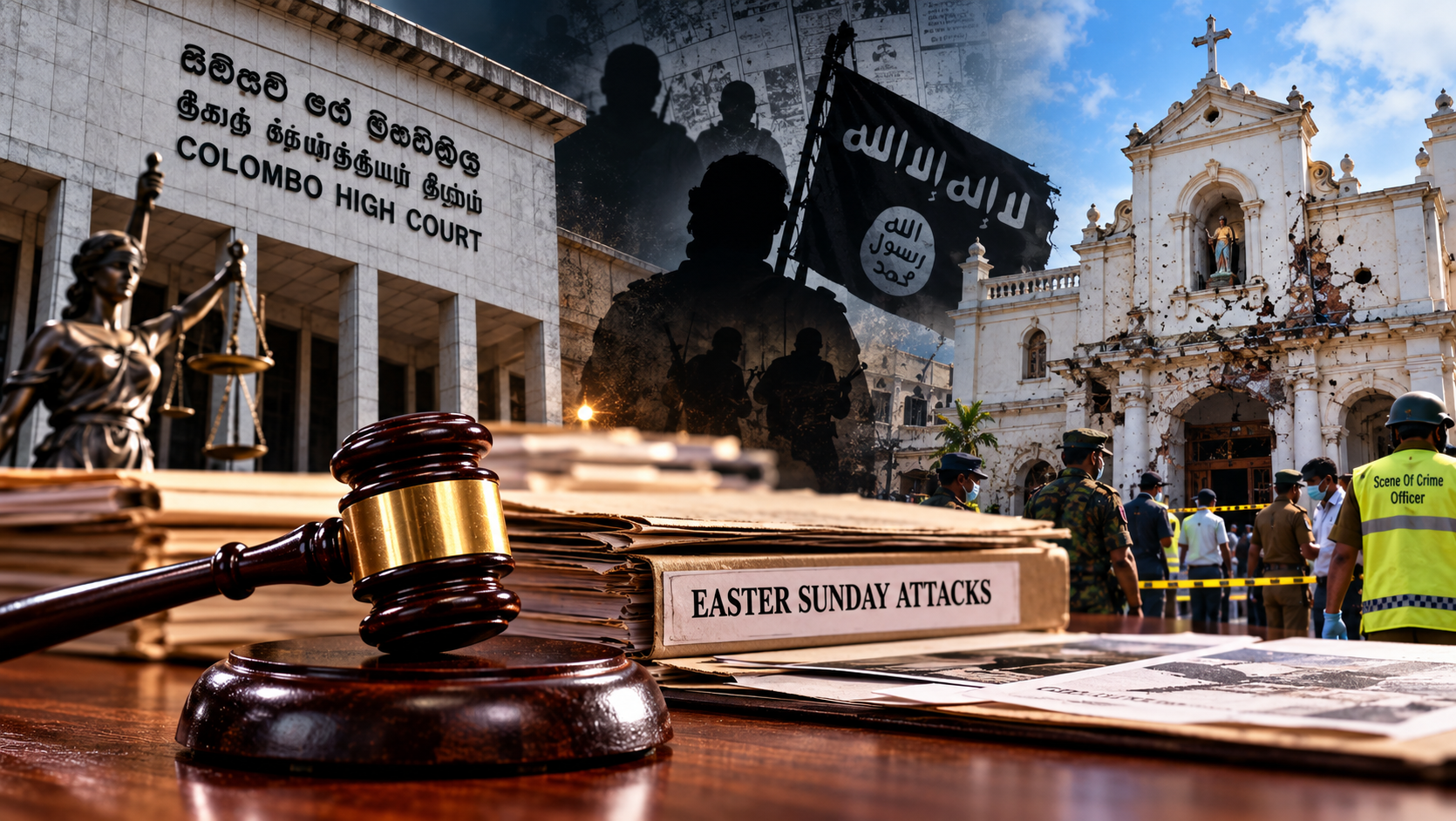
A Colombo High Court judgment details how 15 men helped build the network behind Sri Lanka’s 2019 Easter Sunday bombings.
Beneath the surface of Sri Lanka’s most devastating modern terrorist attack lay a multi-year network of radicalisation, logistical preparation, weapons training, and clandestine activity that turned ordinary homes and remote locations into staging grounds for mass murder.
When a special three-judge High Court in Colombo delivered its verdict relating to the 2019 Easter Sunday bombings, the judgment provided an extensive account of the mechanics behind the conspiracy.
Following an investigation involving 547 witnesses and more than 2,000 exhibits, the court convicted 15 men under an indictment containing more than 23,000 counts, detailing how a network of operatives contributed to preparations for the coordinated attacks.

The Architecture of Radicalisation
The conspiracy developed over several years through systematic ideological indoctrination.
In the absence of a specific legal definition of indoctrination under the Prevention of Terrorism Act, the judiciary referred to established legal and linguistic definitions in examining the deliberate implantation of extremist ideas among recruits.
Throughout 2018, covert meetings and training sessions were held at holiday bungalows, mosques, and other locations in areas including Shanthipura, Hambantota, Kandy, and Mawanella.
Under the influence of extremist figures including Zahran Hashim and Mohammed Ibrahim Mohammed Naufer, participants were exposed to Islamic State propaganda, oaths of allegiance, and teachings promoting violent jihad.
Evidence presented during the proceedings also revealed that some recruits received weapons training.
At a secluded location in Shanthipura, participants were reportedly instructed in handling T-56 assault rifles and 9 mm pistols, including how to aim, disassemble, and reassemble firearms.
Operational Rehearsals
The ideological preparation was accompanied by increasingly dangerous operational activity.
Nearly eight months before the Easter Sunday attacks, an explosion in Kattankudy severely injured Mohamed Cassim Mohamed Rilwan, Zahran’s brother, causing serious injuries to his hands and eyes.
Evidence presented in court indicated that members of the group attempted to conceal the circumstances surrounding his injuries.
Rilwan was reportedly taken to the National Hospital in Colombo under a false identity, with incorrect personal information supplied to hospital staff and his injuries attributed to an exploding gas cylinder.
At the same time, members of the network were allegedly storing explosive material at several locations.
Investigators subsequently recovered RDX, TNT, electrical circuitry, and wiring components from hidden caches.
Five days before the coordinated Easter Sunday bombings, another test explosion involving a modified motor scooter reportedly took place as the group continued refining its devices.
Explosives and Safe Houses
The conspiracy required access to large quantities of explosive material, chemicals, storage locations, and safe houses.
Government analysts examining blast sites and unexploded material reportedly identified water-gel quarry explosives combined with urea nitrate as key components used in the bombs.
Investigators alleged that operatives acquired large quantities of water-gel cartridges and detonators under false pretences, claiming the materials were intended for construction or quarrying purposes.
The network also established multiple safe houses and storage locations extending from Panadura to Daluwakotuwa.
At a villa in Panadura that had reportedly been rented months earlier by individuals linked to the attacks, forensic investigators recovered steel balls, chemical residue, and bags similar to those carried by some of the suicide bombers into hotels and churches.
Fingerprint evidence was also presented as part of the prosecution’s case linking individuals to the premises.
Verdict and Sentences
Nine additional accused were acquitted after the court found insufficient independent evidence directly linking them to the broader conspiracy.
The 15 men who were convicted received lengthy prison sentences ranging from 200 to 260 years.
Beyond the sentences, the judgment provides an extensive judicial record of how radicalisation, weapons training, explosives procurement, safe houses, false identities, and logistical networks contributed to the events that culminated in the Easter Sunday attacks of April 21, 2019.