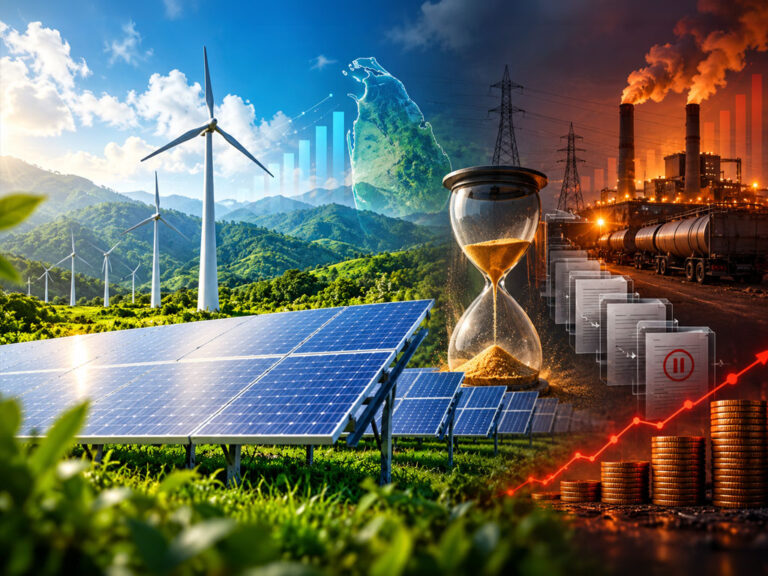
COLOMBO — Sri Lanka risks prolonging its dependence on expensive diesel-generated electricity as administrative delays, unresolved land issues and contractual uncertainty continue to obstruct renewable energy projects intended to reduce generation costs and strengthen the country’s energy security.
WindForce PLC Managing Director Manjula Perera highlighted these obstacles at the Sri Lanka Economic and Investment Summit 2026, warning that the country must urgently address the barriers preventing approved solar, wind and battery storage projects from progressing.
The warning comes as Sri Lanka seeks approximately Rs. 400 billion in renewable energy and battery storage investment over the next three years.
However, delays in implementing projects could undermine these investment ambitions, postpone the availability of lower-cost electricity and weaken investor confidence in the country’s energy sector.

Diesel Accounts for Disproportionate Electricity Costs
Figures presented by Perera illustrate the financial burden associated with Sri Lanka’s reliance on thermal power.
According to his assessment, renewable energy sources account for approximately 54% of electricity generation, while thermal power contributes the remaining 46%.
Despite supplying less than half of the country’s electricity, thermal generation accounts for more than 71% of total generation costs.
Diesel power is particularly expensive, representing approximately 14% of electricity supply but contributing around 40% of generation expenditure.
Perera placed the estimated cost of diesel-generated electricity at Rs. 94 per kilowatt-hour, highlighting the potential financial benefits of replacing part of that generation with competitively priced renewable energy.
These figures describe the generation-cost structure cited at the summit and should not be confused with the retail electricity tariff paid by consumers.
Actual savings from renewable energy depend on several factors, including contracted purchase prices, financing arrangements, grid integration, storage requirements and the cost of maintaining reliable electricity supplies.
Nevertheless, reducing dependence on expensive diesel generation could help ease pressure on electricity production costs and improve the prospects for more affordable power.
Siyambalanduwa Solar Project Faces Five-Year Timeline
One of the examples cited by Perera was WindForce’s 100-megawatt Siyambalanduwa solar project, awarded in 2022.
According to the company’s managing director, the Government took approximately 18 months to hand over the land required for development.
Commissioning is now expected by July 2027, placing approximately five years between the project’s award and its anticipated operation.
The delay is particularly significant because the project forms part of Sri Lanka’s efforts to expand utility-scale solar generation.
In March 2025, the Cabinet approved the allocation of approximately 219.7 hectares for the Siyambalanduwa solar development. The International Finance Corporation subsequently announced financing support for WindForce’s participation in the project.
The project is therefore an example of how securing investment and development agreements does not necessarily translate into the timely delivery of electricity.
Every delay in bringing additional renewable capacity into operation potentially postpones the opportunity to displace more expensive generation, although the precise financial cost of the postponement has not been established.
Mullikulam Wind Projects Await Contractual Progress
Similar concerns surround two 50 MW wind power projects at Mullikulam in the Mannar region.
The projects were awarded to WindForce and a consortium involving Vidullanka following a competitive procurement process.
Perera said the draft power purchase agreement remained with the Attorney General’s Department, while land-related issues had yet to be resolved.
Cabinet approval for the two wind developments was granted in December 2025, and WindForce subsequently received its formal Letter of Award in January 2026.
The projects illustrate the difficulty of moving from procurement decisions to construction when contractual and land-related matters remain outstanding.
For developers, prolonged uncertainty can complicate financing arrangements, equipment procurement and implementation schedules.
For the electricity sector, it can delay access to additional renewable generation capacity that could reduce exposure to costly imported fuels.
Investors Confront More Than 17 Approval Requirements
Perera identified three major obstacles affecting renewable energy investment in Sri Lanka:
- Power purchase agreements that are insufficiently bankable for major investors and lenders.
- Rupee-denominated tariffs that create additional financial considerations for large projects relying on international investment.
- Administrative procedures requiring more than 17 separate approvals before projects can proceed.
These requirements can influence whether international developers and financiers consider Sri Lankan projects commercially attractive.
Foreign investors must assess contractual security, currency exposure, regulatory predictability and implementation risks before committing substantial capital.
Where approvals take an extended period or contractual terms remain uncertain, financing costs may rise and investment decisions may be postponed.
The shift towards competitive tendering also requires careful management.
Although auctions can encourage lower electricity purchase prices, the lowest headline tariff does not necessarily guarantee the best overall outcome.
Project readiness, access to land, financing conditions, grid connection arrangements and realistic construction deadlines are equally important in determining whether an awarded project can deliver electricity on schedule.
Battery Storage Could Reduce Dependence on Thermal Power
Battery energy storage is another major component of Sri Lanka’s proposed electricity transition.
Perera referred to Government tenders covering three tranches of storage capacity:
- 160 MW, with the first tranche approaching commissioning.
- 250 MW, expected to follow the initial projects.
- 150 MW, for which awards were expected shortly.
Battery storage can help the electricity system accommodate greater quantities of solar and wind power, whose output varies according to weather conditions and time of day.
Storage facilities can absorb electricity when renewable production is high and release it when generation declines or demand increases.
Advanced battery systems may also provide services needed to maintain grid stability, potentially reducing the requirement to operate expensive thermal plants solely for reserve capacity and system support.
Their economic contribution will depend on suitable technical specifications, operational arrangements and financing terms.
While storage cannot eliminate every requirement for conventional generation, it can play an important role in making greater renewable energy penetration practical and reliable.
Electricity Sector Reform Must Deliver Results
Beyond individual projects, Perera questioned whether the restructuring of the Ceylon Electricity Board would achieve its intended objectives without sufficient institutional capacity.
Dividing the electricity utility into separate entities will not automatically improve efficiency if the resulting organisations lack experienced personnel, technical expertise and commercial management capabilities.
Effective reform requires clear responsibilities, adequate staffing, competent procurement processes and timely decision-making.
Sri Lanka’s electricity transition therefore depends not only on the availability of renewable technology or private investment but also on institutions capable of delivering major infrastructure projects.
The economic implications extend to households and businesses, which remain sensitive to electricity prices and the wider costs associated with imported energy.
The Government’s renewable energy targets will have limited practical value unless approved projects can proceed through contracting, land allocation, construction and grid connection without unnecessary delay.
With substantial private investment under consideration and expensive diesel generation continuing to influence electricity costs, Sri Lanka faces a critical test of its ability to convert renewable energy commitments into functioning power infrastructure.
The unresolved question is how quickly the authorities can remove the obstacles delaying approved projects and translate the country’s renewable energy potential into measurable reductions in generation costs.