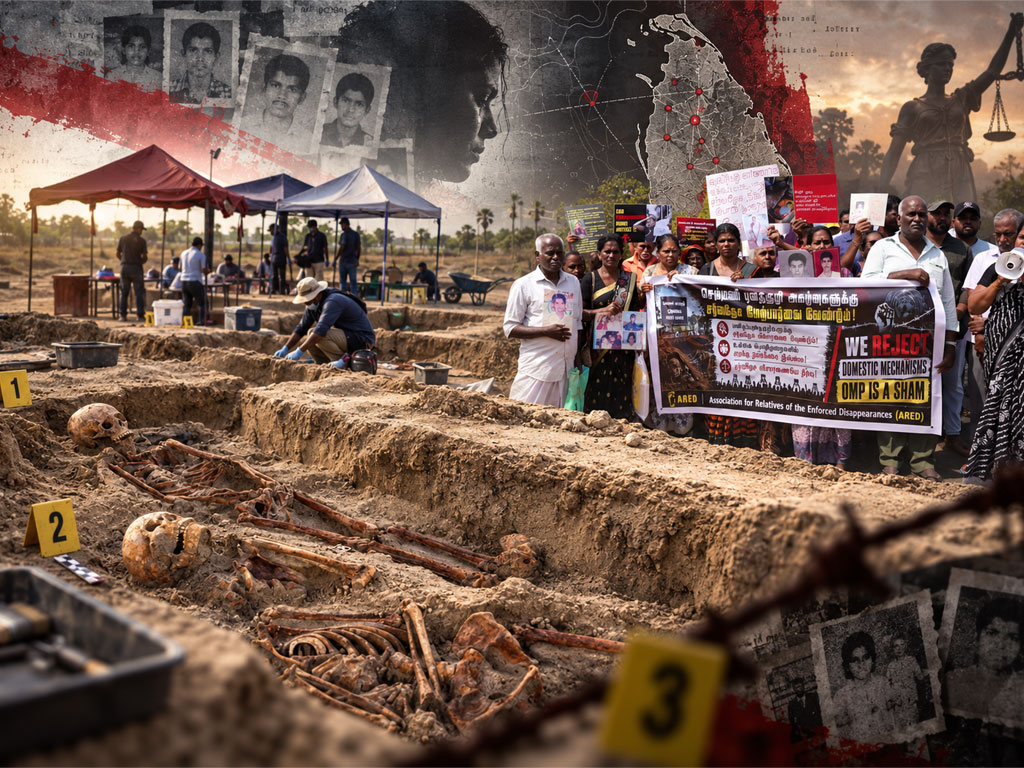
COLOMBO — Professor Raj Somadeva’s archaeological findings have introduced alternative explanations for remains recovered at Chemmani, but scientific dating and forensic examinations are still needed to establish when and how the victims died.
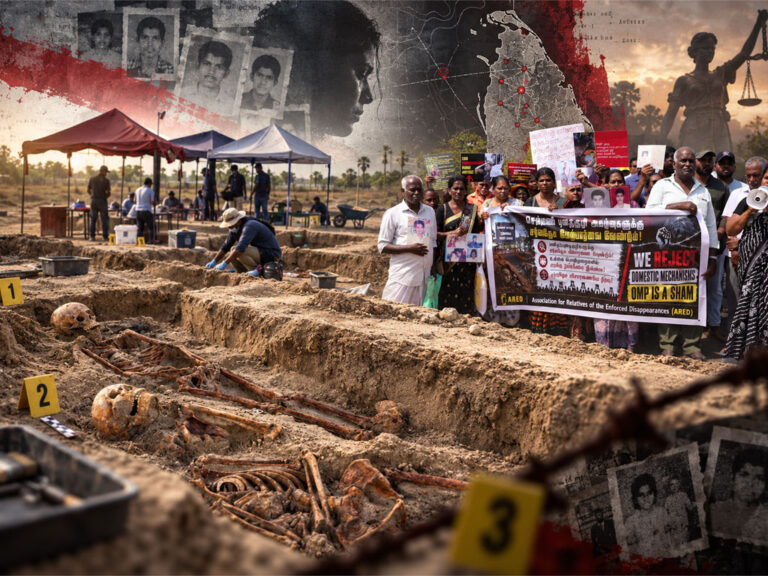
A new archaeological report on the Chemmani mass grave in Jaffna has reopened debate over one of Sri Lanka’s most sensitive unresolved human rights investigations, suggesting that some burial patterns could be consistent with deaths caused by an epidemic or natural disaster while stopping short of determining how the individuals died.
The report, submitted to the Jaffna Magistrate’s Court on October 19, 2026, was prepared by Professor Raj Somadeva and archaeologist Anusha Wanninayake following extensive excavations conducted during 2025 and 2026.
Their findings have attracted political attention because Chemmani has long been associated with allegations of enforced disappearances, extrajudicial killings and the concealment of bodies during Sri Lanka’s civil conflict.
Some commentators have interpreted the report as a challenge to established narratives concerning the site. Others warn that presenting an archaeological hypothesis as evidence disproving criminal wrongdoing would be premature.
Crucially, the report does not establish when the individuals died, what caused their deaths or who was responsible for their burial.
Those questions remain central to the judicial investigation.

Archaeological Evidence Raises Alternative Possibilities
The report examines the arrangement of human remains, burial patterns and associated artefacts recovered during the excavations.
Investigators have recovered 583 sets of human remains, making Chemmani one of the most extensive mass-grave investigations undertaken in Sri Lanka.
Preliminary observations indicate that a substantial proportion of the remains belong to children and infants.
According to the report’s age classifications, approximately 41% were categorised as children and 22% as infants. Adults accounted for about 30%, with another 5% classified as sub-adults.
These are preliminary assessments rather than definitive demographic findings.
Somadeva’s archaeological interpretation also identifies features that may resemble formal burial practices.
The distribution of remains, the limited presence of certain funerary objects and the characteristics of some burial arrangements have prompted consideration of whether the site could have been used during an epidemic or another event involving numerous deaths.
Such possibilities warrant investigation.
However, neither an epidemic nor a natural disaster has been established as the cause of death.
No scientific dating results or completed analyses of disease and skeletal trauma have been presented that conclusively support either explanation.
The report’s observations therefore widen the range of questions facing investigators rather than resolving them.
Political Interpretations Run Ahead of Scientific Findings
Chemmani has occupied an important place in international discussions about Sri Lanka’s unresolved wartime allegations.
Human rights organisations, Tamil diaspora groups and families of disappeared persons have repeatedly called for independent forensic investigations to establish whether individuals buried at the site were victims of unlawful killings.
The latest report has prompted a different interpretation among some nationalist commentators, who argue that the archaeological findings weaken claims that all the remains necessarily relate to wartime atrocities.
That argument contains an important distinction.
If some remains eventually prove to belong to individuals who died from disease or natural causes, it would challenge attempts to attribute every burial automatically to a single criminal episode.
It would not establish that no unlawful killings occurred at Chemmani.
Nor would it invalidate allegations relating to other burial locations or different historical periods.
The scientific question concerns the identity, age, circumstances and causes of death of the people whose remains have been recovered.
The political question concerns how different groups interpret those findings.
Confusing the two risks turning an incomplete forensic investigation into another contest over competing historical narratives.
Human Tragedies and the Politics of NGO Funding
The controversy has also revived criticism of the political and financial influence of non-governmental organisations involved in human rights advocacy.
The original commentary argues that allegations surrounding Chemmani have become a source of political leverage and international fundraising for organisations operating within Sri Lanka and abroad.
It suggests that unresolved human tragedies can generate funding, publicity and influence, creating incentives for competing groups to promote particular interpretations of events.
The financing and accountability of organisations conducting advocacy on mass graves are legitimate subjects for scrutiny.
Where public allegations are used to secure grants or shape international policy, transparency over funding sources, project expenditure, research methods and evidentiary standards is appropriate.
Nevertheless, the archaeological report does not establish that any organisation fabricated evidence, deliberately misled donors or knowingly promoted false claims.
Such accusations would require examination of specific organisations, financial records and documented conduct.
Nor does the existence of international funding demonstrate that investigations into disappearances or unlawful killings are unjustified.
The families seeking answers have interests independent of the organisations representing them.
Accountability must apply equally to government institutions, advocacy organisations and political actors seeking to influence the interpretation of scientific evidence.
Earlier Chemmani Allegations Cannot Be Disregarded
The latest findings must be considered alongside the historical allegations that first brought Chemmani to international attention.
In 1998, during proceedings concerning the rape and murder of schoolgirl Krishanthi Kumaraswamy and the killing of members of her family and another civilian in 1996, Lance Corporal Somaratne Rajapaksa made allegations concerning bodies buried in the Chemmani area.
Rajapaksa, who was convicted in the case, claimed knowledge of burial locations containing hundreds of bodies.
Accounts of his allegations have referred to approximately 300 to 400 individuals.
Those statements contributed to subsequent investigations and demands for exhumations.
The historical record also contains reports of remains discovered in circumstances considered suspicious, including accounts involving restraints and other material inconsistent with ordinary burial practices.
Such claims require evaluation against the original forensic documentation and the precise locations from which remains were recovered.
They should not automatically be attributed to every burial investigated during the latest excavations.
Equally, they cannot simply be dismissed because some newly examined burials may display characteristics associated with formal funerary practices.
On October 19, the Jaffna Magistrate’s Court granted investigators permission to question Rajapaksa in connection with the current investigation.
His earlier allegations therefore remain relevant to the judicial inquiry.
Could Different Historical Periods Overlap at Chemmani?
One possibility deserving examination is that different burial episodes occurred within the wider Chemmani area over an extended period.
A location used for legitimate burials during one historical period could conceivably have been used later for unlawful disposal of bodies.
Alternatively, several burial patterns might reflect changing funeral customs, episodes of disease, displacement or other circumstances.
These remain hypotheses.
Establishing whether different periods are represented requires reliable scientific dating, careful examination of burial layers and forensic analysis of individual remains.
Archaeologists must also determine whether recovered objects are directly associated with particular skeletons or belong to surrounding deposits from different periods.
A burial site’s physical proximity to a known historical location does not necessarily establish that all remains originated from the same event.
Likewise, the existence of a cemetery does not exclude the possibility of criminal burials nearby or within the same broader area.
The conclusions must follow the physical evidence rather than political assumptions.
Carbon Dating Could Clarify the Timeline
Scientific dating is among the most important outstanding steps in the investigation.
Radiocarbon analysis can help establish the approximate period from which human remains originate.
For relatively recent remains, specialised techniques, including bomb-pulse carbon dating, may offer greater precision than conventional methods.
Sri Lanka’s Human Rights Commission has previously recommended credible and independent scientific dating, recognising limitations in the facilities available domestically.
The Criminal Investigation Department has sought permission to send samples abroad for further analysis.
However, dating alone will not establish whether a person died from illness, injury or unlawful violence.
Such determinations may require additional examinations, including forensic anthropology, skeletal trauma analysis, pathological testing and, where feasible, DNA identification.
The reliability of the investigation will also depend on maintaining appropriate evidence records and documenting the locations and conditions in which remains were recovered.
Only a combination of findings can provide a credible account of the burial site’s history.
Science Must Establish the Facts Before Politics Claims Victory
The Chemmani investigation cannot responsibly be reduced to either a confirmed account of mass murder involving every recovered individual or a historical cemetery conclusively unrelated to wartime atrocities.
Both conclusions exceed the currently established evidence.
Professor Somadeva’s report presents archaeological observations and possible explanations that deserve proper scientific assessment.
The allegations arising from the Krishanthi Kumaraswamy case, including Rajapaksa’s account of burial locations, also remain part of the historical record and judicial investigation.
Political parties, diaspora organisations, human rights advocates and government representatives may draw different implications from the emerging evidence.
Their interpretations cannot substitute for forensic findings.
For the families of disappeared persons, the central concern remains the identification of the dead and the circumstances in which they lost their lives.
For investigators, the immediate priorities are reliable dating, examination of possible injuries or disease, assessment of burial practices and continued judicial oversight.
The Chemmani report has introduced questions that may eventually alter understanding of the site.
Whether it confirms natural deaths, unlawful killings or burials from different historical periods can only be determined through further evidence.
Until those investigations are completed, Chemmani remains an unresolved scientific and judicial inquiry, not a political verdict available for either side to claim.