
Documents cited in a report on the 63rd Asia-Pacific Broadcasting Union General Assembly indicate that public tourism promotion funds were earmarked for a Rs. 104.6 million sponsorship, prompting questions about budget priorities, procurement procedures and measurable benefits to Sri Lanka.
A Cabinet-approved proposal to allocate Rs. 104.6 million from the Sri Lanka Tourism Promotion Bureau (SLTPB) to MTV Channel (Pvt) Ltd, associated with the Sirasa media network, has raised questions about the use of public funds for an international broadcasting conference held in Colombo.
The allocation relates to the 63rd General Assembly of the Asia-Pacific Broadcasting Union (ABU), together with associated meetings, a music festival and excursions for participating delegates.
The event, taking place from 30 October to 3 November 2026, is hosted by MTV Sri Lanka.
While the conference brings international broadcasters and media executives to Sri Lanka, scrutiny has focused on the source of the proposed sponsorship and whether the expenditure offers sufficient measurable value to the country’s tourism promotion programme.

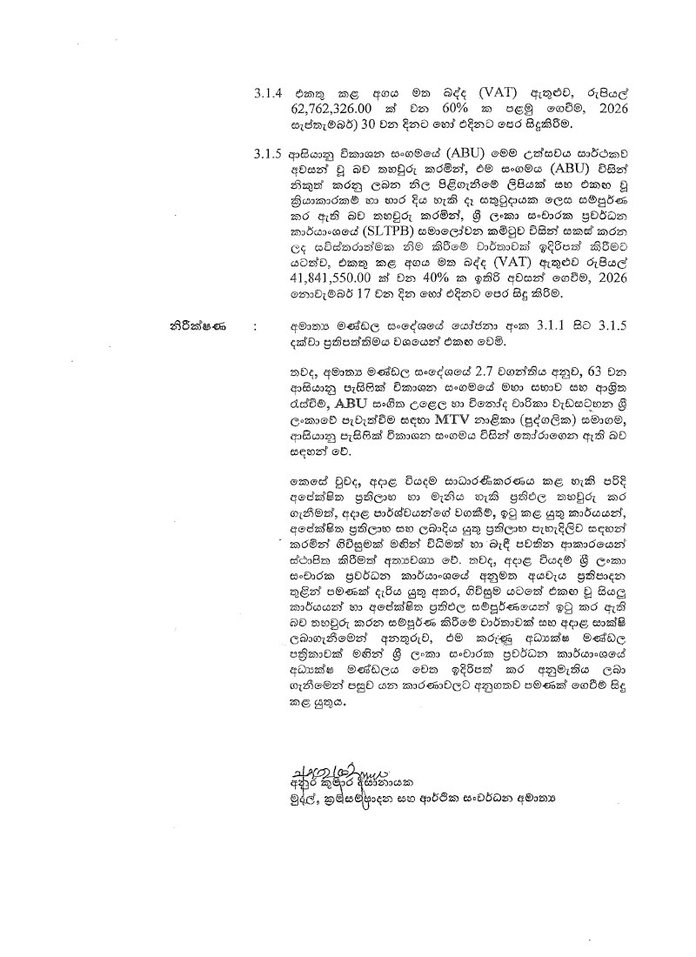
Cabinet Approval for Rs. 104.6 Million Sponsorship
According to the Cabinet and SLTPB documents described in the supplied report, the funding proposal originated in Cabinet Memorandum T/2026/14, presented on 17 September 2026 by Minister of Foreign Affairs, Foreign Employment and Tourism Vijitha Herath.
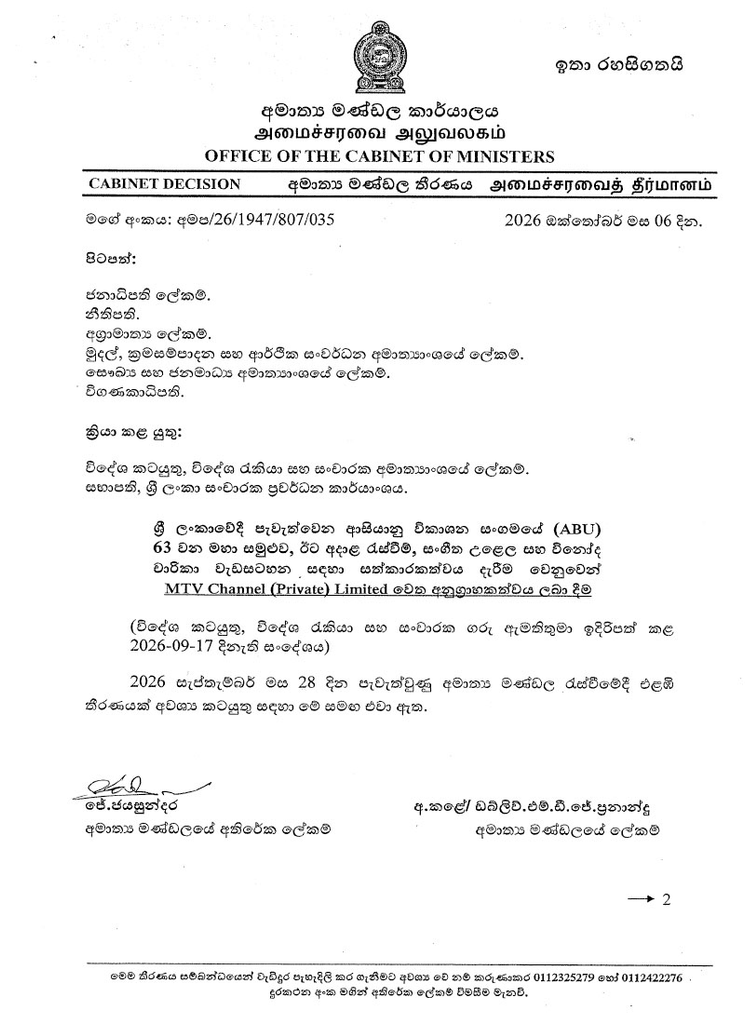
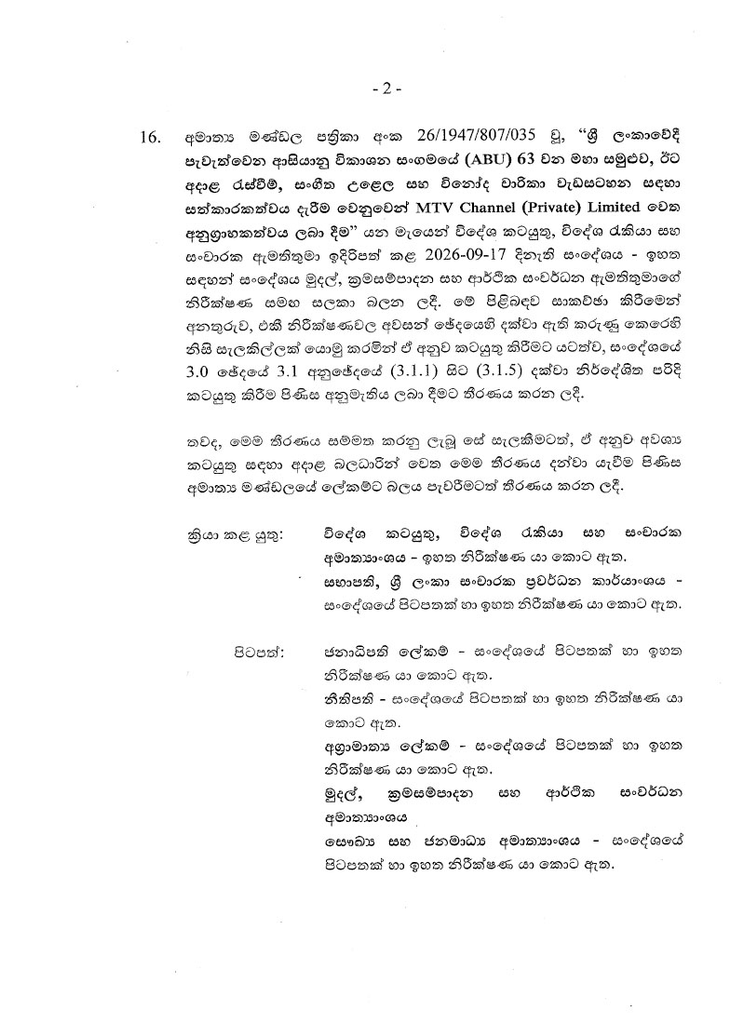
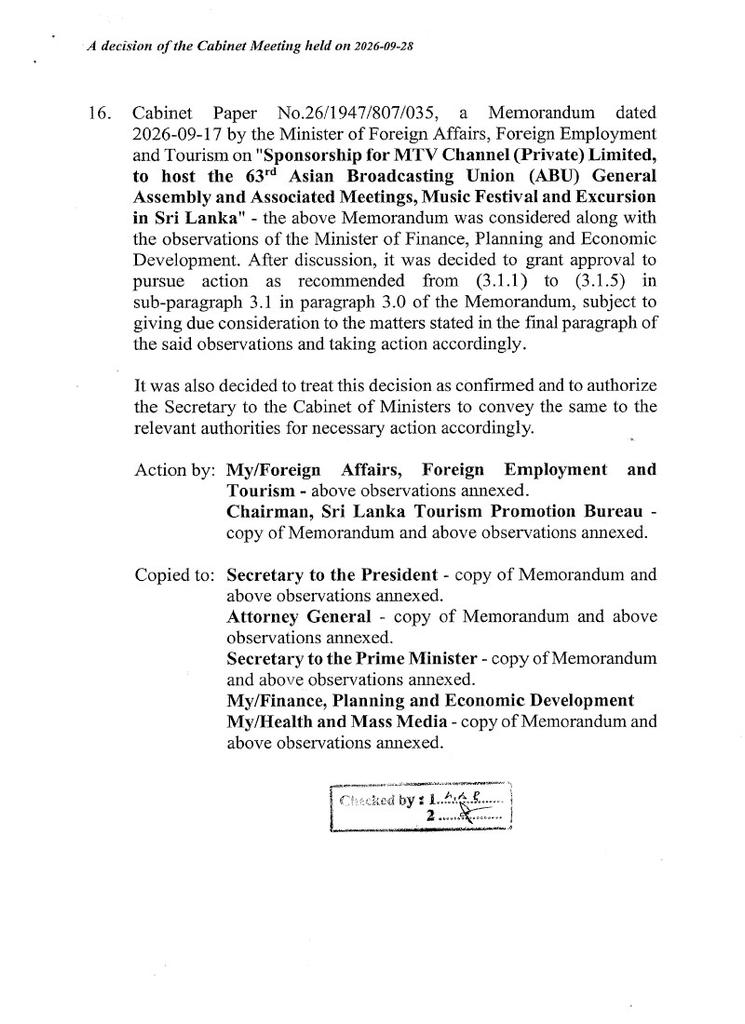
The Cabinet reportedly considered the proposal on 28 September 2026 under reference CP 26/1947/807/035.
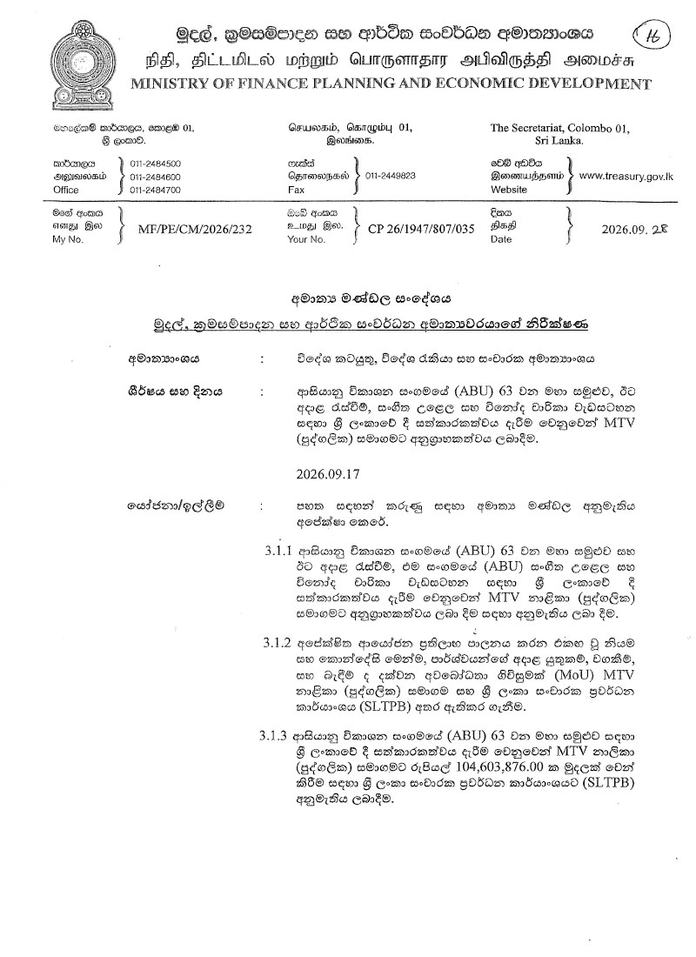
The amount proposed for sponsorship was Rs. 104,603,876, equivalent to approximately Rs. 104.6 million or Rs. 10.46 crore.
The funding was intended to support MTV Channel (Pvt) Ltd in hosting the ABU General Assembly and associated activities.
The ABU independently confirms that MTV Sri Lanka is hosting the gathering in Colombo, while public reporting identifies the participation of tourism-related government institutions.
The central question is therefore not whether the event exists or has an international audience, but whether the particular funding arrangement was appropriately authorised and justified.
Funds Proposed for Transfer from International Advertising Budget
The supplied documentation indicates that the sponsorship was to be financed through an internal transfer within the SLTPB’s 2026 budget.
The source allocation was described as:
Promotion of Destination through Channels Coinciding with International Activities through TV Advertising (International).
According to the report, Rs. 350 million had been allocated under this budget heading.
The proposal sought to transfer Rs. 104,603,876 to a local-media expenditure category described as:
Local Media FAMS/Media Gatherings.
The amount represents approximately 29.9% of the cited Rs. 350 million allocation.
This proposed transfer raises a legitimate policy question: whether money originally budgeted for international television promotion should be redirected to support a conference organised by a domestic private broadcaster.
That question cannot be resolved solely by identifying the original budget heading.
An assessment would also need to consider whether the transfer was legally authorised, whether the event qualified as a tourism promotion activity and what benefits the SLTPB was expected to receive.
Proposed Payment Schedule
The documents reproduced in the supplied account identify a two-stage payment schedule.
| Payment | Percentage | Amount |
|---|---|---|
| First instalment | 60% | Rs. 62,762,326 |
| Final instalment | 40% | Rs. 41,841,550 |
| Total | 100% | Rs. 104,603,876 |
The first instalment was scheduled for payment on or before 30 September 2026.
The final instalment was scheduled for November 2026.
However, the supplied account contains conflicting dates for the final payment, referring to both 15 November and 17 November.
The original Cabinet or SLTPB payment schedule should be consulted to resolve that discrepancy.
The document also refers to VAT in connection with the initial payment. Clarification is needed on whether applicable taxes were included in the approved total or were to be paid separately.
Importantly, an approved payment schedule is not proof that the corresponding funds have already been disbursed.
How Was the Sponsorship Budget Allocated?
The expenditure estimate described in the supplied report identifies several major components.
These include:
- Rs. 46.5 million for hotel food, beverages and conference hall charges.
- Rs. 12.6 million for a one-day excursion to Bentota and Galle.
- Rs. 24.6 million for performances and production costs.
- Applicable taxes and other expenses associated with the programme.
The three identified expenditure categories amount to Rs. 83.7 million.
The report states that the proposed budget also incorporated value-added tax and the Social Security Contribution Levy.
Those costs warrant examination, particularly because the funding comes from resources intended to support Sri Lanka’s tourism promotion activities.
However, their inclusion does not automatically establish financial misconduct.
The relevant questions are whether the amounts were reasonably estimated, properly approved, procured through the applicable procedures and supported by identifiable services or promotional benefits.
Procurement Procedures Come Under Scrutiny
The supplied report raises concerns about a section of the relevant documentation dealing with procurement decisions.
It states that the entry concerning procurement decisions already obtained, or yet to be obtained, was marked “N/A”.
That notation raises questions about the basis on which the sponsorship was approved.
Nevertheless, it would be premature to conclude that the expenditure violated Sri Lanka’s procurement rules solely because a particular form contains that entry.
The legal position may depend on the nature of the transaction, the relevant financial regulations, the powers delegated to the SLTPB and any applicable exceptions or approval procedures.
A sponsorship arrangement may also differ legally from a conventional contract for goods or services.
A proper assessment would require the complete approval file, applicable procurement requirements and any supporting legal or financial advice.
President’s Observations Highlight Need to Measure Benefits
The supplied account refers to observations made on 28 September 2026 by President Anura Kumara Dissanayake in his capacity as Minister of Finance, Planning and Economic Development.
According to the report, the President expressed policy agreement with the proposal, subject to conditions.
These included entering into a memorandum of understanding (MoU) to identify and measure the expected benefits of the expenditure.
The observations also reportedly required the funding to be met within provisions approved by the relevant expenditure authorities.
If accurately reproduced, these conditions are significant.
They indicate that the justification for the sponsorship was expected to extend beyond simply facilitating the event.
The SLTPB would need to demonstrate how the expenditure contributes to its tourism promotion objectives and what measurable outcomes it expects to achieve.
Whether the MoU was executed, what obligations it imposed and how its performance indicators were defined are matters that warrant clarification.
An International Event with Potential Tourism Benefits
The broadcasting conference is not solely a domestic media gathering.
According to the ABU, its 63rd General Assembly brings together broadcasters, industry leaders and media organisations from across the Asia-Pacific region and beyond.
The five-day event is being held at Cinnamon Life in Colombo.
Its programme includes professional discussions, associated meetings and opportunities for international networking.
Delegates are also participating in cultural and tourism-related activities, including visits to Bentota and Galle.
Such exposure may offer Sri Lanka opportunities to promote the destination to international media organisations and their audiences.
However, the existence of potential promotional benefits does not automatically establish that a particular sponsorship amount represents value for money.
A credible assessment should identify the international coverage secured, promotional activities delivered, audiences reached and other benefits obtained in return for the public expenditure.
Officials Named in the Funding Proposal
The documents described in the supplied account identify several SLTPB officials associated with preparing and processing the proposal.
They are listed as:
- Sureshni Ellepola Pilapitiya — Assistant Director, Public Relations
- Tharendri Ranaweera — Assistant Director, Brand Communications
- Anjula Prematilaka — Director of Finance
- D.M.S.A. Niroshana — Managing Director
- Buddhika Hewawasam — Chairman
Their inclusion in the administrative documentation should not be interpreted as evidence that any individual acted unlawfully.
Responsibility for the proposal and compliance with applicable procedures can be established only through examination of the relevant official records.
Public Value Remains the Central Question
Sri Lanka’s tourism sector depends on effective international promotion to attract visitors, strengthen destination awareness and generate foreign exchange.
Public investment in conferences and international media partnerships can potentially contribute to those objectives.
However, substantial public sponsorships should be accompanied by transparent explanations of their purpose, approval process and expected results.
In the present case, several questions require clear answers:
- What specific tourism promotion benefits did the SLTPB agree to receive?
- Was the transfer from the international advertising allocation authorised under the applicable financial rules?
- What procurement or sponsorship approval procedures were followed?
- Was the required memorandum of understanding completed before payments were made?
- How much of the approved Rs. 104.6 million has actually been disbursed?
- What evidence will be used to assess the sponsorship’s value for money?
The answers would help establish whether the allocation represented a justified investment in international destination promotion or an inappropriate use of funds earmarked for other purposes.
The available information establishes grounds for public scrutiny, but not a proven violation of procurement law.
The appropriate standard is straightforward: where public funds are used, the responsible authorities should be able to explain how the expenditure was authorised, what the public received and whether the outcome justified the cost.