By Roy Denish
The Chemmani mass grave investigation faces scrutiny after an interim report fails to establish the causes of death of hundreds of recovered remains.
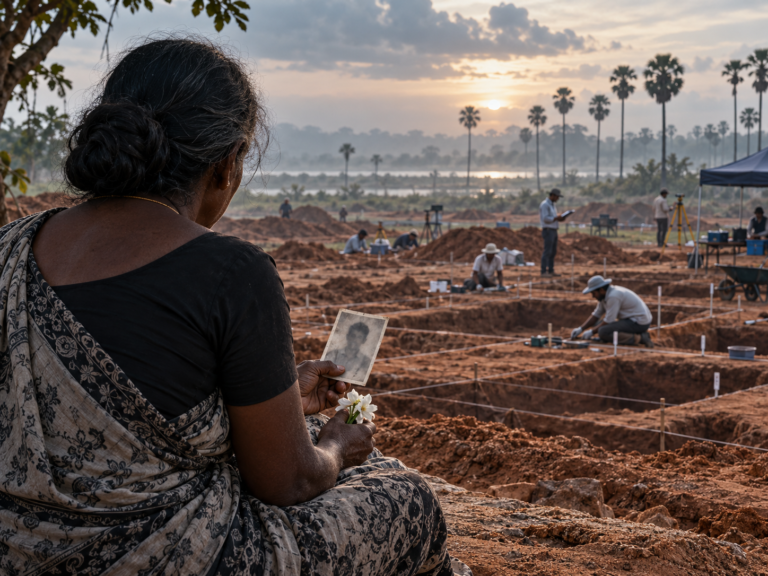
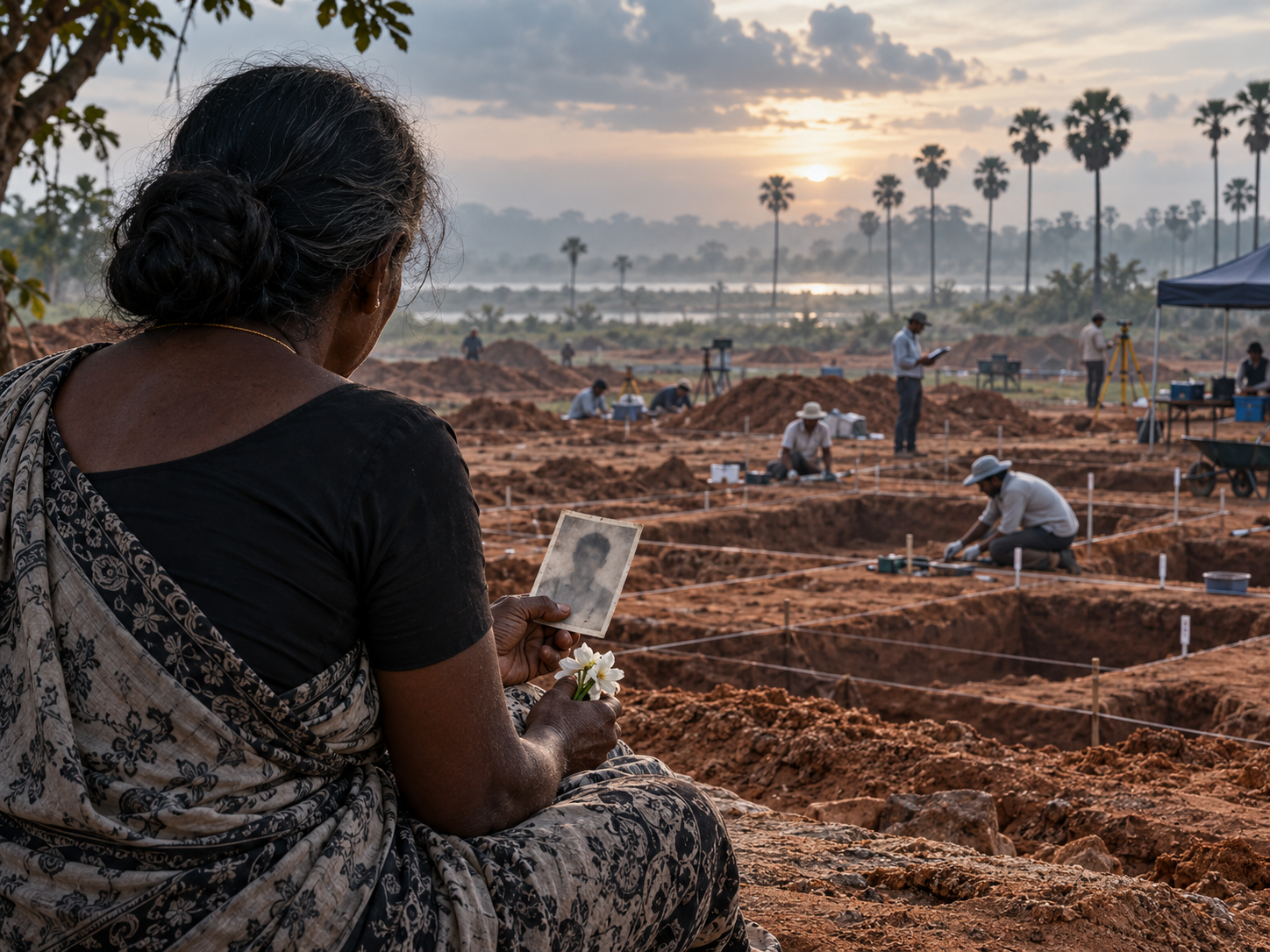
For decades, the mothers, sisters and children of Sri Lanka’s North and East have marched beneath a merciless sun, holding fading photographs of their forcibly disappeared loved ones.
They have pleaded not for charity, but for truth.
They were told that the earth would eventually speak; that science would penetrate the walls of institutional denial and reveal what happened to those who vanished.

Instead, after approximately sixteen months of excavation at Chemmani, where hundreds of human remains have been recovered, the families are confronted with a preliminary archaeological report that raises more questions than it answers.
The latest interim findings document 574 individuals, with preliminary assessments identifying approximately 41 per cent as children and a further 22 per cent as infants.
Yet the report does not establish how these individuals died.
For families who have waited decades for answers, that omission is profoundly troubling.
Six Hundred Human Remains — Yet No Established Cause of Death
The central question is unavoidable: how can investigators recover hundreds of human remains, including those of infants and children, without establishing the circumstances surrounding their deaths?
Reports concerning the excavations have described the recovery of children’s belongings, including school-related items, alongside human skeletal remains.
Other accounts have raised concerns about burial positions, possible restraints and skeletal injuries requiring specialist forensic assessment.
Nevertheless, the preliminary archaeological findings have not provided a comprehensive analysis of trauma, the manner of death or the chronology of the burials.
Those omissions deserve serious scrutiny.
Archaeology can establish burial patterns, identify associated objects and document the physical arrangement of human remains. However, determining whether injuries occurred before, during or after death requires specialist forensic examination.
The absence of a conclusion does not, by itself, establish deliberate concealment. Equally, it cannot reasonably be presented as evidence that no crime occurred.
Until the necessary examinations are completed, fundamental questions remain unanswered.
An Investigation That Raises More Questions Than Answers
The preliminary report has attracted criticism for suggesting that some burial patterns could be consistent with conventional burial practices or circumstances involving disease or natural disaster.
However, no specific historical epidemic or natural disaster has been conclusively established as an explanation for the site.
Such possibilities require scientific evidence.
Were the individuals buried during the same historical period?
Do the remains exhibit evidence of violence?
Were any injuries inflicted before death?
Can DNA analysis assist in identifying the victims?
Do the recovered objects and burial positions support or contradict particular explanations?
These are not peripheral questions. They are central to determining what happened at Chemmani.
A Painfully Familiar Pattern
For Tamil families searching for their disappeared relatives, the controversy surrounding Chemmani recalls longstanding concerns about the handling of other suspected mass graves in Sri Lanka.
Investigations at Mannar and Kokkuthoduvai have generated disputes over forensic interpretation, investigative progress and the adequacy of accountability mechanisms.
At Mannar, radiocarbon-dating results became a subject of intense debate about the historical origins of the remains.
At Kokkuthoduvai, the discovery of skeletal remains and items associated with the Liberation Tigers of Tamil Eelam raised additional questions about the identities of those buried and the circumstances of their deaths.
These cases are not identical. Each requires an investigation grounded in its own evidence.
What connects them is the persistent anxiety of families who fear that investigations may conclude without identifying victims, establishing responsibility or delivering meaningful answers.
Scientific Uncertainty Must Not Become Institutional Complacency
The Chemmani findings should not be used to establish guilt before the evidence has been examined.
But neither should scientific uncertainty become an excuse for institutional inaction.
If the authorities cannot yet determine the cause or manner of death, that should strengthen the case for further forensic investigation.
It should not become the final word.
The discovery of such a large concentration of human remains, particularly those of children and infants, warrants exhaustive examination regardless of the historical explanation ultimately established.
Specialists in forensic anthropology, pathology, archaeology, genetics and human-rights investigations should be involved in an independent, transparent process.
Families must also be given meaningful access to information about the investigation and its progress.
The Case for Independent International Forensic Expertise
The credibility of any investigation depends not only on its technical findings but also on public confidence in the independence of the process.
In a country where enforced disappearances and allegations of wartime abuses remain deeply contested, that confidence cannot be assumed.
International forensic participation, transparent scientific testing and credible judicial oversight would help ensure that competing explanations are examined objectively.
Such measures would serve victims’ families, protect the integrity of the investigation and strengthen the credibility of any eventual conclusions.
Chemmani must not become another case in which the discovery of human remains produces years of controversy without definitive answers.
The truth should emerge through evidence, not political convenience.
For the families who continue to wait, the obligation is simple: establish who the dead were, determine when and how they died, and investigate whether crimes were committed.
The dead deserve identification. The families deserve answers. And justice demands an investigation capable of delivering both.
Sources
- The Morning — Chemmani Excavations: 574 Individuals, 41% Children
- Tamil Guardian — Chemmani Archaeologist’s Report Contradicted by Its Own Evidence
- Jaffna Monitor — First Expert Report on Chemmani Mass Grave
- Human Rights Commission of Sri Lanka — Chemmani Fact-Finding Report (PDF)
- Tamil Guardian — Six Hundred Bodies, No Cause of Death