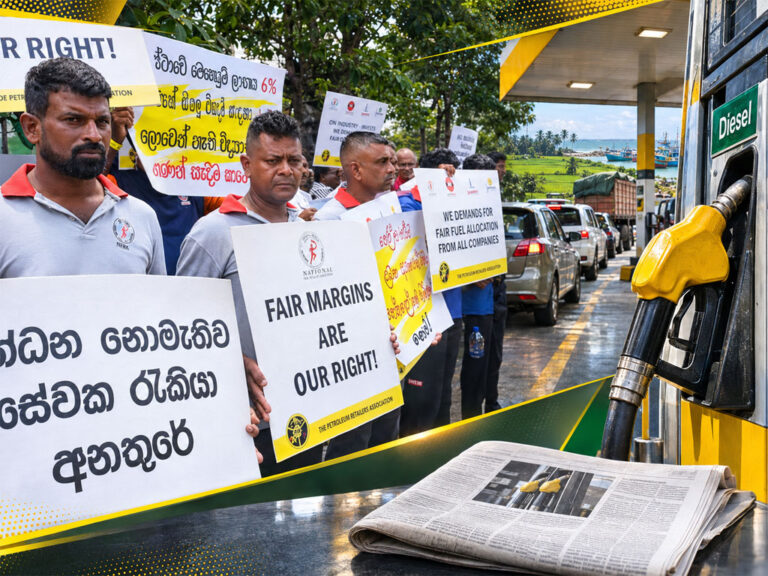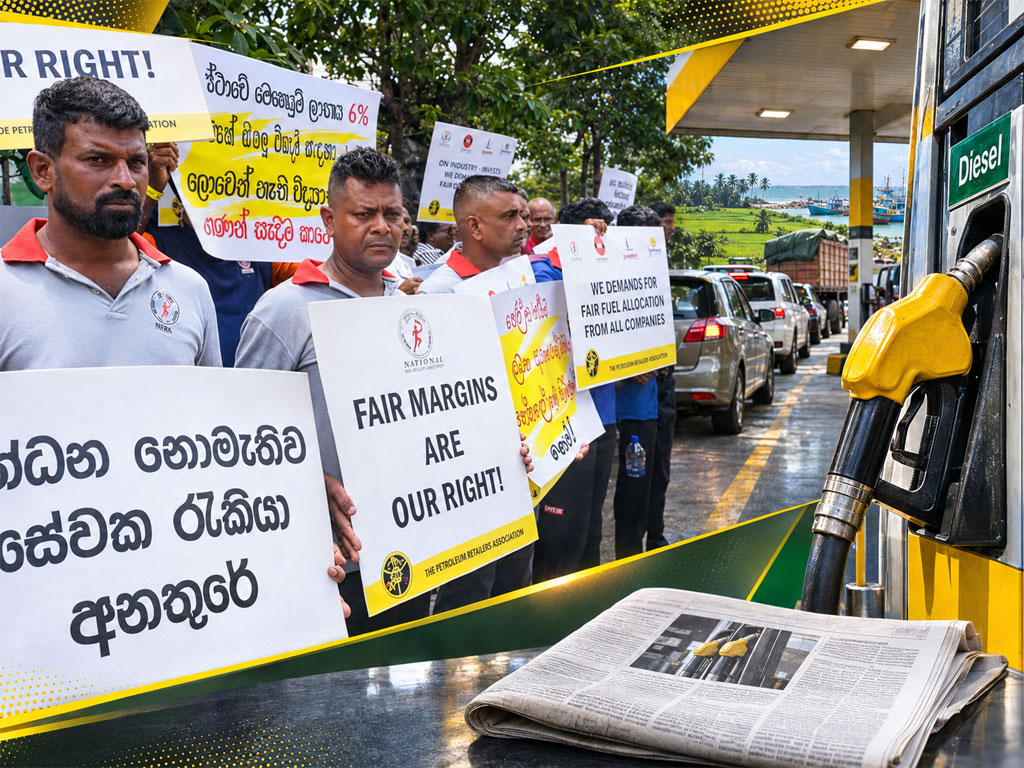
COLOMBO — A silent protest outside Colombo’s World Trade Centre on November 10 has brought Sri Lanka’s troubled fuel distribution system into renewed focus, exposing a dispute over dealer commissions, restricted supplies and the financial pressures facing private petroleum operators.
Members of the Petroleum Distributors’ Association, representing filling stations affiliated with Lanka IOC, Sinopec and RM Parks, protested against the reported reduction of their commission from 3.6% to 1.5%. They also demanded uninterrupted fuel deliveries and independent oversight of the pricing formula.
Their grievances deserve examination. Yet the controversy extends beyond the profitability of filling stations.
When fuel supplies are restricted, the consequences are felt by farmers, fishermen, transport operators and ordinary consumers who depend on reliable access to petrol and diesel.
The central question is whether Sri Lanka’s regulatory arrangements adequately protect the public when disagreements between fuel companies, dealers and the government threaten essential supplies.

Fuel Restrictions and the Risk of Artificial Scarcity
The dispute has unfolded against a backdrop of reduced diesel distribution by private petroleum suppliers.
Lanka IOC, Sinopec and RM Parks have attributed restrictions to financial losses arising from higher international fuel costs and domestic pricing arrangements.
Government officials have acknowledged that private operators reduced deliveries, while maintaining that Sri Lanka was not facing an overall shortage of fuel.
This distinction is important.
A country can possess adequate fuel stocks and still experience serious shortages at particular filling stations when deliveries are reduced or unevenly distributed.
Reports have indicated reductions in diesel supplies approaching or exceeding 50% among some private operators.
The original concerns raised about the Northern, Eastern and North Central provinces deserve particular attention because of those regions’ dependence on agriculture and fishing.
However, claims that these provinces were deliberately selected for reduced supplies while Colombo and the Western Province were protected require independent verification.
Without such evidence, it would be irresponsible to describe the restrictions as a proven campaign of economic sabotage.
Nevertheless, the potential consequences of uneven fuel distribution are serious enough to justify urgent investigation.
Who Benefits From a Prolonged Fuel Dispute?
The controversy raises questions about the commercial and political consequences of fuel shortages.
Three groups warrant particular scrutiny.
1. Private Petroleum Companies and Distributors
Commercial operators have legitimate interests in recovering costs and maintaining viable businesses.
However, those interests must be balanced against their responsibilities to consumers.
Several concerns require examination:
- Commission payments: Dealers opposing the reduction from 3.6% to 1.5% argue that lower commissions threaten their ability to operate profitably.
- Pricing arrangements: Private suppliers maintain that prevailing prices have made some fuel sales commercially unsustainable. Independent scrutiny of import costs, operating expenses and claimed losses is essential.
- Market influence: When private suppliers reduce deliveries, their decisions can place pressure on the government to reconsider prices, subsidies or contractual arrangements.
None of these circumstances automatically establishes profiteering or misconduct.
They do, however, demonstrate why pricing transparency and enforceable supply obligations are necessary in an essential industry.
2. Political Groups That Could Exploit Public Frustration
Fuel shortages have immediate political consequences.
When motorists encounter queues, farmers cannot operate machinery and businesses struggle to obtain diesel, public frustration is often directed towards the government.
Opposition groups may seek to capitalise on that dissatisfaction.
That possibility is part of normal political competition and does not establish that any political organisation is coordinating or financing supply restrictions.
The suggestion that the present dispute represents a rehearsal for overthrowing the government is a serious allegation for which no supporting evidence has been established.
It should not be advanced as fact.
Nevertheless, prolonged disruption could weaken public confidence in the authorities’ ability to regulate essential services.
3. Hoarders and Unauthorised Fuel Traders
Supply restrictions can create opportunities for profiteering.
Where legitimate fuel deliveries become unreliable, consumers may become vulnerable to unauthorised sellers charging inflated prices.
Such conditions could encourage hoarding and black-market transactions.
Authorities should therefore monitor unusual purchasing patterns, unauthorised storage and illegal resale wherever credible evidence indicates that these activities are occurring.
Farmers, Fishermen and Consumers Bear the Greatest Risk
The economic consequences of fuel disruption are not shared equally.
Three groups are particularly exposed:
- The farming community: Farmers depend on diesel for tractors, irrigation pumps, harvesting machinery and transportation. Interrupted supplies can delay agricultural operations and increase production costs.
- The fishing community: Fishing vessels require reliable fuel supplies to operate. Restrictions can reduce fishing activity, disrupt household income and affect the distribution of seafood.
- Ordinary consumers: Disruptions to farming, fishing and transportation can contribute to higher prices and increased pressure on household budgets.
These consequences are particularly troubling in communities where alternative fuel suppliers may be difficult to access.
A pricing disagreement negotiated in Colombo can therefore create hardships far beyond the capital.
The interests of rural communities should not become secondary to arguments over commissions, company margins or government revenue.
The Government Must Establish Who Is Responsible
The public deserves more than competing claims from petroleum companies, filling-station operators and government officials.
A credible response should establish whether the supply restrictions were commercially justified, consistent with contractual obligations and implemented without unfair discrimination between regions.
The authorities should publish or independently verify the relevant pricing calculations, examine distribution records and determine whether vulnerable communities experienced disproportionate shortages.
There must also be clarity about the legal powers available to ensure continuity of supply when private operators cannot meet demand.
Where existing agreements prevent effective intervention, the government should consider appropriate contractual and regulatory reforms.
Equally, filling-station dealers must have a fair opportunity to demonstrate whether the revised commission structure allows them to operate sustainably.
Neither private profitability nor political expediency should determine whether essential fuel reaches the public.
Transparency Is the Only Sustainable Solution
The Petroleum Distributors’ Association is entitled to raise legitimate commercial grievances through peaceful protest.
Private petroleum companies are also entitled to explain financial losses and seek lawful changes to pricing arrangements.
But these rights come with responsibilities.
Sri Lanka cannot afford a fuel distribution system in which disagreements over profitability repeatedly threaten the livelihoods of people who have little influence over the decisions being made.
If evidence emerges of deliberate hoarding, discriminatory distribution or unlawful attempts to manipulate supply, those responsible must face appropriate legal scrutiny.
If the restrictions arise from genuine contractual and pricing failures, those failures must be corrected transparently.
The question is not simply whether distributors should receive a commission of 1.5% or 3.6%.
It is whether Sri Lanka has built a petroleum market capable of protecting consumers when commercial interests collide.
Until that question is answered, farmers, fishermen and ordinary households will remain vulnerable to a crisis they did not create.