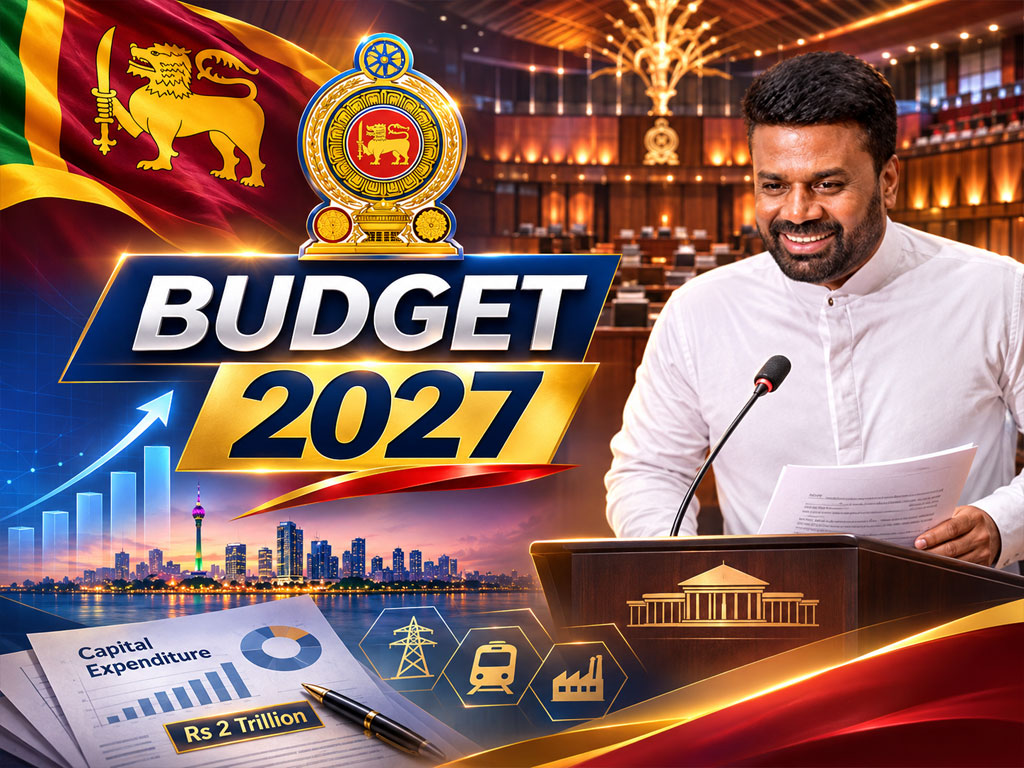
COLOMBO, November 12, 2026 – Sri Lanka’s 2027 Budget promises Rs. 2 trillion in capital investment as the government shifts its attention from economic stabilisation to growth. Yet fresh Treasury figures reveal billions in losses at 13 state enterprises, a petroleum profit supported by subsidies and mounting financial pressures that will test the credibility of the government’s expansion plans.
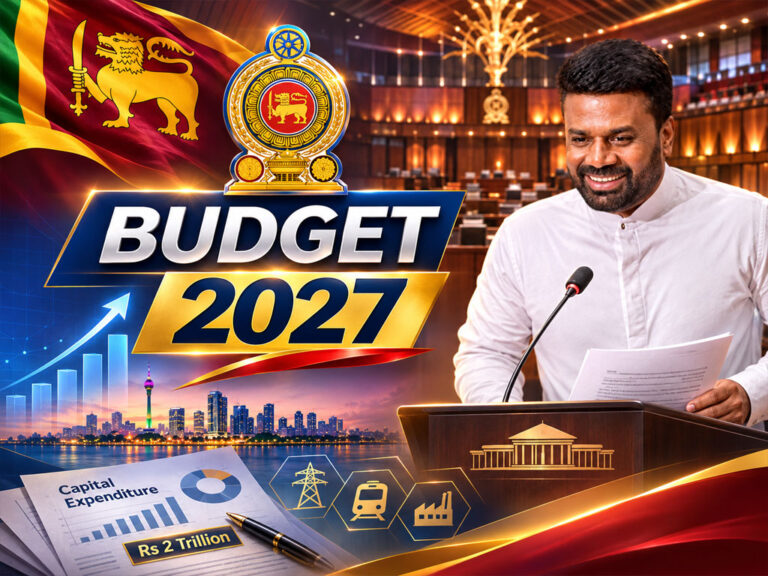
President Anura Kumara Dissanayake is scheduled to present Sri Lanka’s 2027 Budget to Parliament this afternoon, with the government allocating Rs. 2 trillion for capital expenditure as it seeks to move beyond economic stabilisation towards investment-led growth.
The Budget arrives alongside new Treasury figures revealing substantial losses at 13 state-owned enterprises, improved Customs revenue, rising foreign remittances and continued financial pressure on major public institutions.
Dissanayake, who also serves as Minister of Finance, Planning and Economic Development, completed a final review of the Budget proposals on November 11 with Treasury Secretary Dr. Harshana Suriyapperuma.
The President’s Media Division confirmed that Rs. 2,000 billion has been allocated for capital expenditure, positioning public investment as a central element of the government’s economic strategy.
Parliament is scheduled to convene at 1.30 p.m. for the Budget presentation.
The opposition has also launched a public monitoring initiative intended to compare government Budget commitments with actual ministry-level expenditure.

Rs. 2 Trillion Allocated for Economic Expansion
The government’s proposed capital expenditure allocation represents a shift in emphasis from the fiscal stabilisation measures that have shaped Sri Lanka’s economic recovery.
Capital expenditure generally covers investment in infrastructure and other long-term public assets, including transport, public facilities and development projects.
Unlike routine government expenditure on salaries and administration, such investment is intended to strengthen productive capacity and support future economic activity.
However, an allocation does not necessarily mean that the full amount will be spent during the financial year.
Actual expenditure depends on project readiness, procurement procedures, administrative capacity and the government’s ability to finance approved programmes.
The 2027 Appropriation Bill, presented for its first reading on October 7, includes expenditure authorisations amounting to approximately Rs. 4.99 trillion for government ministries and departments.
The Budget’s second reading debate is scheduled from November 13 to November 20, followed by committee-stage consideration from November 21 to December 14.
The second reading vote is scheduled for November 20, with the final vote expected on December 14.
Customs Revenue Exceeds October Target
Sri Lanka Customs collected Rs. 202.7 billion in October 2026, exceeding its monthly revenue target of Rs. 193.3 billion by approximately 4.9%.
According to official data, Customs met or exceeded its monthly collection targets for the tenth consecutive month.
Revenue collected during the first ten months of the year increased by 15.9% compared with the corresponding period in 2025.
These figures provide a positive indication of revenue collection performance as the government prepares its next fiscal programme.
The National Lotteries Board also reported that revenue during the first ten months of 2026 exceeded Rs. 50 billion.
Although improved collection strengthens the government’s fiscal position, revenue performance must still be considered alongside expenditure requirements, debt obligations and the costs of public investment.
Private Credit Expands as Banking Indicators Improve
The Central Bank informed Parliament’s Committee on Public Finance that cumulative private-sector credit extended during the first nine months of 2026 had reached approximately Rs. 2.1 trillion.
The banking system’s Stage 3 non-performing loan ratio, a measure of loans showing significant credit deterioration, reportedly improved from 9.7% to 8.8%.
Expansion in private credit can indicate stronger demand for investment and consumption, while improvements in loan quality may reduce pressure on financial institutions.
Nevertheless, higher lending does not automatically translate into productive investment.
The economic impact will depend on where the credit is directed and whether businesses use the additional financing to increase production, employment and exports.
Foreign Remittances Approach a New Annual Record
Sri Lankan workers overseas sent home US$735.6 million in October 2026, an increase of approximately 3.3% compared with the corresponding month last year.
Total remittances during January–October reached US$7,600.9 million, representing growth of approximately 16.5%.
The latest figures place the country within reach of surpassing the record US$8,076.2 million received during 2025.
A further US$475.3 million would be sufficient to exceed that annual total.
If inflows maintain their recent pace, the record could be surpassed during November, with some projections placing total remittances close to US$9 billion by the end of 2026.
These remain forecasts rather than confirmed year-end receipts.
Approximately 211,666 Sri Lankans reportedly departed for foreign employment during the first nine months of 2026.
Remittances continue to provide an important source of foreign exchange, supporting household spending, external reserves and the broader balance of payments.
Treasury Bill Auction Raises Rs. 79.05 Billion
The Public Debt Management Office accepted approximately Rs. 79.05 billion in bids at the weekly Treasury bill auction held on November 11, against an announced offering of Rs. 90 billion.
The accepted amount represented approximately 87.8% of the auction’s overall offering.
The results were:
- 91-day Treasury bills: Rs. 40 billion offered, with Rs. 54.08 billion accepted. The yield remained unchanged at 9.35%.
- 182-day Treasury bills: Rs. 30 billion offered, with Rs. 11.10 billion accepted. The yield declined by one basis point to 9.43%.
- 364-day Treasury bills: Rs. 20 billion offered, with Rs. 13.87 billion accepted. The yield remained at 9.95%.
The auction results indicate that the government accepted more than the announced amount in the shortest maturity category while accepting less than offered in the longer maturities.
In the interbank foreign-exchange market, the rupee closed at approximately Rs. 332.37/42 against the US dollar on November 11.
Secondary-market government bond yields remained broadly stable, with indicative quotations for selected 2029 maturities around 10.75% to 10.85%.
Stock Market Retreats Ahead of Budget
After gaining more than 2,000 points over the preceding six trading sessions, the Colombo Stock Exchange recorded a modest decline ahead of the Budget presentation.
The All Share Price Index fell 90.46 points, or 0.41%, to 22,032.93.
The S&P SL20 Index declined 19.12 points, or 0.30%, to 6,349.00.
The pullback followed a sustained period of market gains as investors awaited further details of the government’s economic and fiscal proposals.
Corporate earnings also presented contrasting results.
Dialog Axiata reported a 62.4% increase in third-quarter net profit to Rs. 9.24 billion.
Odel PLC, meanwhile, reported an 8.4% increase in its third-quarter net loss to Rs. 704.1 million.
The differing performances illustrate the uneven conditions facing listed companies despite broader signs of economic recovery.
Petroleum Corporation’s Profit Supported by Treasury Subsidy
One of the most notable findings in the Ministry of Finance’s Mid-Year Fiscal Position Report concerns the Ceylon Petroleum Corporation (CPC).
CPC reported a net profit of Rs. 29.2 billion during the first six months of 2026, an increase of 71.8% compared with the corresponding period in 2025.
Its gross profit, however, fell sharply by 72.9% to Rs. 8.9 billion.
During April–June 2026, the Treasury provided Rs. 41 billion in subsidies to CPC as part of measures intended to limit the impact of higher global petroleum prices.
The government also provided Rs. 15 billion to National System Operator (Private) Limited, bringing the support given to these two entities to Rs. 56 billion.
The petroleum subsidy was particularly important to CPC’s operating results.
Despite the decline in gross profit, operating profit increased to Rs. 23.9 billion from Rs. 11.1 billion a year earlier, with Treasury assistance identified as a principal contributing factor.
An unrealised foreign-exchange gain of approximately Rs. 7.2 billion also contributed to the corporation’s financial performance.
The figures demonstrate why the reported net profit cannot be assessed independently of government support and accounting adjustments.
Although the subsidy helped cushion the impact of rising petroleum costs, its financing also placed demands on public resources.
Thirteen State Enterprises Report Rs. 38.59 Billion in Losses
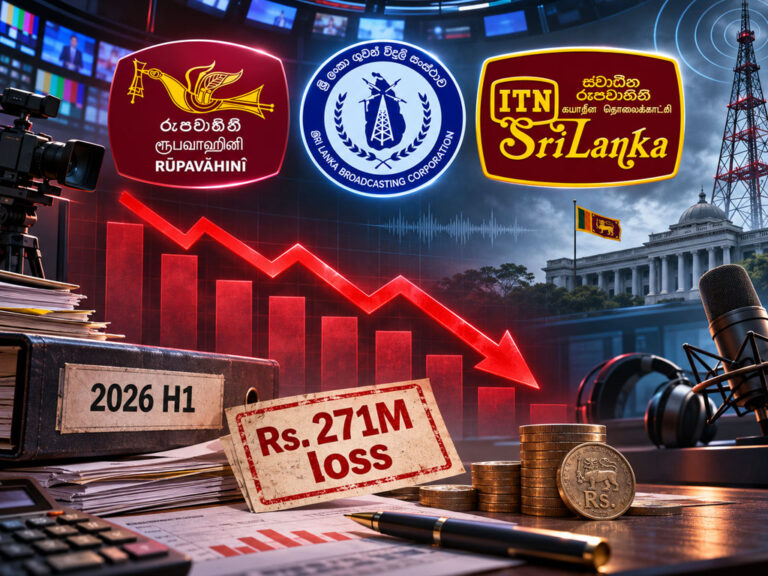
Separate Treasury disclosures identify 13 major state enterprises that recorded combined losses of approximately Rs. 38.59 billion in the reporting periods covered by the mid-year review.
SriLankan Airlines accounted for the overwhelming majority of that amount, with a reported pre-tax loss of Rs. 35.588 billion during April–June 2026, the first quarter of its 2026/27 financial year.
The airline’s reporting period differs from the January–June periods used for several other enterprises, an important distinction when comparing the figures.
The reported losses were:
| State enterprise | Reported loss |
|---|---|
| SriLankan Airlines | Rs. 35,588 million |
| Lanka Sugar Company | Rs. 1,525 million |
| Sri Lanka Transport Board | Rs. 471 million |
| State Development and Construction Corporation | Rs. 193 million |
| State Printing Corporation | Rs. 185 million |
| State Engineering Corporation | Rs. 182 million |
| Sri Lanka Rupavahini Corporation | Rs. 166 million |
| Lanka Sathosa | Rs. 89 million |
| Sri Lanka Broadcasting Corporation | Rs. 68 million |
| Sri Lanka State Plantations Corporation | Rs. 60 million |
| Independent Television Network | Rs. 37 million |
| Janatha Estate Development Board | Rs. 26 million |
| Kahatagaha Graphite Lanka Company | Rs. 5 million |
The figures add up to approximately Rs. 38.595 billion.
SriLankan Airlines alone accounted for more than 92% of the combined losses.
The airline’s deficit reflects wider structural and financial pressures, including rising fuel expenditure, foreign-exchange movements, debt obligations and liquidity constraints.
While the country’s leading state enterprises collectively recorded profits of Rs. 259.3 billion during the first half of 2026, the continued losses at these institutions demonstrate that financial recovery remains uneven across the public sector.
Ravi Karunanayake Appeals to HSBC Over 1,659 Jobs
In a separate development, former Finance Minister and opposition parliamentarian Ravi Karunanayake has appealed to HSBC’s global leadership to reconsider its decision to close or relocate operations conducted through HSBC Electronic Data Processing Lanka (HDPL).
In a letter dated November 9, Karunanayake called for urgent discussions to explore alternatives before the proposed migration of operations becomes irreversible.
HDPL commenced operations in Sri Lanka in 2004 and employed approximately 4,500 people at its peak.
As of September 30, 2026, its workforce stood at 1,659.
The potential closure has raised concerns about employment, business-process outsourcing and Sri Lanka’s competitiveness as a location for international service operations.
HSBC has attributed the proposed changes to a broader review of its global operating model rather than the performance of its Sri Lankan workforce.
Karunanayake has requested discussions with the bank’s senior management and offered to facilitate government engagement aimed at retaining the operation.
Budget Faces a Test of Delivery
The government’s Rs. 2 trillion capital expenditure programme will be judged not only by the scale of its announced allocations but by the projects completed and their contribution to economic activity.
Improving Customs revenue, expanding private credit and record remittance inflows provide encouraging signs for the economy.
Yet substantial losses among selected state enterprises, the continued need for Treasury subsidies and uncertainties affecting major employers demonstrate that fiscal and structural challenges remain.
As Parliament begins its examination of the 2027 Budget, attention will turn to the financing of proposed investments, the timetable for implementation and the government’s plans for institutions that continue to require financial support.
The central test is whether Sri Lanka can translate its improved fiscal position into productive investment and sustainable growth without undermining the financial stability achieved since the economic crisis.