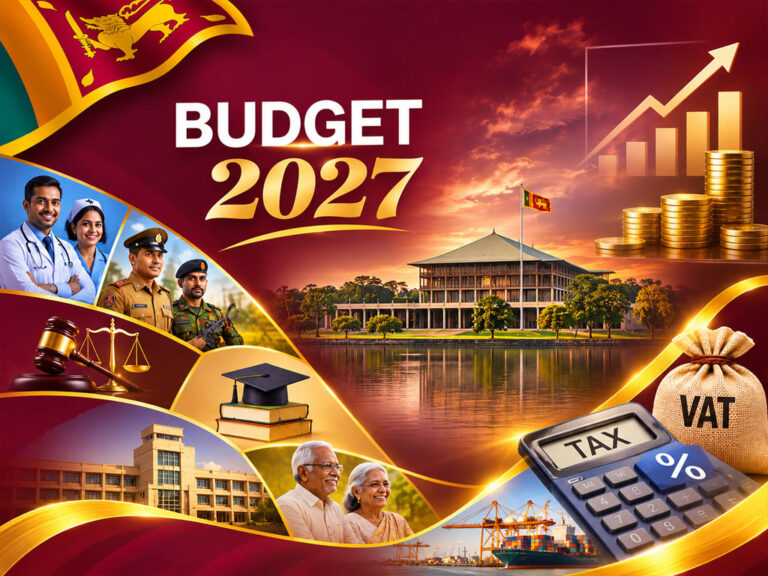
COLOMBO, November 12, 2026 – Sri Lanka’s 2027 Budget sets out the final phase of public-sector salary increases, higher allowances for doctors, nurses, police officers, judges and other government employees, new pension relief and revised income tax thresholds. With some benefits beginning in April, others in July and several extending into 2028, the proposals reveal precisely who stands to gain, how much they could receive and when the changes are expected to take effect.
President Anura Kumara Dissanayake has outlined extensive changes to public-sector salaries, professional allowances, pensions and taxation in the 2027 Budget, including the final phase of a Rs. 330 billion salary revision programme and an increase in the monthly personal income tax-free threshold to Rs. 162,500.
The proposals cover employees across the public service, including medical officers, nurses, university academics, military personnel, police officers, prison staff, field officers and judicial officials.
Several increases are scheduled to take effect in April or July 2027, while others will be introduced in stages extending into 2028.
The government has also proposed pension relief for public servants who retired between 2020 and 2024, revisions to progressive income tax brackets, VAT exemptions for educational materials and changes to import duties affecting several essential commodities.
Although the measures are intended to ease financial pressures on workers, pensioners, businesses and households, their implementation will depend on the relevant administrative arrangements, legislative changes and Budget approvals.

Final Phase of Public-Sector Salary Increase in 2027
The government will implement the third and final phase of the public-sector salary revision introduced through its first Budget in 2025.
Under that programme, the minimum monthly basic salary in the public service was increased by Rs. 15,750, while the value of annual salary increments was raised by 80%.
The government identified a total expenditure commitment of Rs. 330 billion for the salary revision programme.
Implementation was divided into three phases to distribute the financial impact over successive years.
The first two phases have already been introduced, and the final phase is scheduled for implementation in 2027.
An additional Rs. 110 billion has been allocated in the 2027 Budget for this final stage.
Beyond basic salaries, government employees in several sectors have sought revisions to professional and operational allowances to reflect the higher costs associated with performing their duties.
The President acknowledged those requests but explained that the government could not accommodate every proposal immediately.
Instead, selected allowances will be increased on a priority basis, taking account of available fiscal resources.
Requests that have not been addressed in the 2027 Budget are expected to receive consideration in subsequent Budgets, subject to the government’s financial capacity.
Transport Allowance for Executive Officers Doubled
Public-sector executive officers entitled to official vehicles under Public Administration Circular No. 05/2016 will benefit from a proposed increase in their monthly transport allowance when using privately owned vehicles for official duties.
The existing allowance of Rs. 50,000 will increase to Rs. 100,000.
The revision represents an additional Rs. 50,000 per month for eligible officers.
The government said the increase reflects higher maintenance, repair and operating expenses associated with the use of private vehicles for official work.
It also considers the arrangement more economical than providing government-owned vehicles to every eligible officer.
Encouraging public servants to use their own vehicles is therefore intended to reduce the state’s expenditure on maintaining an official vehicle fleet.
Higher Allowances for Electric Vehicle Users
A separate measure is intended to encourage the use of fully electric vehicles.
From July 2027, the monthly allowance provided under Public Administration Circular No. 13/2008(V) to eligible officers who use fully electric private vehicles will increase by 150%.
The proposal forms part of the government’s wider effort to promote electric transport and reduce dependence on conventional fuel.
The Budget does not specify a single revised rupee amount applicable to every recipient under this arrangement.
Individual entitlements will depend on the allowance currently applicable under the relevant circular and the conditions governing eligibility.
Doctors’ DAT Allowance to Rise to Rs. 95,000
Medical officers will receive a substantial increase in their Disturbance, Availability and Transport allowance, commonly known as the DAT allowance.
The government proposes raising the monthly payment by Rs. 25,000, from Rs. 70,000 to Rs. 95,000.
The increase recognises the professional responsibilities of medical officers and the demands associated with providing healthcare services.
The revised payment will be introduced in two stages.
From July 2027, medical officers will receive 50% of the proposed increase, equivalent to an additional Rs. 12,500 per month.
The remaining Rs. 12,500 will be introduced in 2028.
Once fully implemented, the monthly DAT allowance will reach Rs. 95,000.
The phased arrangement is intended to deliver additional remuneration while managing the financial burden on the Treasury.
Nursing and Paramedical Allowances to Double
Nursing officers and employees in paramedical and supplementary medical services will also receive increased monthly special duty allowances.
Their existing allowance of Rs. 6,000 will rise to Rs. 12,000.
Other health-sector employees currently receiving a special duty allowance of Rs. 2,000 will see that payment increase to Rs. 4,000.
Both proposals represent a doubling of the existing amounts.
As with the DAT allowance, implementation will take place in two stages.
Half of each increase will be paid from July 2027, with the balance introduced in 2028.
For nursing officers and eligible paramedical and supplementary medical personnel, the allowance will initially rise from Rs. 6,000 to Rs. 9,000 before reaching Rs. 12,000.
For other eligible health employees, the payment will increase from Rs. 2,000 to Rs. 3,000 in the first phase and subsequently to Rs. 4,000.
The government said the revisions recognise the contribution made by healthcare personnel to the operation and resilience of the national health system.
University Academics to Receive Higher Allowances
University academic staff are among the professional groups covered by the new remuneration proposals.
The Budget provides for an increase of Rs. 25,000 in the monthly academic allowance paid to eligible university employees.
The increase is intended to recognise their contribution to teaching, research and the development of skilled human resources.
Like several other professional allowance adjustments, the revision will be introduced in two stages.
Half of the increase, equivalent to Rs. 12,500, is scheduled to take effect in July 2027.
The remaining Rs. 12,500 will be added from July 2028.
External University Lecturer Payments Tripled
The government also intends to increase payments made to external university lecturers who contribute specialist knowledge and professional expertise.
The existing payment of Rs. 1,500 per hour will be raised to Rs. 4,500.
This represents a threefold increase in the hourly payment.
External advisers participating in university practical examinations will receive a similar adjustment.
Their current payment of Rs. 600 per hour is proposed to increase to Rs. 1,800.
The government expects the revised rates to improve universities’ ability to attract experienced external specialists and maintain the quality of academic instruction and assessment.
Higher Rates for Vocational Training Lecturers
External lecturers serving vocational and technical education institutions will also benefit.
Their existing payments are proposed to increase by 100%, effectively doubling the applicable rates.
The measure is intended to attract instructors with specialised technical and professional expertise and improve the delivery of employment-oriented training.
Unlike the university lecturer revisions, the source proposals do not specify a uniform existing hourly payment or a single new rate for all vocational and technical lecturers.
Food Allowances Increased for Armed Forces Personnel
Members of Sri Lanka’s three armed services will receive higher food allowances from July 2027.
The increase is intended to address rising food costs and support the nutritional requirements and welfare of military personnel.
The proposed daily increases are:
- Commissioned officers: Rs. 315.
- Other ranks: Rs. 332.
These amounts represent increases to the existing daily allowances rather than the total revised daily payments.
The Budget identifies the additional amounts but does not provide a uniform new total allowance for all ranks.
The revised payments will be introduced with effect from July 2027.
Police Food and Accommodation Allowance Increased
Police officers will receive an additional Rs. 10,000 per month towards food and accommodation expenses incurred in the performance of their duties.
The increase is scheduled to take effect in July 2027.
The government said the measure reflects the higher costs police personnel face while carrying out operational and administrative responsibilities.
The proposal applies to the monthly food and accommodation allowance, rather than constituting a general Rs. 10,000 increase in every officer’s basic salary.
The final payment received by individual officers will depend on the relevant service conditions and allowance entitlements.
Prison Officers’ Risk Allowance Doubled
Prison officers will receive a 100% increase in their monthly risk allowance.
The existing payment of Rs. 8,000 will rise to Rs. 16,000.
The government said the increase recognises the difficult and potentially dangerous working conditions faced by officers serving in the prison system.
Civilian employees of the Department of Prisons will also receive a substantial increase in their existing allowance.
Their monthly payment will rise from Rs. 2,250 to Rs. 10,000.
This represents an increase of Rs. 7,750.
Both revisions are scheduled to take effect in July 2027.
Field Officers Receive Higher Travel and Office Allowances
The Budget proposes increased travelling and office rent allowances for several categories of field-based public servants.
Unlike many professional allowance revisions scheduled for July, these changes will take effect from April 2027.
The government said field officers frequently incur expenses while travelling within assigned areas and maintaining offices used to provide services to local communities.
Grama Niladhari Officers
The monthly travelling allowance for Grama Niladharis will rise from Rs. 1,600 to Rs. 4,000.
Their office rent allowance will increase according to the administrative area in which they serve.
- Municipal Council and Urban Council areas: Rs. 3,000 to Rs. 6,000 per month.
- Pradeshiya Sabha areas: Rs. 2,000 to Rs. 4,000 per month.
Development Officers
Development Officers will receive a higher monthly travelling allowance, increasing from Rs. 300 to Rs. 1,000.
Office rent allowances will also be revised.
- Municipal Council and Urban Council areas: Rs. 1,000 to Rs. 2,000.
- Pradeshiya Sabha areas: Rs. 750 to Rs. 1,500.
Samurdhi Officers
The monthly travelling allowance for Samurdhi Officers will increase from Rs. 2,000 to Rs. 2,500.
Their office rent allowance will rise as follows:
- Municipal Council and Urban Council areas: Rs. 2,500 to Rs. 5,000.
- Pradeshiya Sabha areas: Rs. 2,000 to Rs. 4,000.
Agriculture Research and Production Assistants
Agriculture Research and Production Assistants will receive an increase in their monthly travelling allowance from Rs. 400 to Rs. 1,000.
Their office rent allowances will also double.
- Municipal Council and Urban Council areas: Rs. 3,000 to Rs. 6,000.
- Pradeshiya Sabha areas: Rs. 2,000 to Rs. 4,000.
The government intends to implement all four categories of field officer allowance revisions from April 2027.
Judicial Officers to Receive Higher Professional Allowances
High Court judges, Special Grade Judicial Officers and judicial officers serving in other grades will receive an increase of Rs. 25,000 in their monthly professional allowance.
The measure is intended to recognise the responsibilities and demands of judicial service.
Implementation will take place in two stages.
Half of the proposed increase will be paid from July 2027, followed by the remaining half in 2028.
The first stage will therefore provide an additional Rs. 12,500 per month to eligible judicial officers.
Transport, Driver and Housing Allowances
Further revisions are proposed for judicial officers entitled to official vehicles and other service-related benefits.
From July 2027:
- The monthly transport allowance for eligible officers will increase by Rs. 50,000.
- The monthly driver allowance will rise from Rs. 25,000 to Rs. 50,000.
- The monthly housing allowance for eligible High Court judges and other judges will increase by 100%.
The housing allowance revision applies to officers who must meet their own residential expenses because an official residence has not been provided.
The qualifying residence may be owned or leased by the officer.
The revised benefits are intended to reflect increased transport and housing costs associated with judicial appointments.
Attorney General’s Department Allowances Revised
Legal officers serving in the Attorney General’s Department will receive increases in their monthly non-practising allowances.
The proposed amounts vary according to appointment and seniority.
An additional Rs. 25,000 per month is proposed for the following posts:
- Attorney General.
- Solicitor General.
- Senior State Counsel.
An increase of Rs. 20,000 per month is proposed for:
- Senior State Attorney.
- State Attorney.
Half of these increases will take effect from July 2027, with the remaining half to be introduced in 2028.
Eligible officers will therefore initially receive increases of Rs. 12,500 or Rs. 10,000, depending on their respective positions.
Additional Benefits for Legal Officers
Further adjustments are proposed for eligible officers in the Attorney General’s Department.
From July 2027:
- The monthly transport allowance for officers entitled to official vehicles will increase by Rs. 50,000.
- The monthly driver allowance for eligible officers will increase from Rs. 25,000 to Rs. 50,000.
- Existing housing allowances will increase by 100%.
These revisions are separate from the phased adjustments to non-practising allowances.
Legal Draftsman’s Department to Receive Higher Allowances
The government also proposes increased special allowances for legal professionals serving in the Legal Draftsman’s Department.
The Legal Draftsman, Additional Legal Draftsman and Deputy Legal Draftsman will receive increases of Rs. 25,000 per month.
Senior Assistant Legal Draftsmen and Assistant Legal Draftsmen will receive increases of Rs. 20,000 per month.
As with the comparable professional allowances proposed for judicial officers and the Attorney General’s Department, the increases will be introduced in two stages.
Half will take effect in July 2027, with the remaining half in 2028.
Eligible officers will initially receive additional amounts of Rs. 12,500 or Rs. 10,000 per month, according to their positions.
The monthly driver allowance for entitled officers will also increase from Rs. 10,000 to Rs. 50,000 with effect from July 2027.
Judicial Support Staff to Receive Allowance Revisions
Employees providing administrative and operational support to the judiciary are also covered by the Budget proposals.
The government intends to revise relevant allowances paid to judicial support staff from April 2027.
The measure takes account of their responsibilities, workload and contribution to maintaining the effective operation of the justice system.
Although the Budget Speech confirms that the revisions will take effect in April, the supplied section does not specify individual revised rates for each category of support staff.
Those details will need to be established through the applicable circulars and implementation instructions.
Allowances for Independent Commissions and State Institutions
The Budget also addresses allowances paid to members and senior officials of independent commissions, other commissions and statutory organisations.
According to the government, monthly allowances for chairpersons and members of independent commissions and other commissions have not been revised since 2018.
Allowances paid to chairpersons, executive directors and working directors of state corporations, statutory institutions and government-owned companies have remained unchanged since 2015.
The government proposes revising these payments from July 2027, taking into account the responsibilities attached to the relevant appointments.
Detailed revised allowances for chairpersons and members of other commissions are provided in Annexure VI of the Budget documents.
Further implementation arrangements are included in the accompanying Technical Note.
Final Phase of Pension Revision Scheduled for 2027
The government is continuing a phased programme intended to reduce disparities among the pensions of retired public servants.
Under the 2025 Budget, steps were taken to convert the pensions of public servants who retired before 2020 to the basic salary scale applicable in 2020.
The programme was divided into three phases.
Its first and second phases have already been completed, while the third and final phase is scheduled for implementation in 2027.
The government said the programme is designed to ensure fairer pension treatment for retirees whose benefits were calculated under different salary structures.
Differences between retirement dates and the salary scales used in calculating pensions have resulted in disparities among former public servants.
These disparities have become more pronounced following the basic salary revision introduced in 2025.
The government intends to address them through a further phased programme while protecting the long-term sustainability of public finances.
Rs. 2,500 Monthly Relief for Pensioners Who Retired in 2020–2024
Public servants who retired between 2020 and 2024 will receive a proposed interim monthly allowance of Rs. 2,500 from July 1, 2027.
The payment is intended to provide temporary relief until their pensions are revised under the new basic salary structure introduced in 2025.
The government plans to begin that broader pension revision through the 2028 Budget.
Implementation will take place in several phases.
Once an eligible pensioner’s benefit has been recalculated under the revised structure and payment of the revised pension begins, the interim Rs. 2,500 allowance will cease.
The interim payment is therefore not intended to remain as a permanent addition after the relevant pension revision has been implemented.
These arrangements will also apply to public-sector pensioners whose salaries were determined under Department of Management Services Circulars 02/2025, 03/2025, 04/2025 and 05/2025.
The government said the objective is to reduce differences between pensioners who retired at different times while maintaining a financially sustainable pension system.
Monthly Income Tax-Free Threshold Rises to Rs. 162,500
The 2027 Budget also proposes significant revisions to personal income taxation.
In 2025, the government increased the annual personal income tax-free threshold from Rs. 1.2 million to Rs. 1.8 million.
That adjustment raised the monthly tax-free threshold from Rs. 100,000 to Rs. 150,000.
According to the Budget Speech, the 2025 reform provided individual taxpayers with monthly tax relief ranging from Rs. 3,500 to Rs. 20,500.
The government now proposes increasing the monthly tax-free threshold further to Rs. 162,500.
This represents an increase of Rs. 12,500 per month over the existing threshold.
On an annual basis, the tax-free allowance will increase from Rs. 1.8 million to Rs. 1.95 million.
Under the proposed structure, an individual receiving a monthly salary and allowances of up to Rs. 162,500 would not be required to pay personal income tax on that income.
The government is also revising the structure of progressive income tax bands to provide additional relief to taxpayers earning above the tax-free threshold.
Progressive Income Tax Bands Widened
The proposed revisions retain the existing personal income tax rates of:
- 6%.
- 12%.
- 18%.
- 24%.
- 30%.
- 36%.
The tax band to which the 6% rate applies will be Rs. 70,833 per month.
Subsequent monthly tax bands will be widened from Rs. 41,667 to Rs. 50,000.
The government also proposes applying the 12% rate immediately after the 6% band, rather than moving directly to an 18% rate.
These revisions will increase the monthly income threshold at which the highest personal income tax rate applies from approximately Rs. 358,000 to Rs. 433,000.
According to the government’s calculations, the changes proposed for 2027 will deliver additional monthly tax relief ranging from Rs. 750 to Rs. 15,750, depending on an individual’s taxable income.
When combined with the changes introduced in 2025, total monthly relief is estimated to range from Rs. 4,250 to Rs. 36,250.
The exact saving for an individual taxpayer will depend on taxable income and the applicable progressive bands.
The revised tax arrangements will require implementation through the relevant legislative and administrative mechanisms.
Enhanced Capital Allowances for BOI-Approved Enterprises
The government intends to encourage investment in export-oriented manufacturing and tourism through enhanced capital allowances.
Enterprises operating under agreements with the Board of Investment of Sri Lanka will be able to qualify for an enhanced allowance where they meet the relevant requirements.
Eligible investments must amount to at least US$3 million.
Qualifying businesses will be permitted to opt for an enhanced capital allowance equivalent to 200% of qualifying capital expenditure instead of the existing allowance regime.
The proposal applies to BOI-approved enterprises engaged in export-oriented manufacturing or tourism development activities.
The government expects the measure to stimulate private investment, improve export competitiveness and strengthen tourism-sector development.
Eligibility will depend on the statutory conditions and qualifying expenditure defined under the revised tax arrangements.
VAT Exemption Proposed for Books and Exercise Books
Educational materials are another major focus of the Budget’s tax relief measures.
Printed books and certain other printed publications became subject to Value Added Tax from January 2024.
Exercise books had been subject to VAT even before that date.
The government proposes removing VAT from specified educational and printed materials to improve affordability and encourage access to education.
The proposed exemption covers:
- Textbooks.
- Dictionaries.
- Encyclopaedias.
- Children’s drawing and colouring books.
- Educational publications.
- Other printed books.
- Exercise books.
The government said the measure is intended to support education, reading and access to knowledge.
The actual effect on retail prices will depend on implementation and the pricing decisions of publishers, distributors and retailers.
VAT on Cinema Tickets to Be Calculated Differently
The government proposes revising the way VAT liability is calculated on cinema ticket revenue.
Under the proposed system, VAT obligations will be assessed according to the share of ticket revenue received by or allocated to each party.
The measure applies to film producers, distributors, the National Film Corporation and cinema operators.
Rather than calculating VAT on the full ticket price at each stage, the applicable liability would be based on the portion of revenue attributable to the relevant participant.
The government said the change is intended to establish a fairer and more consistent approach to VAT in the film industry.
Exporters to Qualify Earlier for VAT Benefits
Newly VAT-registered export businesses will also benefit from a proposed change to the criteria for recognition as Eligible Exporters.
Under the revised arrangement, newly registered persons may qualify when more than 80% of their turnover during the preceding six months comes from exports.
They will no longer have to satisfy the existing requirement linked to turnover during the preceding calendar year.
The change is intended to make the VAT system more responsive to newly established export-oriented businesses.
Earlier recognition could allow qualifying enterprises to access the relevant benefits without waiting for the completion of a full previous calendar-year assessment period.
Central Bank Exchange Rate to Be Used for Foreign Currency VAT
The Budget proposes using the Indicative Exchange Rate published by the Central Bank of Sri Lanka when converting foreign-currency-denominated taxable supplies into Sri Lankan rupees for VAT purposes.
The objective is to improve transparency, consistency and fairness in the valuation of transactions involving foreign currencies.
The Commissioner General of Inland Revenue will issue a circular specifying how the exchange rate must be applied.
The government expects the change to reduce inconsistencies arising from the use of different exchange-rate calculations.
Bunker Fuel Supplies to Receive SSCL Exemption
Fuel supplied to vessels engaged in international transportation will be exempted from the Social Security Contribution Levy under the proposed changes.
The measure is intended to improve the competitiveness of Sri Lanka’s maritime services industry.
International bunkering is a competitive market in which fuel prices, service charges and tax treatment can influence where shipping operators purchase supplies.
The government expects the exemption to support Sri Lanka’s position as a regional maritime services hub.
The proposal applies specifically to fuel supplied to ships engaged in international transportation.
Betting and Gaming Tax Structure to Be Reviewed
The government intends to undertake a comprehensive review of taxes, fees and charges imposed on betting and gaming activities.
The Gambling Regulatory Authority has already been established and commenced operations.
With a regulatory framework now in place, the government proposes examining the tax structure to address inconsistencies and instances of double taxation.
The review will consider international practices and seek to establish a simpler, more transparent system.
Its stated objective is to support effective regulation, improve compliance and protect government revenue.
The Budget does not announce a single revised tax rate applicable to every category of betting and gaming activity.
Instead, it proposes a broader review before the necessary adjustments are introduced.
Tax Administration to Be Simplified
The government also intends to amend existing tax legislation to eliminate ambiguities, strengthen legal certainty and simplify compliance.
Several provisions will be reviewed to ensure that the tax system remains appropriate for changing business practices and new forms of transactions.
Particular attention will be paid to procedural requirements that can result in taxpayers losing legitimate entitlements to refunds or input tax credits because of technical non-compliance.
The government proposes reviewing those provisions while retaining safeguards designed to protect public revenue.
The objective is to develop a more transparent, efficient and predictable tax administration system that encourages voluntary compliance.
Import Levies Reduced on Sprats, Maldive Fish and Chillies
Consumers could benefit from proposed reductions in the Special Commodity Levy on selected essential food imports.
The changes are scheduled to take effect on November 13, 2026.
The revised rates are:
- Imported sprats: Levy reduced from Rs. 100 to Rs. 10 per kilogram.
- Maldive fish: Levy reduced from Rs. 302 to Rs. 10 per kilogram.
- Powdered and unpowdered dried chillies: Levy reduced by Rs. 50 per kilogram.
The government said the reductions are intended to ease cost-of-living pressures associated with higher food prices.
For imported sprats, the proposed reduction amounts to Rs. 90 per kilogram.
For Maldive fish, the reduction is Rs. 292 per kilogram.
The Budget does not specify a single new levy rate for all varieties of imported powdered and unpowdered dried chillies, instead identifying a reduction of Rs. 50 per kilogram.
Any corresponding reduction in retail prices will depend on import costs, distribution expenses and pricing decisions throughout the supply chain.
CESS Rates to Fall on 800 Import Categories
The government proposes reducing existing CESS rates by 25% across 800 selected Harmonized System tariff lines.
The measure forms part of a phased programme to simplify import taxation, reduce trade-related costs and strengthen economic competitiveness.
The affected categories will be determined by the specified tariff classifications.
A 25% reduction in an existing CESS rate should not be confused with a blanket reduction of 25 percentage points or a reduction covering every imported product.
The final effect on import costs will depend on the applicable rates and the relevant product classifications.
Newsprint Import Levy to Be Removed
The government also proposes removing the 10% Ports and Airports Development Levy currently charged on imported newsprint falling within specified tariff codes.
The change is scheduled to take effect on January 1, 2027.
The proposal could reduce an element of the import tax burden on qualifying newsprint used by the newspaper publishing industry.
Actual savings will depend on the classification of imports and the total costs incurred by publishers.
Imported Sugar Levy to Increase
While reducing duties on selected essential food products, the government proposes increasing the Special Commodity Levy on imported sugar by Rs. 10 per kilogram.
The measure is intended to support domestic sugar producers by reducing the tax disparity between imported and locally produced sugar.
According to the Budget Speech, the proposal seeks to establish more equal competitive conditions for domestic manufacturers.
The effect on consumer prices will depend on market conditions and the extent to which importers and retailers pass the additional levy through to buyers.
Tourism Development Levy to Be Abolished
The government proposes abolishing the Tourism Development Levy currently charged on the turnover of tourism establishments.
The measure is intended to reduce the tax burden on tourism businesses and improve the sector’s competitiveness.
The levy has been a source of funding for tourism promotion and development activities.
To avoid interrupting those programmes, the government intends to establish an alternative financing mechanism.
Until the new arrangement is introduced, the Treasury will provide funding for eligible tourism promotion and development expenditure upon requests from the Sri Lanka Tourism Development Authority.
The proposal therefore changes the intended financing arrangement for tourism development rather than eliminating the government’s responsibility to support the sector.
Excise Ordinance to Be Amended
The 2025 Budget proposed replacing Sri Lanka’s century-old Excise Ordinance with a new Excise Act.
However, the government now intends to simplify the current framework by amending the existing Ordinance until comprehensive replacement legislation is introduced.
The proposed amendments are intended to streamline revenue administration and address procedural complexities.
The Budget does not provide a complete schedule of every amendment within the section describing this proposal.
Further details will depend on the legislation submitted for parliamentary consideration.
Borrowing Limit and Budget Documentation
The government’s proposed borrowing limit for the 2027 financial year is provided in Annexure IV of the Appropriation Bill documentation.
A summary of new expenditure proposals appears in Annexure II.
The President also confirmed that the documents required for presentation during the Second Reading under the Public Financial Management Act, No. 44 of 2024, have been tabled.
These supporting documents form part of the financial and legislative framework governing the Budget.
They are essential for examining the overall borrowing requirement, the allocation of expenditure and compliance with statutory public financial management obligations.
Rs. 260 Billion Proposed for Cyclone Ditwah Reconstruction
The government intends to reallocate Rs. 260 billion for reconstruction work associated with damage caused by Cyclone Ditwah.
Parliament previously approved a supplementary estimate of Rs. 500 billion for reconstruction.
However, part of that allocation has remained unutilised because of various factors, including the economic disruption associated with the Middle East conflict.
The government now proposes securing Rs. 260 billion in budgetary provisions for 2027 to complete the outstanding reconstruction activities.
A supplementary estimate will be presented to Parliament under Section 16 of the Public Financial Management Act.
The President indicated that the supplementary estimate would be tabled on November 12 following the Budget Speech.
The additional allocation is intended to support the restoration of damaged infrastructure and livelihoods.
What Happens Next for Public Servants and Taxpayers
The Budget sets out several different implementation dates that public servants, pensioners and taxpayers will need to distinguish.
Field officers and judicial support staff are scheduled to receive selected allowance revisions from April 2027.
Many professional allowance changes will begin in July 2027, with some of the larger increases divided into two instalments extending into 2028.
The final stage of the basic public-sector salary revision is scheduled for 2027, while the proposed Rs. 2,500 interim pension allowance for those who retired between 2020 and 2024 will begin on July 1.
Tax proposals will follow their respective implementation dates and any legislative or administrative requirements.
The government has also committed to considering further allowance requests in later Budgets, subject to fiscal capacity.
For public servants, the immediate priority will be understanding which revised allowances apply to their particular positions, when payments begin and whether they qualify under the relevant administrative circulars.
For taxpayers, attention will focus on the new income tax thresholds, progressive bands and the additional relief available under the revised system.
As Parliament examines the Budget, the practical impact of the proposals will depend on the final approved measures, detailed implementation instructions and the government’s ability to meet the resulting financial commitments.