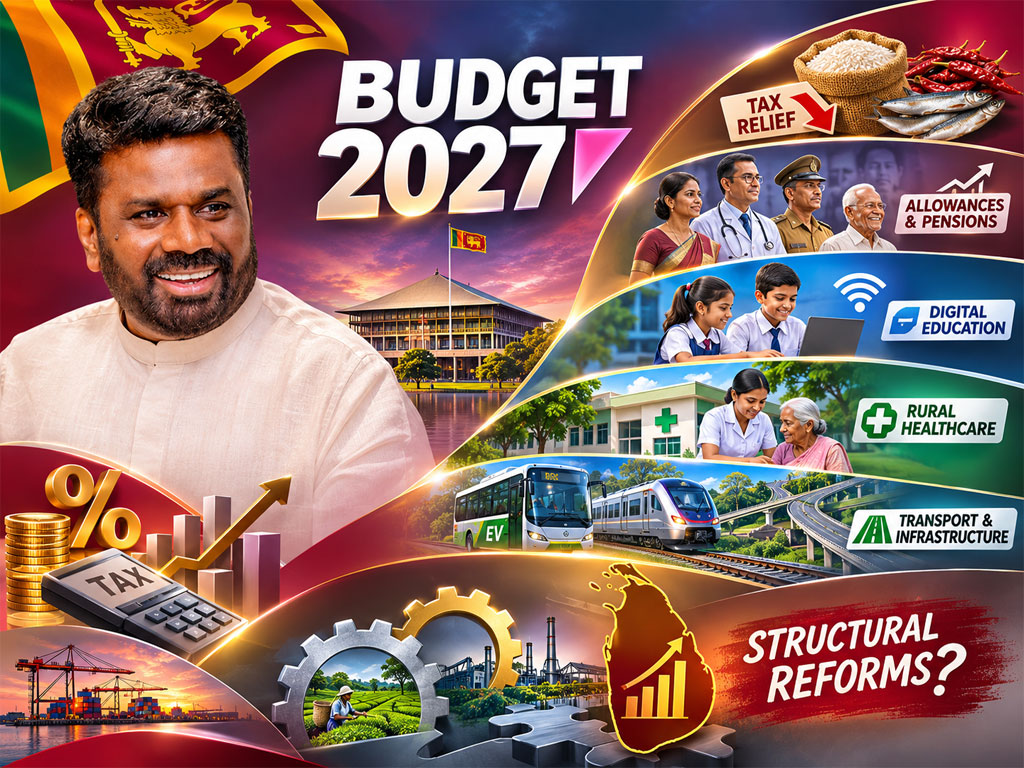
COLOMBO, November 13, 2026 – Sri Lanka’s 2027 Budget promises tax relief, higher allowances and major investments in healthcare, education and transport. Yet beneath these proposals lies a fundamental concern: can another Budget built around conventional economic policies deliver the lasting structural change the country needs?
Every Sri Lankan government and finance minister has presented annual Budgets with promises of national development and economic progress. Whatever their political differences, it is reasonable to assume that successive leaders have sought to improve the country’s future rather than deliberately undermine it.
Yet decades of experience have exposed an uncomfortable reality. The distance between ambitious proposals presented in Parliament and their successful implementation has often been enormous.
Why do policies that appear convincing on paper repeatedly fail to deliver the expected results?
President Anura Kumara Dissanayake’s third Budget, presented to Parliament on November 12, must be examined against that history.
Despite the government’s previous two Budgets, many ordinary Sri Lankans continue to struggle with rising living costs, taxation and financial insecurity. For those households, improvements in economic indicators have not necessarily translated into meaningful relief.
A more fundamental concern is whether Sri Lanka continues to rely too heavily on economic models and policy frameworks developed for circumstances different from its own.
Successive administrations have attempted to address the country’s economic problems through borrowing, taxation and policies influenced by Western economic thinking.
The National People’s Power government now faces the same challenge: developing solutions that recognise Sri Lanka’s particular economic conditions, productive capacity, social needs and consumption patterns.
The question is whether Budget 2027 represents a genuine departure from that approach or another attempt to manage longstanding problems through familiar policy instruments.

Relief for Household Food Expenses
Among the Budget measures likely to attract immediate public attention are reductions in taxes imposed on essential imported food items.
Effective November 13, the government has proposed substantial reductions in levies on imported sprats, Maldive fish and dried chillies.
From April 2027, CESS rates on 800 categories of imported goods are also expected to be reduced by 25%.
These measures are intended to reduce import-related costs and ease pressure on consumer prices.
For households struggling to meet daily expenses, even modest reductions in the prices of frequently purchased goods could provide welcome relief.
However, lower import duties do not automatically guarantee equivalent reductions in retail prices. Whether consumers receive the intended benefits will depend on market conditions and the pricing practices of importers, distributors and retailers.
New Hope for Public Servants and Pensioners
The Budget also gives considerable attention to the financial difficulties experienced by public-sector employees and retired government servants.
Several proposals are intended to improve allowances and provide additional support to groups affected by rising living expenses.
- Pension relief: Public servants who retired between 2020 and 2024 are expected to receive an interim monthly allowance of Rs. 2,500 from July 1, 2027.
- Teacher trainees and medical officers: Monthly allowances for students attending teacher training colleges are proposed to increase from Rs. 10,500 to Rs. 20,000, while the allowance paid to medical officers will rise from Rs. 70,000 to Rs. 95,000, with the latter increase introduced in stages.
- Transport allowances: Eligible executive officers who use privately owned vehicles for official duties will see their monthly transport allowance increase from Rs. 50,000 to Rs. 100,000.
These measures recognise the financial pressures affecting public servants and pensioners.
Their lasting value, however, will depend on whether the additional income translates into improved purchasing power rather than being absorbed by further increases in living costs.
Preparing Children for a Digital Future
Education and technology feature prominently in the government’s development proposals.
The Budget includes plans to provide free broadband vouchers to 750,000 schoolchildren and allocate Rs. 3 billion towards digitalising provincial schools.
A National Centre for Artificial Intelligence is also proposed as part of efforts to prepare Sri Lanka for technological transformation.
Such investments could help reduce inequalities in access to digital education and strengthen the skills required by future generations.
Nevertheless, providing equipment, connectivity and technological facilities is only one part of the challenge.
Meaningful progress will depend on teacher training, the quality of educational content and the ability of students throughout the country to use these resources effectively.
Healthcare Closer to Rural Communities
The government intends to establish 1,000 Arogya Wellness Centres across Sri Lanka, with the objective of improving access to healthcare within local communities.
The initiative could reduce the need for rural residents to travel considerable distances to larger hospitals for basic medical attention.
The Budget also proposes increasing monthly allowances for kidney patients and persons with disabilities to Rs. 12,500.
These measures acknowledge the importance of protecting vulnerable groups and improving access to essential services.
Their effectiveness will depend on adequate staffing, equipment, medicines and consistent service delivery.
Public Transport and Infrastructure Development
Transport modernisation is another major component of Budget 2027.
Proposals include introducing 100 new electric buses, investing approximately Rs. 80 billion in the initial phase of railway electrification and expanding the Metro Bus service beyond Colombo to Kandy, Galle and Jaffna.
Significant allocations have also been announced to accelerate work on the Central and Ruwanpura expressways.
These investments are intended to improve mobility, reduce transport-related difficulties and strengthen economic connectivity.
A modern public transport system could benefit commuters, businesses and the wider economy.
However, infrastructure development must be supported by realistic implementation schedules, sound financial management and improvements in the quality and reliability of services.
The Structural Change Still Missing
Viewed individually, many of the Budget’s proposals are constructive.
Tax reductions on essential goods, support for public servants, digital education, improved healthcare and modern transport infrastructure could all contribute to better living conditions.
The Budget also reflects the government’s intention to support small and medium-sized enterprises while pursuing environmentally sustainable development.
Nevertheless, its broader economic approach remains influenced by the fiscal commitments and policy framework associated with Sri Lanka’s International Monetary Fund programme.
This raises a question that extends beyond the merits of individual spending proposals.
Can a country achieve lasting prosperity simply by adjusting tax rates, redistributing allowances and announcing new investment projects?
Sri Lanka’s economic difficulties are not confined to inadequate government expenditure or insufficient tax revenue.
They also concern how the country produces, imports, consumes and manages its resources.
A genuinely transformative Budget should encourage a national consumption pattern consistent with the country’s productive capabilities and economic realities.
It should help cultivate greater financial discipline, reduce unnecessary imports, strengthen domestic production and encourage citizens to recognise the connection between individual consumption choices and national economic stability.
Such reforms require more than adjustments to fiscal policy.
They demand a change in economic thinking, supported by long-term national priorities that extend beyond election cycles and short-term political popularity.
Sri Lanka must also examine whether imported economic theories adequately address the distinctive circumstances of its economy.
International experience can provide valuable guidance, but policies cannot succeed merely because they have worked elsewhere.
They must be adapted to domestic conditions, institutional capabilities and the needs of Sri Lankan society.
The central challenge for the NPP government is therefore not simply implementing the proposals contained in Budget 2027.
It is demonstrating that those measures form part of a deeper transformation in the way Sri Lanka earns, spends, produces and consumes.
Without that change in direction, even an ambitious Budget risks becoming another collection of attractive proposals whose promised benefits remain largely confined to paper.