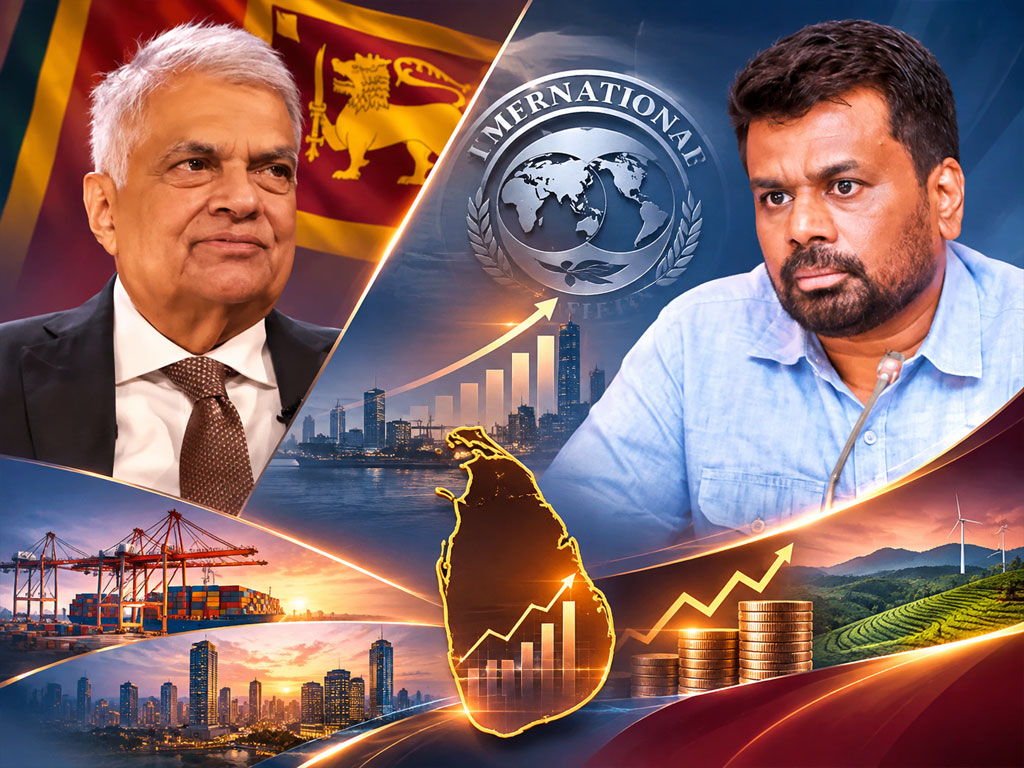
COLOMBO, November 13, 2026 – Nearly four years after Sri Lanka secured a US$3 billion IMF programme to escape its worst economic crisis, the country is approaching a defining decision. With financial stability improving but debt repayments, global uncertainty and economic vulnerabilities remaining, the government must decide whether to seek another IMF agreement after March 2027.
Sri Lanka is approaching the final months of the four-year Extended Fund Facility (EFF) approved by the Executive Board of the International Monetary Fund (IMF) on March 20, 2023.
The programme, worth approximately US$3 billion, was introduced after the country’s unprecedented economic collapse, with the objective of restoring financial stability, restructuring unsustainable debt, rebuilding foreign reserves and strengthening public financial management.
It is scheduled to conclude in March 2027.
The arrangement marked Sri Lanka’s 17th IMF-supported programme, reflecting the country’s long history of seeking international financial assistance during periods of economic instability.
Nearly four years after its approval, the central question is whether the reforms introduced under the agreement have created sufficient economic resilience for Sri Lanka to move forward independently.
President Anura Kumara Dissanayake has acknowledged that the programme has helped restore stability and has indicated that the government is considering whether a new arrangement could support the next stage of economic development.
Economists, however, caution that the recovery remains incomplete and that withdrawing from IMF-supported reforms too early could expose the country to renewed financial instability.

Why Sri Lanka Needed the US$3 Billion IMF Facility
Sri Lanka’s economic difficulties developed over several years before reaching crisis proportions in 2022.
Political and social instability from 2018, the economic disruption caused by the COVID-19 pandemic, weaknesses in public finances and mounting external debt obligations combined to undermine the country’s financial position.
The Central Bank of Sri Lanka identified several interconnected factors behind the collapse.
These included weaknesses in fiscal management, external-sector pressures, an overvalued Sri Lankan rupee, declining foreign exchange reserves, governance deficiencies and the use of Central Bank financing to support government expenditure.
Debt had also reached levels that could no longer be sustained under the country’s prevailing economic conditions.
Higher interest rates and the rapid depreciation of the rupee placed additional pressure on banks, businesses and households.
The deterioration in Sri Lanka’s sovereign credit ratings further restricted access to international financing for both the government and the banking sector.
By 2022, the economy had entered an unprecedented crisis.
According to the Central Bank figures cited in the original assessment, economic output contracted by 7.3%, while inflation reached approximately 70%.
The rupee depreciated sharply, usable foreign reserves fell to critically low levels, and the government faced severe difficulties servicing its external debt.
The Human Cost of the Economic Collapse
The consequences extended far beyond financial markets and government accounts.
Sri Lankans experienced shortages of essential imported goods, including fuel, cooking gas and medicines.
Long queues became a defining feature of everyday life, with people sometimes waiting for days to obtain basic necessities.
Businesses struggled to operate, transport services were disrupted, and households faced extraordinary increases in living expenses.
Public anger over the deteriorating economic situation contributed to widespread demonstrations against then-President Gotabaya Rajapaksa and the Sri Lanka Podujana Peramuna-led government.
The protest movement eventually culminated in Rajapaksa’s resignation.
Ranil Wickremesinghe subsequently became President through a parliamentary vote and led the administration that secured the IMF-supported Extended Fund Facility in March 2023.
The agreement was intended not merely to provide immediate foreign financing but also to support a broader programme of reforms addressing the structural weaknesses behind the crisis.
What the IMF Programme Was Designed to Achieve
The 48-month programme established several economic and institutional objectives intended to restore stability and reduce the likelihood of another financial collapse.
According to IMF and Central Bank documents, its principal priorities were:
- Macroeconomic stability and debt sustainability: Increase government revenue, reduce fiscal deficits, restructure unsustainable debt and restore the country’s ability to meet future financial obligations.
- Price stability and financial-sector protection: Bring exceptionally high inflation under control while safeguarding the banking and financial system against further deterioration.
- Rebuilding foreign exchange reserves: Strengthen the country’s ability to finance essential imports, maintain international trade and withstand external economic shocks.
- Protecting vulnerable communities: Expand targeted social protection programmes to assist low-income households affected by taxation, price adjustments and other economic reforms.
- Strengthening governance and reducing corruption: Introduce legal and institutional reforms to improve transparency, public financial management and accountability.
- Implementing structural reforms: Improve the management of state-owned enterprises, address persistent economic weaknesses and create conditions for sustainable growth.
These objectives reflected the IMF’s assessment that emergency financial assistance alone would not resolve Sri Lanka’s underlying economic problems.
Changes to fiscal policy, debt management, public institutions and the broader investment environment were considered necessary to support a lasting recovery.
Renewed International Confidence
The programme also brought benefits beyond the direct financing provided by the IMF.
Approval of the arrangement helped restore confidence among international development partners and created opportunities for additional assistance from institutions such as the World Bank and Asian Development Bank.
The financing arrangement provided support to the government in stages, with each disbursement linked to periodic reviews of economic performance and reform implementation.
This process was intended to ensure that the release of additional funding remained connected to progress in restoring fiscal and financial stability.
The agreement therefore served both as a source of international financing and as a framework for monitoring the government’s reform commitments.
How Sri Lanka Received the IMF Loan in Stages
The IMF did not release the entire US$3 billion when the agreement was approved.
Instead, financing was made available through an initial disbursement and subsequent instalments linked to the completion of programme reviews.
Each scheduled review examined Sri Lanka’s progress against agreed economic targets, including fiscal performance, monetary stability, debt restructuring and structural reforms.
The disbursements made or scheduled under the arrangement are as follows:
- First disbursement – March 2023: Approximately US$333 million was made available following the IMF Executive Board’s approval of the Extended Fund Facility.
- Second disbursement – December 2023: Approximately US$337 million was released following completion of the First Review.
- Third disbursement – June 2024: Approximately US$336 million to US$337 million became available after the Second Review.
- Fourth disbursement – February 2025: Approximately US$334 million was released following completion of the Third Review.
- Fifth disbursement – July 2025: Approximately US$350 million was made available following the Fourth Review.
- Sixth and seventh disbursements – May 2026: The IMF completed the combined Fifth and Sixth Reviews, releasing approximately US$695 million in total. These two reviews were considered together rather than through separate Board decisions.
- Eighth disbursement – Pending Seventh Review approval: Approximately US$345 million is expected to become available following approval of the Seventh Review by the IMF Executive Board.
- Final scheduled disbursement – March 2027: A further instalment is envisaged under the programme’s final scheduled review, subject to the required conditions and Executive Board approval.
The US dollar equivalents vary slightly because IMF financing is denominated in Special Drawing Rights (SDRs), whose exchange value changes over time.
How Much Has Sri Lanka Received?
Following the combined Fifth and Sixth Reviews completed on May 27, 2026, total disbursements under the arrangement reached SDR 1.778 billion, equivalent to approximately US$2.4 billion.
The IMF subsequently reached a staff-level agreement with Sri Lanka on the Seventh Review on October 4, 2026.
Successful completion of that review would make a further SDR 254 million, approximately US$345 million, available to the country.
This would bring total financing released under the arrangement to SDR 2.032 billion, or approximately US$2.7 billion at the exchange rate used in the IMF announcement.
The additional financing remains subject to Executive Board approval.
Among the conditions attached to the Seventh Review is the presentation of a 2027 Budget consistent with the programme’s agreed fiscal parameters.
President Dissanayake presented that Budget to Parliament on November 12, setting out the government’s revenue, expenditure and investment proposals for the coming year.
The final scheduled review and disbursement remain separate from the financing associated with the Seventh Review.
President Says Sri Lanka Has Largely Restored Stability
President Dissanayake has acknowledged the contribution made by the IMF programme towards stabilising Sri Lanka’s economy.
Speaking at the 2026 Sri Lanka Economic and Investment Summit at the Shangri-La Hotel in Colombo, he discussed the country’s progress and the possibility of entering another agreement with the Fund.
During a moderated discussion, he was asked whether Sri Lanka should pursue an 18th IMF programme after the current arrangement concludes.
The President said the country had achieved considerable progress towards the original objective of restoring economic stability.
“In the first Extended Fund programme with the IMF, the four-year goal was to achieve our stability. I think we have achieved stability to a considerable extent in every respect. Now our next plan is, while protecting this stability, how do we achieve growth? So I think if we can go for a new agreement for growth, we are ready to go.”
His remarks indicated that the government was not ruling out further IMF assistance but wanted any subsequent agreement to reflect the economy’s changing priorities.
Rather than focusing primarily on stabilisation, a future programme could be structured around investment, growth and protection against economic shocks.
Government Has Not Ruled Out an 18th IMF Programme
Dissanayake explained that discussions were already underway among economic officials regarding the structure and purpose of any future IMF arrangement.
The President said the government was considering whether the country’s financial position had improved sufficiently to proceed without further programme support.
He also acknowledged that Sri Lanka remained exposed to unpredictable global developments.
“At present, our team including the Governor of the Central Bank at the Ministry of Finance, a team that has some understanding of our economy, is engaged in discussion, and the decision on what kind of programme we should go for will be based on that.”
He stressed that the decision should take account of the economy’s ability to withstand external shocks.
“There is no point at which we completely abandon it. Nor is there any point at which we must go. But we are still in an open place.”
The President’s position reflects a willingness to consider another agreement without treating it as an unavoidable commitment.
Cabinet Committee Appointed to Examine Future Agreement
During the presentation of the 2027 Budget on November 12, Dissanayake confirmed that the Cabinet had appointed a committee to examine the suitability of entering another IMF programme after March 2027.
The committee is chaired by the Deputy Minister of Finance and Planning and includes the Governor of the Central Bank, the Secretary to the Ministry of Finance and economic specialists.
Its responsibility is to assess whether a new programme would benefit Sri Lanka and, if so, what form such an agreement should take.
The review will consider economic stability, foreign exchange reserves, future growth requirements and potential risks arising from international developments and natural disasters.
The committee’s findings are expected to inform the government’s eventual decision on its relationship with the IMF after the current arrangement concludes.
External Economic Shocks Remain a Major Threat
Although Sri Lanka has made substantial progress since 2022, several external risks could undermine the recovery.
The IMF has identified global uncertainty, geopolitical tensions and climate-related disasters among the challenges facing the economy.
Middle East Conflict and Rising Fuel Prices
Continued instability in the Middle East poses risks to international energy markets.
Higher crude oil prices increase the cost of imported petroleum products, placing additional pressure on Sri Lanka’s foreign exchange requirements and domestic prices.
An increase in fuel expenditure could also contribute to higher transport, production and distribution costs.
The effects may extend beyond energy imports.
Regional instability could affect international tourism, airline operations and overseas employment, with potential consequences for foreign exchange earnings and workers’ remittances.
For an economy that remains heavily dependent on imported fuel and external income, sustained price increases could significantly weaken financial stability.
Climate Change and Natural Disasters
Sri Lanka also faces increasing economic risks from extreme weather.
Reconstruction following Cyclone Ditwah has created additional demands on government finances, infrastructure spending and public administration.
Future climate-related events could damage roads, homes, agricultural production and electricity infrastructure.
The possibility of El Niño-related weather disturbances presents further uncertainty for farming, water availability and power generation.
These risks highlight the importance of maintaining fiscal reserves and disaster-response capacity.
Uncertainty in International Trade
Changes in global trade policies and international market conditions could affect demand for Sri Lankan exports.
Reduced export earnings would place pressure on the balance of payments and the availability of foreign exchange.
Developments in major trading economies could therefore influence Sri Lanka’s recovery even when domestic fiscal targets are being met.
Maintaining Fiscal Discipline After the IMF
One of the government’s most difficult responsibilities will be preserving fiscal discipline while addressing public demands for relief and increased spending.
The 2027 Budget is particularly important because its revenue and expenditure proposals form part of the conditions associated with the IMF’s Seventh Review.
The government must demonstrate that its fiscal plans remain consistent with the programme’s agreed targets.
Revenue Collection and Tax Administration
Maintaining sufficient government revenue is essential to financing public services, meeting debt obligations and reducing reliance on borrowing.
The IMF has emphasised the importance of strengthening tax administration, broadening compliance and maintaining a sustainable revenue base.
Any reduction in tax revenue would have to be assessed against the government’s ability to meet expenditure commitments and agreed fiscal targets.
Fuel and Electricity Pricing
Another challenge concerns the continuation of cost-reflective pricing arrangements for electricity and petroleum products.
The IMF has identified these mechanisms as important safeguards against the accumulation of financial losses within state-owned enterprises.
Price adjustments, however, can impose additional burdens on households and businesses, particularly when global energy prices rise.
The government’s challenge will be to maintain the financial sustainability of energy suppliers while providing targeted protection for vulnerable consumers.
Efficient Capital Expenditure
Public investment is expected to play a greater role in the next stage of Sri Lanka’s economic recovery.
The 2027 Budget contains substantial allocations for infrastructure, energy, transport, education and other development projects.
The economic benefits will depend on whether those allocations are used efficiently.
Delays, weak procurement practices or poorly designed projects could reduce the anticipated contribution to economic growth.
Debt Restructuring and Repayment Obligations
Sri Lanka’s debt restructuring process has been central to the IMF-supported recovery.
The programme sought to reduce immediate repayment pressures and establish a more sustainable debt profile.
Progress has been made through agreements with creditors and the restructuring of important categories of sovereign debt.
Nevertheless, the IMF has continued to identify high debt-related risks.
Remaining Creditor Agreements
The government must complete outstanding financing assurances and any remaining bilateral or commercial debt agreements.
Such arrangements are important for establishing the country’s future repayment obligations and ensuring that the debt restructuring programme remains consistent with agreed sustainability objectives.
Preparing for Higher Debt Payments
The resumption and increase of restructured debt payments from 2028 represent another major challenge.
Sri Lanka will need sufficient foreign exchange earnings, reserves and government revenue to meet those obligations without undermining essential public expenditure.
Maintaining confidence among international creditors will also be important if the country seeks renewed access to international financial markets.
The challenge is therefore not limited to reducing the immediate debt burden.
It involves developing an economy capable of servicing its obligations over the longer term.
Governance and Structural Reforms Must Continue
The IMF programme has also influenced reforms in public financial management, anti-corruption legislation and the governance of state institutions.
Sri Lanka introduced the Anti-Corruption Act and strengthened aspects of the legal framework governing public finances during the reform period.
Asset and liability declarations, improved transparency and stronger institutional accountability have been identified as important elements of the programme.
The longer-term test will be whether these reforms are effectively enforced.
Legislation alone cannot prevent corruption or financial mismanagement unless the institutions responsible for implementation operate independently and consistently.
State-Owned Enterprise Restructuring
Loss-making state enterprises remain another source of fiscal risk.
The government must improve financial oversight, strengthen governance and determine how commercially unsustainable institutions should be managed or restructured.
Failure to address persistent operational losses could place renewed demands on public finances and undermine gains made through fiscal consolidation.
Keeping Inflation Under Control
The Central Bank also faces the responsibility of maintaining price stability.
The monetary policy framework is designed around an inflation target of 5%.
However, fluctuations in energy and food prices, changes in exchange rates and external economic shocks can complicate the effort to maintain inflation near that target.
The challenge will be to preserve price stability without unnecessarily restricting productive economic activity.
University Economist Warns Against Leaving IMF Too Early
Professor Priyanga Dunusinghe of the Department of Economics at the University of Colombo has argued that Sri Lanka should consider entering another IMF programme.
Speaking to BBC Sinhala, he cautioned against interpreting the country’s improved economic indicators as evidence that all the weaknesses behind the 2022 crisis had been resolved.
He used a medical comparison to explain the risks of ending the reform programme prematurely.
“It is not good to cut the ticket and go home just because the patient is somewhat better now. Because the root cause of the illness is still there. It has not been completely cured. If you cut the ticket and go without a complete cure, in a short time the illness may re-emerge and reach a condition that cannot be cured.”
Dunusinghe argued that continued IMF support could strengthen Sri Lanka’s ability to withstand future global crises.
He specifically referred to risks associated with El Niño weather conditions and instability in the Middle East.
The economist also highlighted institutional reforms introduced during the programme, including anti-corruption legislation and asset declaration requirements.
“Many good things like the anti-corruption act and asset and liability declaration were received because of the agreement made with the IMF. So maintaining fiscal discipline is very important.”
He maintained that another programme could help preserve reform momentum and strengthen international confidence before Sri Lanka eventually moves forward without IMF supervision.
“I say it is good to go for another programme, stabilize the economy and exit from it. That is when the international community will have trust in us.”
Dunusinghe also rejected the suggestion that the current arrangement had damaged the economy.
“We have all seen how the country’s economy was rebuilt after obtaining this Extended Fund facility in 2023. So that programme has not harmed the country,” he said.
What Comes After March 2027?
Sri Lanka’s economic position has improved substantially since the crisis of 2022, but the conditions that produced the collapse have not disappeared entirely.
Foreign reserves have recovered, financial stability has strengthened and important reforms have been introduced under the IMF-supported programme.
Yet the country remains exposed to external shocks, debt repayment obligations, weaknesses in state enterprises and the need to generate stronger export earnings and sustained investment.
The government now faces two broad options.
It could seek another IMF agreement, potentially designed to support growth while maintaining fiscal discipline and protection against unexpected economic disruptions.
Alternatively, it could allow the current arrangement to conclude and continue implementing reforms without a new IMF financing programme.
Neither option removes the responsibility to maintain sound economic management.
The decision will ultimately depend on Sri Lanka’s financial resilience, its ability to meet future debt repayments and the government’s confidence in sustaining reforms without continued programme oversight.
With the 2027 Budget now before Parliament and the remaining IMF reviews approaching, the next few months will determine whether Sri Lanka’s economic recovery enters a new phase of growth or continues to require international financial support.
The most important measure of success will not simply be whether the country completes its 17th IMF programme.
It will be whether the reforms introduced since 2023 have made another economic collapse less likely and created the conditions for a recovery that ordinary Sri Lankans can sustain.