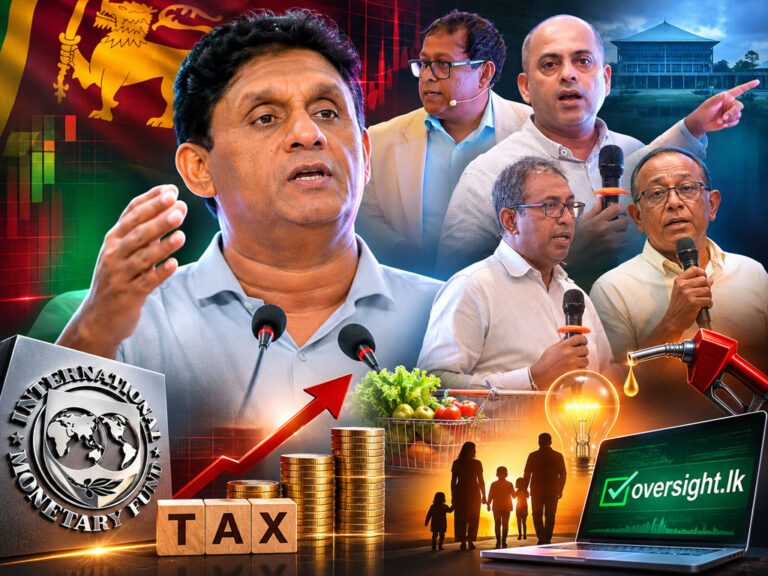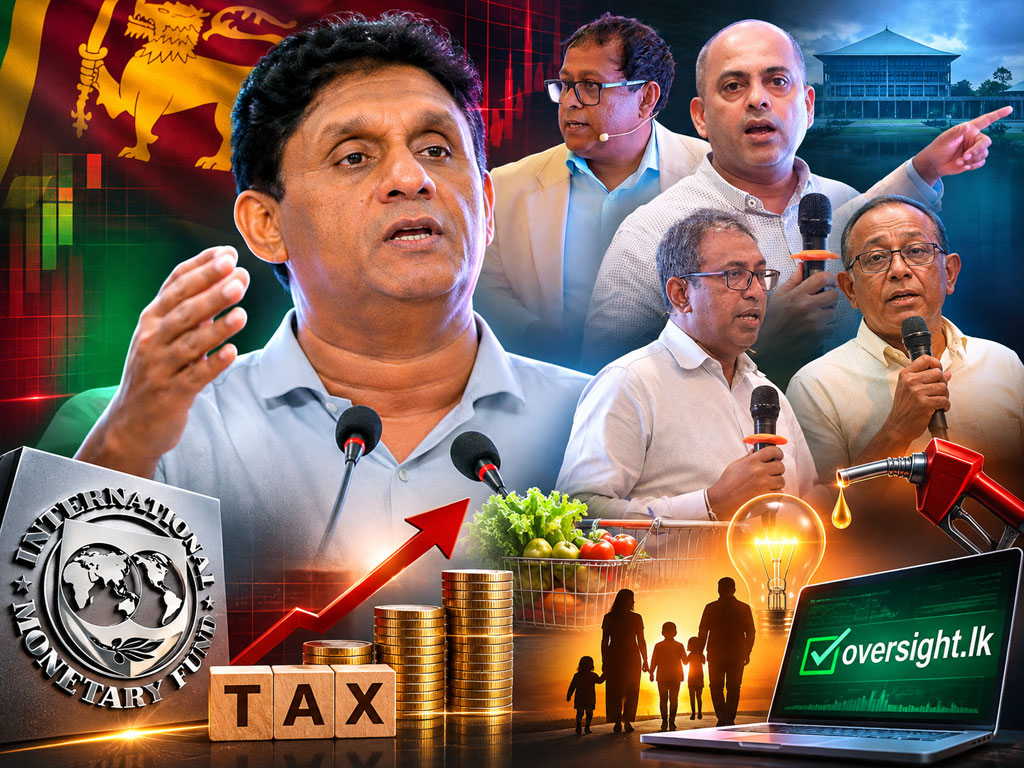
COLOMBO, November 13, 2026 – Opposition Leader Sajith Premadasa has accused President Anura Kumara Dissanayake’s government of concealing the country’s true economic position, imposing excessive taxes and failing to honour its election promises, as the Samagi Jana Balawegaya intensifies scrutiny of the 2027 Budget through a new public monitoring platform.
Premadasa made the allegations at a pre-Budget workshop attended by Opposition parliamentarians, academics and industry experts, where participants examined the government’s economic policies, taxation, poverty levels and commitments under the International Monetary Fund (IMF) programme.
He accused the administration of presenting misleading economic figures to justify its political and financial decisions, arguing that the burden of economic recovery had fallen disproportionately on working people.
The Opposition Leader also renewed his demand for a revised IMF agreement, insisting that economic reforms should protect all 22 million Sri Lankans rather than favour wealthy business interests.
His criticism was accompanied by the launch of oversight.lk, a new Opposition-backed website intended to monitor government expenditure, audit findings and the implementation of Budget commitments.

Premadasa Says Government Abandoned Its IMF Election Mandate
Premadasa argued that the government had disregarded the mandate received during the 2024 Presidential Election by continuing with the existing IMF programme instead of negotiating a new agreement.
He noted that Anura Kumara Dissanayake received approximately 42% of the vote, while the Samagi Jana Balawegaya candidate secured approximately 32%.
Combining those figures, Premadasa claimed that 74% of voters had supported political platforms advocating a revised IMF arrangement.
Both the Janatha Vimukthi Peramuna-led National People’s Power (NPP) and the SJB had indicated during the election campaign that they would seek changes to the IMF agreement, he said.
According to Premadasa, the governing party abandoned that commitment after assuming office and instead continued implementing policies that placed additional financial pressure on the public.
His interpretation of the combined vote share is a political argument rather than a direct electoral measure of public support for a particular IMF policy.
Government Accused of Going Beyond Previous Neoliberal Policies
Premadasa criticised the distribution of economic burdens under successive governments, arguing that wealthy individuals continued to benefit regardless of which political party held power.
He claimed that billionaires and trillionaires remained protected while employees and ordinary households carried the costs of fiscal adjustments.
The Opposition Leader specifically questioned the treatment of retirement savings during Sri Lanka’s domestic debt restructuring programme.
He alleged that Employees’ Provident Fund (EPF) and Employees’ Trust Fund (ETF) savings had been exposed to financial disadvantages while the banking sector’s interests were protected.
Premadasa maintained that commercial banks had not suffered comparable losses through the restructuring arrangements.
He accused the NPP administration of pursuing neoliberal economic policies even more aggressively than its predecessor, despite having criticised the IMF programme while in Opposition.
The allegations concern the distribution of costs under debt restructuring and the government’s fiscal policies. The precise financial consequences for individual funds, banks and depositors require separate examination of the restructuring terms.
New IMF Agreement Needed to Protect 22 Million Sri Lankans
Turning to the country’s external debt negotiations, Premadasa referred to the involvement of international financial advisory firm Lazard.
He noted that Lazard had also participated in debt restructuring processes in Ghana and Zambia.
The Opposition Leader criticised Sri Lanka’s adoption of Macro-Linked Bonds, arguing that the instruments could become a financial burden as the economy recovers.
Under the relevant arrangements, certain repayment obligations can increase if specified economic performance conditions are met.
Premadasa described the structure as a potential debt trap because stronger economic growth could trigger higher payments to creditors.
He said the issue had also been raised during a recent meeting between IMF representatives and Opposition members.
According to Premadasa, the country requires a new agreement that protects its entire population while ensuring that debt restructuring does not disproportionately benefit powerful financial interests.
Higher Tax Collections and Primary Surplus Criticised
Premadasa accused the government of collecting more revenue than necessary to satisfy its IMF commitments.
He claimed that the primary surplus had increased from 2.3% to 5.4%, while government revenue as a share of Gross Domestic Product had risen from 13.9% to 15.4%.
The Opposition Leader argued that these developments reflected an excessive reliance on taxation.
He maintained that the government had imposed a heavier burden on households and businesses rather than using its improved fiscal position to provide adequate relief.
Premadasa said the SJB would continue presenting proposals designed to reduce taxation and improve living standards.
The figures he cited require careful distinction between fiscal targets, actual outcomes and different reporting periods. A larger primary surplus does not, by itself, prove that taxes exceeded the requirements of the IMF programme.
Poverty Statistics and Cost-of-Living Calculations Challenged
Premadasa also disputed the government’s use of official poverty figures, questioning whether the statistical assumptions reflected the actual cost of living.
He criticised the suggestion that an individual could meet essential monthly needs with approximately Rs. 17,000.
According to the Opposition Leader, the poverty calculation relied on a daily nutritional requirement of 2,030 kilocalories per person.
Referring to figures attributed to the Medical Research Institute (MRI), he argued that nutritional requirements differ according to gender and physical activity.
He cited the following daily calorie requirements:
- Active adult male: 3,340 kilocalories.
- Average adult male: 2,340 kilocalories.
- Active adult female: 2,680 kilocalories.
- Average adult female: 1,890 kilocalories.
Premadasa argued that poverty assessments should take account of these differences rather than relying on a single nutritional benchmark.
He further claimed, citing the World Bank, that nearly 60% of Sri Lanka’s population was living in poverty.
That assertion requires qualification. The World Bank’s October 2026 Sri Lanka Development Update estimated the poverty rate at 16.9% in 2025 using its US$4.20-a-day international poverty line. The 60% figure should not therefore be presented as the World Bank’s official poverty-headcount estimate without identifying a different measurement or source.
Premadasa nevertheless maintained that significant numbers of Sri Lankans continued to struggle with food costs, taxation and inadequate incomes despite improvements in economic indicators.
Aswesuma Beneficiary Selection Questioned
The Opposition Leader also challenged the effectiveness of the Aswesuma welfare programme.
He questioned whether financial assistance was consistently reaching households genuinely experiencing poverty.
Premadasa compared the programme with its predecessor, Samurdhi, claiming that deserving families were sometimes excluded while individuals who did not meet the eligibility requirements received benefits.
He criticised the beneficiary selection process, alleging that local government officials had not been adequately involved.
Instead, he claimed, decisions had been concentrated within a limited group of individuals.
Premadasa called for the introduction of an improved Janasaviya programme, with more accurate poverty identification and stronger safeguards to ensure that welfare payments reached eligible families.
Development Bank Proposed for Young Entrepreneurs and MSMEs
Premadasa also outlined the need to strengthen Sri Lanka’s productive economy, particularly agriculture, fisheries, labour-intensive industries and businesses established by young entrepreneurs.
He called for a new development bank dedicated to supporting micro, small and medium-sized enterprises (MSMEs).
According to the Opposition Leader, such an institution could provide financial assistance to entrepreneurs struggling to access conventional bank credit.
He argued that the proposed bank would also be important for implementing the government’s ambition of creating one million new entrepreneurs.
Premadasa claimed that the initiative had yet to produce the promised results.
Although Budget allocations had reportedly been made to assist MSMEs, he alleged that many struggling businesses were still unable to obtain the support they needed.
He also referred to approximately 250,000 micro, small and medium-sized enterprises that reportedly closed during the 2022 economic crisis.
The Opposition Leader called for more effective financial support to revive failed businesses, encourage investment and create employment opportunities.
Government Challenged Over Unfulfilled Budget Promises
Premadasa urged the administration to account for commitments made during previous Budget presentations and election campaigns.
Among the promises he cited were:
- A 33% reduction in electricity bills.
- Supplying fuel at the price at which it is unloaded at the port.
- Providing 1.2 million Vitz cars.
- Providing 50,000 motorcycles.
- Removing VAT from school supplies.
He accused the government of failing to deliver these commitments within the periods anticipated by the public.
The Opposition Leader maintained that promises involving household expenditure and transport affordability should be assessed against measurable results rather than repeated political assurances.
The status and original wording of each commitment require separate verification before they can be classified definitively as unfulfilled.
Opposition Launches Website to Monitor Budget Performance
Alongside its criticism of government economic policies, the Opposition launched a new public monitoring website, oversight.lk, on November 11.
Introduced under Premadasa’s instructions, the platform is designed to examine the implementation of government Budget proposals and provide accessible information about public expenditure.
The website is intended to monitor commitments made through the government’s first two Budgets and the proposals contained in the 2027 Budget presented by President Dissanayake on November 12.
Its planned information resources include:
- Progress reports on previous Budget commitments.
- Ministry-by-ministry performance assessments.
- Information concerning government institutions.
- Public-sector audit findings and related observations.
- Analysis of government revenue and expenditure.
The Opposition says the initiative will allow citizens to compare government announcements with implementation and assess how public funds are managed.
For Premadasa and the SJB, the challenge now extends beyond criticising the government’s economic policies.
Having launched a platform dedicated to financial oversight, the Opposition will also be expected to demonstrate that its assessments are accurate, transparent and supported by verifiable evidence.
Whether oversight.lk becomes a credible public accountability tool will depend on the quality of its information and its ability to distinguish political criticism from independently established financial findings.