Two tournaments lost, millions in potential revenue forfeited and Sri Lanka’s voice restricted at the ICC as reforms remain unfinished.
COLOMBO, November 17, 2026 — Sri Lanka’s cricketing future has come under renewed scrutiny after revelations that the country has been excluded from the hosting arrangements for several major International Cricket Council tournaments, raising serious questions about the financial and sporting consequences of repeated government intervention in cricket administration.
A report published by the Daily FT on Tuesday states that Sri Lanka has failed to secure major men’s ICC tournament hosting rights in the latest cycle, with India and Bangladesh emerging among the principal Asian beneficiaries.

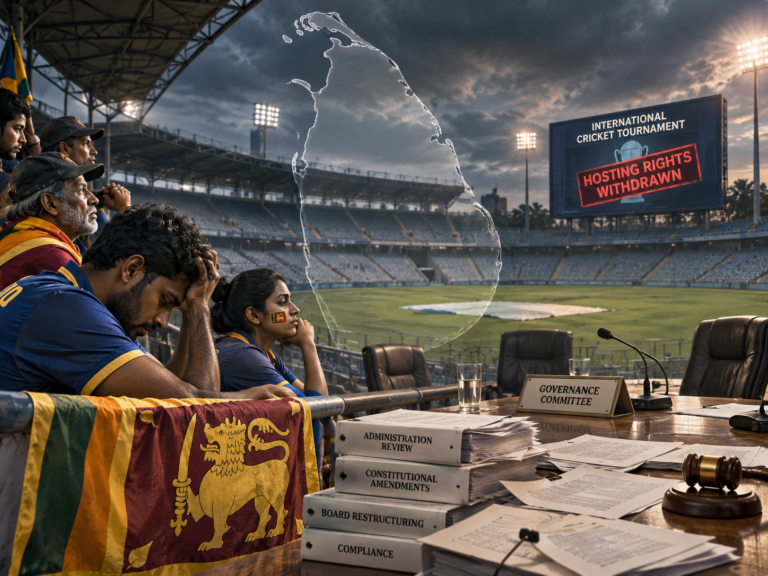
The development follows earlier decisions that deprived Sri Lanka of hosting two ICC tournaments, including the 2024 Under-19 Men’s Cricket World Cup and the inaugural Women’s Champions Trophy scheduled for 2027.
The controversy centres on the International Cricket Council’s governance requirements and Sri Lanka’s repeated reliance on government-appointed interim administrative bodies.
India and Bangladesh emerge as beneficiaries
Following its latest Board meetings in Bali, Indonesia, the ICC confirmed the scheduling of major men’s tournaments through 2035.
India will host the 2029 Champions Trophy, while India and Bangladesh will jointly stage the 2031 Men’s Cricket World Cup.
The 2028 T20 World Cup will be hosted by Australia and New Zealand, with England, Ireland and Scotland staging the 2030 edition.
Sri Lanka does not feature among the confirmed hosts of these tournaments.
However, several competitions scheduled from 2032 onward still have hosts listed as unconfirmed. Therefore, while Sri Lanka has been excluded from the currently confirmed arrangements, it would be premature to conclude that every hosting opportunity through 2035 has definitively disappeared.
The cost of government-appointed committees
The central issue involves the relationship between national cricket administration and political authorities.
The ICC requires member boards to maintain independence from inappropriate government interference.
Sri Lanka Cricket’s administrative structure has repeatedly been disrupted by disputes over governance, electoral arrangements and government intervention.
Following the resignation of the elected executive committee, the Government appointed a Cricket Transformation Committee to oversee constitutional and administrative reforms.
According to the Daily FT, the absence of an elected administration has affected Sri Lanka’s representation at ICC Board meetings.
The committee has been tasked with introducing a new constitution and reforming the country’s cricket administration, an objective supporters regard as necessary to address long-standing governance problems.
However, even reforms intended to strengthen accountability must satisfy ICC requirements if Sri Lanka is to maintain its position within international cricket.
The result is a complicated situation in which domestic efforts to reform cricket administration risk creating international consequences.
Sri Lanka has already lost two tournaments
The latest controversy follows two significant hosting setbacks.
In November 2023, the ICC relocated the 2024 Under-19 Men’s Cricket World Cup from Sri Lanka to South Africa after governance-related concerns.
More recently, Sri Lanka lost the hosting rights for the inaugural Women’s Champions Trophy, scheduled for February 2027.
That competition was transferred to India, with matches allocated to Mumbai and Vadodara.
Sri Lanka Cricket formally acknowledged the decision in September 2026 while confirming that the Sri Lankan women’s team had nevertheless qualified for the tournament.
These developments demonstrate that the consequences of cricket administration disputes extend beyond boardroom disagreements.
They can directly affect hosting opportunities, infrastructure planning, tourism and the commercial value of international sporting events.
Millions of dollars in potential revenue lost
The financial consequences may be substantial.
According to previously published reports, Sri Lanka’s loss of the 2027 Women’s Champions Trophy was associated with an estimated US$20 million in potential revenue and economic activity.
The Daily FT also reported a forfeited hosting fee of approximately US$2 million.
Such estimates should be distinguished from audited losses. They encompass potential financial benefits and should not be interpreted as money already received by Sri Lanka Cricket.
Nevertheless, hosting international cricket brings substantial opportunities for hotels, transport providers, restaurants, broadcasters, sponsors and local businesses.
Large tournaments also provide employment opportunities and showcase Sri Lanka to international audiences.
For a country seeking tourism revenue and foreign exchange, the loss of international sporting events carries consequences beyond the cricket field.
Who must take responsibility?
Sri Lanka’s recurring cricket governance disputes raise an uncomfortable question about accountability.
Government authorities have argued that administrative reform is necessary to improve transparency and governance within Sri Lanka Cricket.
At the same time, the ICC’s independence requirements place clear limits on political intervention.
Both considerations are important.
The challenge is to establish a credible administrative structure that addresses governance concerns without jeopardising Sri Lanka’s international standing.
The country’s cricket authorities must now explain how quickly an ICC-compliant governance structure can be established and whether Sri Lanka can actively pursue future tournament hosting opportunities.
Equally important is whether previous financial losses and missed opportunities have been properly assessed.
The fans ultimately pay the price
Sri Lanka has a proud history of hosting international cricket, including major World Cup competitions.
The country’s passionate supporters have helped make Colombo, Kandy and other cricketing centres internationally recognised venues.
Yet administrative instability now threatens opportunities that extend well beyond the national team’s performances.
The players may continue competing internationally, but Sri Lankan supporters could find themselves travelling overseas to watch tournaments their own country might otherwise have hosted.
The greatest cost of cricket’s governance failures may ultimately be paid by the supporters, athletes and businesses who had no role in creating them.
Sri Lanka does not merely need another cricket administration reform.
It needs a lasting solution that protects both the integrity of its cricket institutions and the country’s place in international sport.