By Marlon Dale Ferreira
Sri Lanka’s Right to Information Commission records a significant breakthrough in Captain Anil Jayasinghe’s pursuit of answers over alleged aviation licensing irregularities, as CIABOC discloses that its investigation is nearing completion.
COLOMBO, Sri Lanka — In a significant victory for transparency and accountability, Sri Lanka’s Right to Information (RTI) Commission has issued its decision following an appeal by veteran airline pilot Captain Anil Jayasinghe, with the Commission to Investigate Allegations of Bribery or Corruption (CIABOC) revealing that its investigation into an aviation-related bribery and corruption complaint is approximately 95% complete.
The disclosure was made during an RTI Commission hearing on 30 September 2026, more than two years after Captain Jayasinghe originally lodged his complaint.
During proceedings, CIABOC’s Director of Complaints Management and Designated Officer, Roshan Amarasinghe, together with Assistant Director and Information Officer R. A. Thamara Rupika, represented the public authority.
According to the Commission’s written decision, CIABOC informed the commissioners that the relevant investigating officer had confirmed approximately 95% of the investigation was complete, with a further two to three months estimated before its conclusion.
The revelation represents a significant development in a case that has raised questions about aviation regulatory oversight, transparency and the handling of complaints involving officials entrusted with aviation safety.
A Two-Year Battle for Answers
Questions surrounding aviation safety, regulatory accountability and public access to information came into sharp focus as Captain Jayasinghe pursued his appeal before the RTI Commission, seeking an update on the status of an investigation into a complaint lodged more than two years earlier.
The Morning Telegraph, in an article published on 3 August 2026, highlighted how the appeal and the eventual decision of the RTI Commission could set an important precedent regarding the public’s right to obtain information responsibly, particularly where matters of substantial public interest are concerned.
What began as a complaint further raises allegations concerning the official’s subsequent employment as a pilot with private airline FitsAir, suggesting a possible quid pro quo arrangement.
The concerns arise partly because the official had previously exercised regulatory responsibilities involving the same airline while serving at CAASL.
These allegations remain unproven, and no finding of bribery, corruption or wrongdoing against the official has been established through the information available in the RTI Commission’s decision.
Captain Jayasinghe maintains that the complaint raises broader concerns about aviation licensing, the independence of regulatory oversight, aviation safety policy and the potential consequences of corruption within an authority responsible for safeguarding the country’s civil aviation system.
Parliamentary Scrutiny and an Earlier Investigation Report
According to Captain Jayasinghe’s submissions to the RTI Commission, a petition had also been filed before the Committee on Public Enterprises (COPE), creating a separate avenue of parliamentary scrutiny.
He further stated that an investigation report was provided to CIABOC in June 2025.
The report, identified under reference DG/10/02(CA/24/381) and dated 4 September 2024, had reportedly been compiled by CAASL and submitted through the Ministry of Ports, Shipping and Civil Aviation.
Captain Jayasinghe’s submissions indicate that he considered this material relevant to the investigation of his original complaint.
Repeated Requests Met With Silence
Captain Jayasinghe appeared before CIABOC in August 2024 to provide a formal statement concerning his complaint.
He subsequently sought updates on the progress of the investigation, including requests addressed to the relevant authorities in February and September 2025.
According to his account, these attempts failed to produce a meaningful response.
On 24 November 2025, he submitted a formal Right to Information request to CIABOC’s Information Officer and Designated Officer, seeking information about the status of his complaint.
Further correspondence followed in December 2025 and January 2026.
However, Captain Jayasinghe maintained that his requests were neither acknowledged nor answered within the statutory time limits, raising concerns regarding compliance with Sections 24(3) and 25(1) of the Right to Information Act.
The RTI Commission’s decision subsequently recorded that both the Information Officer and Designated Officer had failed to respond within the periods stipulated by law.
Faced with this continued absence of information, Captain Jayasinghe pursued an appeal before the RTI Commission.
CIABOC Responds After RTI Proceedings Begin
Following the initiation of the RTI appeal process, CIABOC reportedly informed Captain Jayasinghe by letter dated 21 April 2026 that the investigation was ongoing and had not yet been concluded.
However, Captain Jayasinghe argued that merely stating an investigation remained pending did not provide a meaningful indication of its progress.
He sought clarification as to whether the investigation was actively progressing and whether further investigative steps or action were anticipated.
At the centre of the dispute was the question of whether information concerning an ongoing investigation could be withheld from the individual who had originally submitted the complaint.
CIABOC had relied on concerns regarding the disclosure of material that could prejudice an investigation.
Captain Jayasinghe maintained that this interpretation mischaracterised the nature of his request.
He emphasised that he was not seeking confidential evidence, witness statements, investigative reports or access to sensitive material.
Instead, he wanted a basic and meaningful update on the progress of the complaint he had personally lodged.
His submissions referred to the Right to Information Act No. 12 of 2016, including provisions governing statutory response deadlines, exemptions from disclosure, the public-interest override and the responsibility of public authorities to justify withholding requested information.
Three Aviation Accidents Highlight Broader Safety Concerns
In a further submission dated 23 September 2026, Captain Jayasinghe drew the RTI Commission’s attention to three separate aviation accidents reported in Sri Lanka during 2026.
He argued that the incidents demonstrated the continuing importance of effective aviation safety management and regulatory accountability.
The incidents cited included:
- 7 January 2026: A Cinnamon Air Cessna 208 Caravan reportedly crashed while attempting to land on Lake Gregory in Nuwara Eliya.
- 29 July 2026: A powered paraglider reportedly crashed into the sea off Bentota during a sightseeing flight, killing a 31-year-old foreign passenger. The pilot survived.
- 25 August 2026: A Cessna 152 operated by Redbird Aviation/Fly Southern reportedly crashed during a training flight at Ratmalana Airport. The trainee pilot escaped unharmed, while the aircraft sustained substantial damage.
Captain Jayasinghe pointed out that each incident had occurred before a hearing in his RTI appeal.
Although the accidents involved different aircraft and aviation activities, he argued that all fell within the broader regulatory oversight responsibilities of CAASL.
In his submission, the common concern was the importance of ensuring the effectiveness of licensing, certification, surveillance and regulatory oversight.
Anti-Corruption Act Raises Further Questions About Disclosure
A further issue raised by Captain Jayasinghe concerned written submissions filed by CIABOC before the RTI Commission on 14 September 2026.
According to his submissions, CIABOC had referred to Section 44(1)(c) of the Anti-Corruption Act No. 9 of 2023.
Captain Jayasinghe argued that this provision supported the principle that complainants may receive basic information about the progress of investigations, provided such disclosure does not compromise investigative proceedings.
He maintained that a limited update confirming whether an investigation remained active and how far it had progressed was fundamentally different from disclosing confidential investigative material.
Importantly, Captain Jayasinghe expressly clarified that he was not alleging CIABOC’s delay had caused any of the aviation accidents cited in his submissions.
Rather, he argued that aviation regulatory integrity and public safety remained matters of substantial public interest while his complaint continued to be investigated.
He also linked these concerns to CAASL’s statutory responsibilities under the Civil Aviation Act No. 14 of 2010 and the accompanying aviation regulatory framework.
His position remained consistent: if an investigation is genuinely active, the complainant should be entitled to receive basic information about its progress to the extent permitted by law. If it is no longer active, that status should likewise be communicated.
RTI Commission Hearing Forces a Meaningful Disclosure
The appeal ultimately raised a broader question concerning the balance between investigative confidentiality and the public’s right to information.
Can a complainant obtain meaningful information about an investigation without compromising its confidentiality?
In Captain Jayasinghe’s case, the proceedings produced precisely the kind of update he had repeatedly requested.
The RTI Commission’s written decision records that it had previously directed CIABOC to clarify why it could not disclose information concerning the current progress of the complaint beyond merely stating that it was pending.
Following that direction, CIABOC consulted the relevant investigating officer, who confirmed that the investigation was approximately 95% complete, with an estimated completion period of another two to three months.
The Commission also clarified that Captain Jayasinghe was seeking information about the status of the investigation rather than confidential investigative reports, disclosures or substantive evidence.
When asked whether the information provided at the hearing addressed his concerns, Captain Jayasinghe indicated that he was satisfied as to whether the investigation was genuinely active.
The appeal was consequently concluded.
While the order does not establish a universal entitlement to all investigative information, it demonstrates that an appropriately limited status update can be provided without necessarily compromising the confidentiality of an investigation.
Official RTI Commission Order Confirms Investigation Is 95% Complete
The official RTI Commission order, issued under RTIC Appeal No. 295/2026, records the disclosure made by CIABOC during the hearing of 30 September 2026.
The decision was communicated under a covering letter dated 23 October 2026.
The three-page decision, together with the covering letter, records the Commission’s consideration of the appeal, the position presented by CIABOC and the circumstances under which the appellant agreed that his central concern had been addressed.
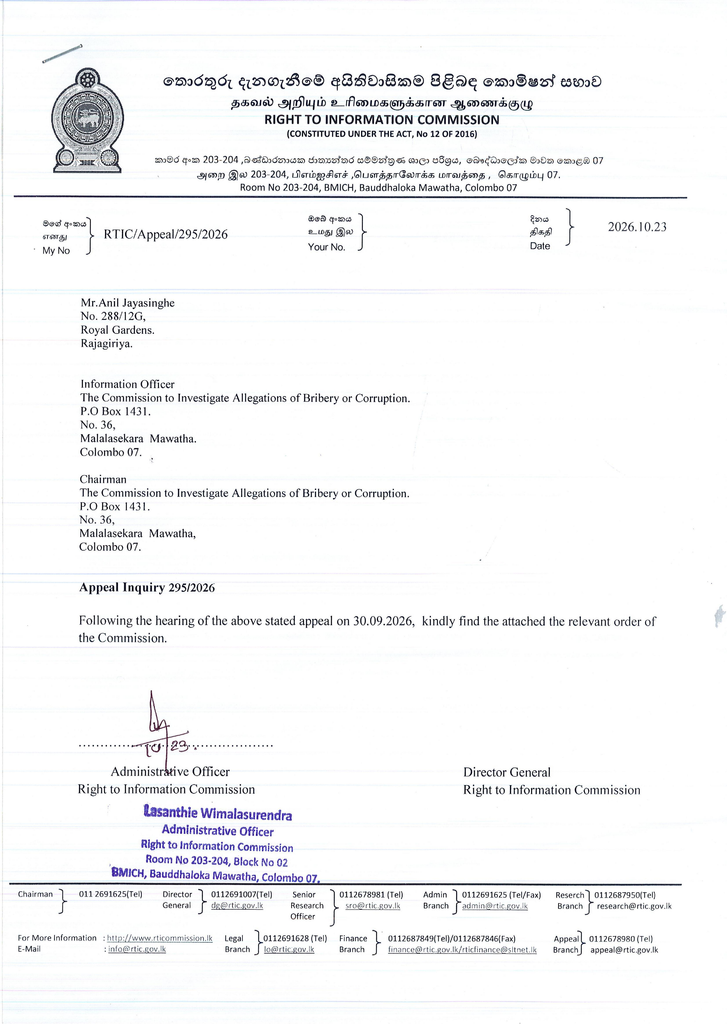
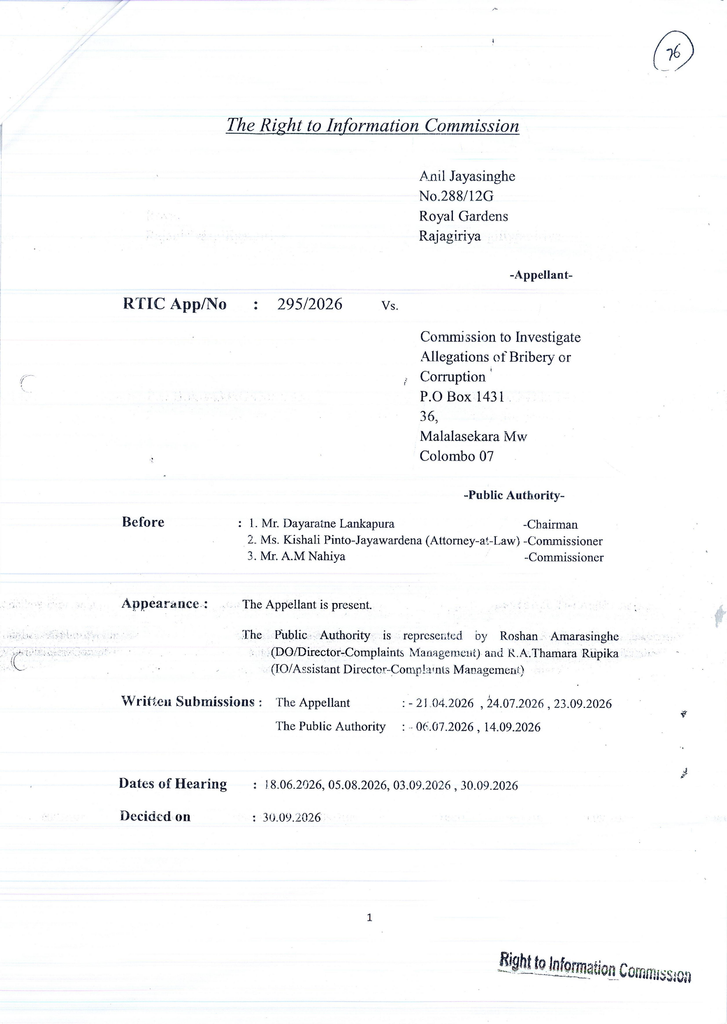
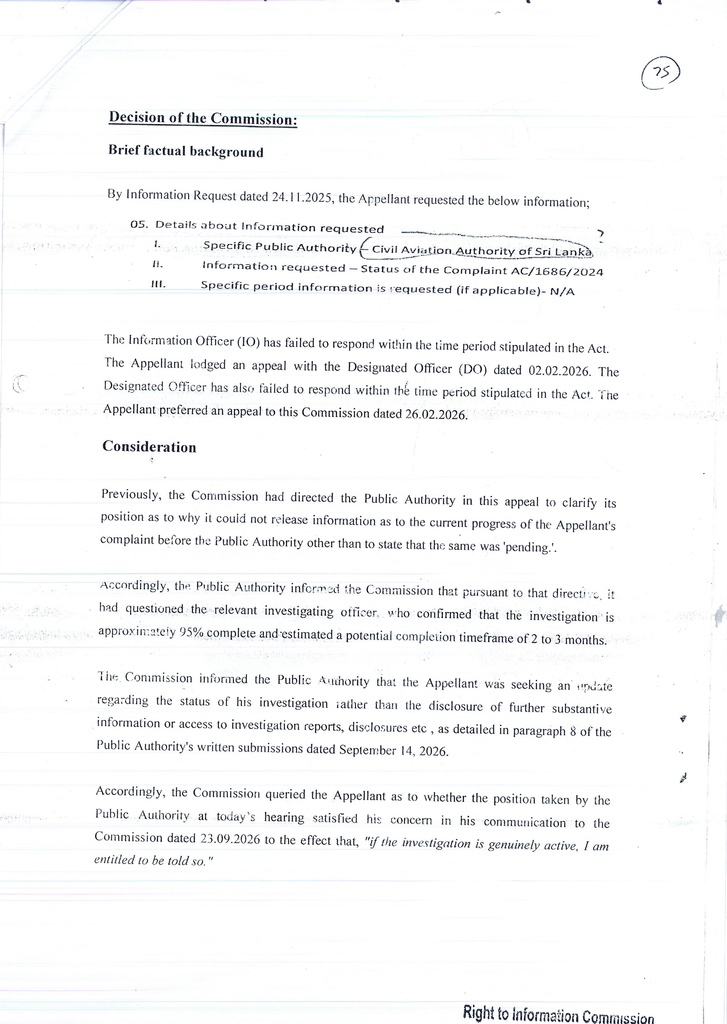
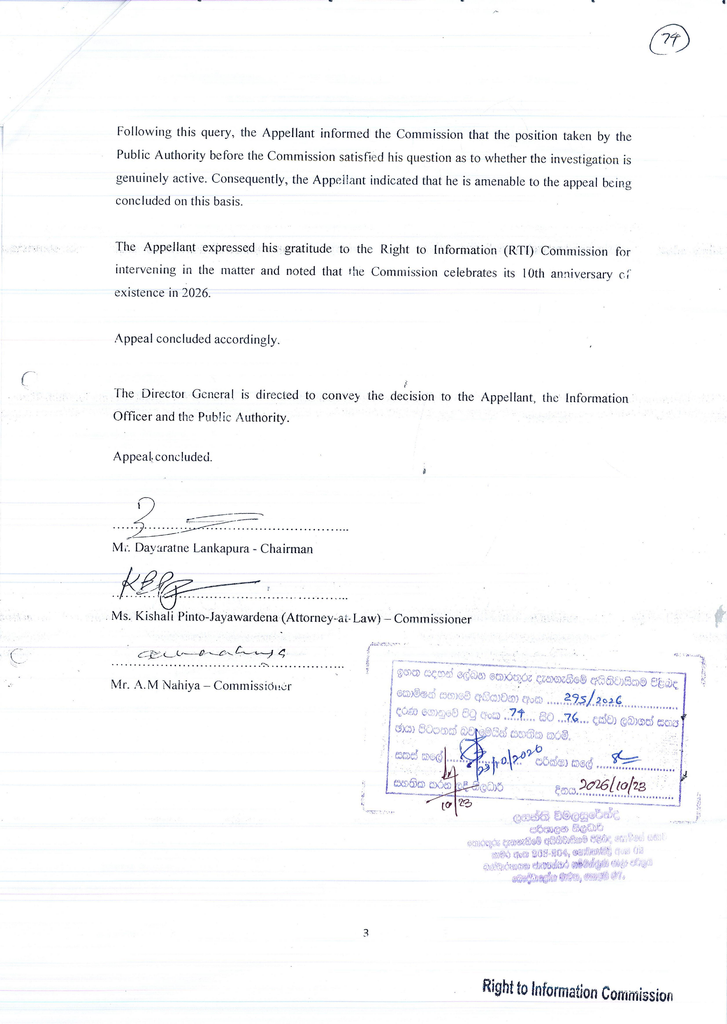
Document: Right to Information Commission, RTIC Appeal No. 295/2026, decided on 30 September 2026 and communicated on 23 October 2026.
A Victory for Transparency, but the Investigation Remains Unfinished
The proceedings represent a meaningful transparency victory for Captain Jayasinghe, who pursued answers over a prolonged period despite repeated unsuccessful requests.
His appeal demonstrates that investigative confidentiality need not automatically prevent the disclosure of basic information concerning the status of a complaint.
It also places renewed attention on CIABOC’s responsibility to bring the underlying investigation to an appropriate conclusion and communicate its outcome in accordance with the law.
The Commission’s decision itself concluded the RTI appeal after Captain Jayasinghe accepted the clarification that the investigation was genuinely active. It did not determine the merits of the original corruption allegations or issue a binding deadline for the completion of CIABOC’s investigation.
Nevertheless, the estimated two-to-three-month completion period disclosed at the September hearing places the anticipated conclusion towards the end of December 2026.
Based on that estimate, the investigation could be expected to reach its conclusion by approximately 31 December 2026, although the date is an expectation arising from CIABOC’s stated timeframe rather than a formal deadline imposed by the RTI Commission.
For Captain Jayasinghe, the immediate struggle to establish whether his complaint was being actively investigated has produced an answer.
For CIABOC, the greater task remains unfinished.
After more than two years, a 95% complete investigation must now be measured not merely by the progress reported, but by its eventual findings, the fairness of the investigative process and the accountability that follows.
The public interest in this case extends beyond the career of one aviation official or the persistence of one complainant.
It concerns the integrity of an aviation regulatory system entrusted with protecting passengers, aircrews and the travelling public.
Captain Jayasinghe has fought for the right to know whether his complaint was being investigated. The next question is whether that investigation will deliver the answers the country deserves.