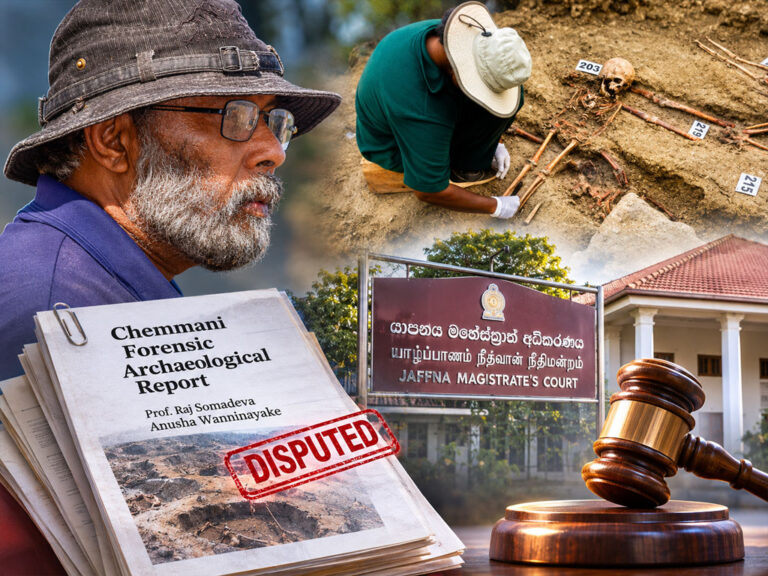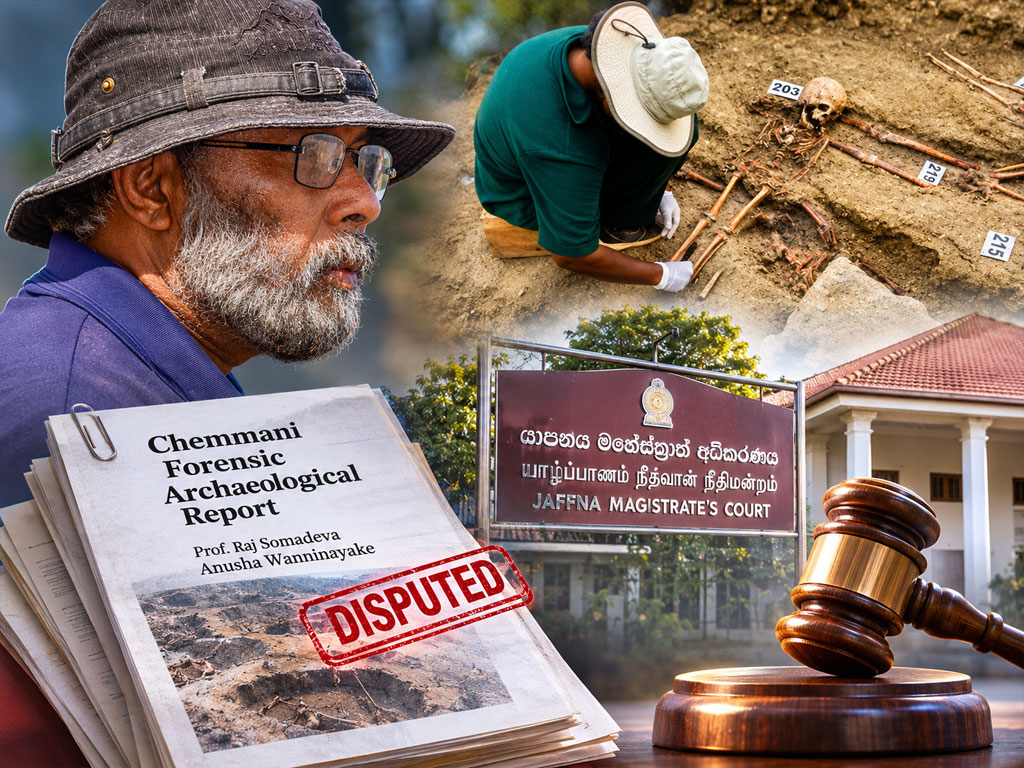
JAFFNA, November 20, 2026 — The Jaffna Magistrate’s Court has decided that further proceedings in the Chemmani mass grave investigation need not rely on a disputed archaeological report prepared by Professor Raj Somadeva and Anusha Wanninayake, following objections from lawyers representing families of the disappeared and concerns over inconsistencies with earlier findings.
The decision followed a hearing on November 19 before Jaffna Magistrate S. Lenin Kumar, during which lawyers challenged the report’s suggestion that the burial site displayed characteristics more consistent with formal burial practices than clandestine disposal of human remains.
The court did not formally reject the report. Instead, it determined that the investigation could proceed without relying on its conclusions, after finding no reasonable explanation for differences between the archaeologists’ earlier assessments and their latest findings.
The proceedings have renewed scrutiny of the investigation into one of Sri Lanka’s largest discoveries of human remains, with 583 sets of skeletal remains reported recovered during three phases of excavations at Chemmani.

Archaeologists’ Findings Challenged Over Burial Conclusions
The disputed report, titled “Forensic Archaeological Excavation in Chemmani, Jaffna (2025/2026): A Summary Report on Findings,” was prepared by Professor Raj Somadeva and archaeologist Anusha Wanninayake and submitted to the Jaffna Magistrate’s Court in October 2026.
The report, described as a 190-page submission, states that the available physical evidence is insufficient on its own to establish a definitive conclusion about the nature and characteristics of the burials.
Its authors nevertheless argued that the archaeological evidence indicated greater similarities with sites associated with formal burial practices than with clandestine burial locations documented elsewhere.
The report also considered whether an epidemic or natural disaster could explain the concentration of human remains, while acknowledging that additional scientific examinations would be necessary before definitive conclusions could be reached.
These interpretations have been challenged by families of the disappeared and their legal representatives, who argue that the report does not adequately account for the physical condition of the remains, their locations, the historical background of the area and evidence recorded during earlier excavations.
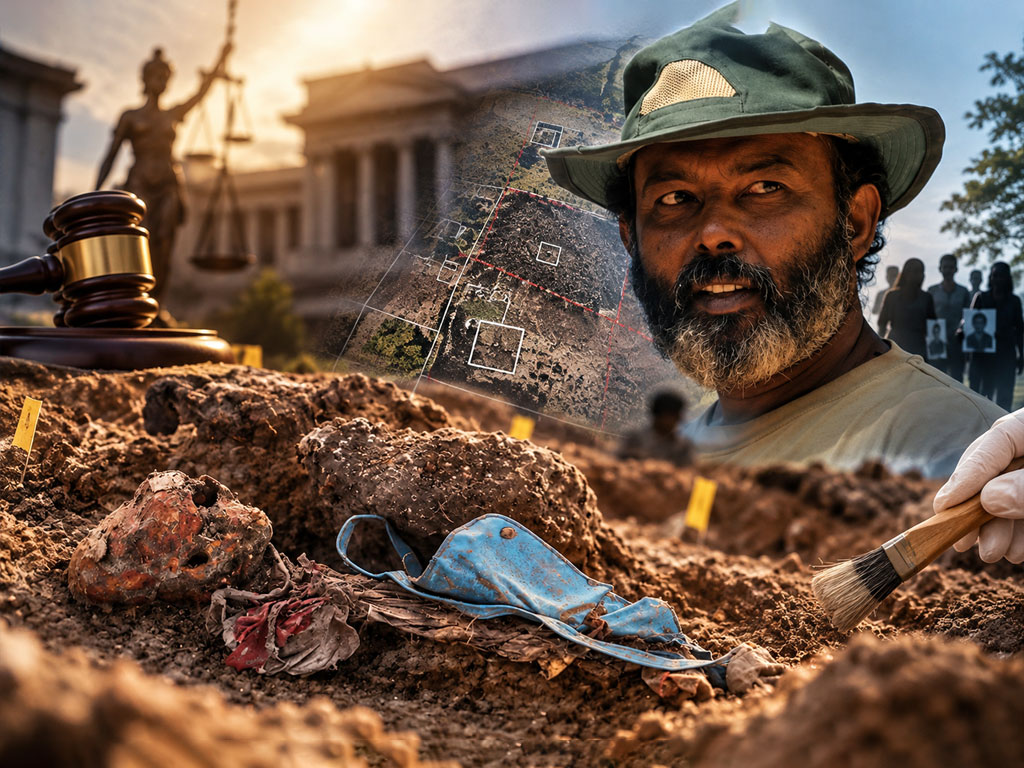
Families Challenge Somadeva’s Chemmani Excavation Report
Families of the disappeared have asked the Jaffna Magistrate’s Court to scrutinise an interim archaeological assessment suggesting that the Chemmani site resembles a formal burial ground, arguing that critical forensic and historical questions remain unanswered.
Sumanthiran Identifies Contradictions in Expert Evidence
President’s Counsel and former Parliamentarian M. A. Sumanthiran, representing affected families, told journalists following the hearing that the court had been informed of shortcomings and contradictions in the archaeologists’ latest report.
According to Sumanthiran, lawyers representing the families and the Office on Missing Persons argued that the court should not determine the investigation’s future course solely on the basis of Somadeva’s findings.
Objections included alleged inconsistencies with earlier reports, insufficient supporting evidence for certain interpretations and the absence of a satisfactory explanation for changes in the archaeologist’s assessment.
The court subsequently determined that its next decisions need not depend on the disputed report.
Sumanthiran also challenged the suggestion that an epidemic could account for the burials, referring to the discovery of coins bearing dates later than the last recorded major epidemic cited during the proceedings.
The historical significance of those objects remains subject to archaeological interpretation. A coin’s date of manufacture does not, by itself, establish when the associated burial occurred, particularly where its original location or relationship to human remains is uncertain.
Court Defers Decision on Carbon Dating
The hearing also examined proposals for further scientific testing, including radiocarbon dating of skeletal remains recovered from the excavation site.
Senior Attorney K. S. Ratnavel, Executive Director of the Centre for Human Rights and Development, said the court had discussed the interim report and indicated that no further action would be taken on the basis of its disputed conclusions.
He explained that the forensic medical team had provided details of specialists expected to participate in further examination of the recovered bone fragments.
The Criminal Investigation Department had requested carbon dating to help establish the approximate period to which the remains belonged.
No order authorising that procedure was made during the November 19 hearing.
The court instead allowed consideration of other scientific methods and requested proposals concerning laboratories capable of undertaking appropriate testing.
Lawyers representing affected families have also emphasised the importance of DNA examination, particularly because establishing the identities of the deceased remains central to the investigation.
Carbon dating can help estimate the age of biological material, while DNA analysis can support identification through comparison with genetic samples provided by relatives.
Office on Missing Persons Commissioner Mirak Raheem confirmed that the parties are expected to return to court on December 14 to discuss the scientific methods and laboratories that could be used in the next stage of the investigation.
Families Reject Report and Demand International Investigation
Attorney Kanagaratnam Sugas of the Tamil National People’s Front told journalists that the affected families had rejected the archaeologists’ conclusions and continued to demand an investigation involving international participation.
Their objections followed a formal petition submitted to the court by Attorney Kasthuri Ahalangan on behalf of affected parties.
The nine-page submission challenged the report’s observations, interpretations and conclusions, arguing that it had failed to examine sufficiently the material circumstances surrounding the discovery of the human remains.
In particular, the petition questioned whether the available evidence justified treating the site as an ordinary burial ground without adequately considering its archaeological context, the positioning of the skeletons and the history of the surrounding area.
The families also challenged the suggestion that conventional burial practices could explain the discoveries without a more comprehensive forensic assessment.
Their demand for international participation reflects longstanding concerns among relatives of the disappeared over the credibility, independence and transparency of investigations into alleged wartime abuses.
Excavations Recover 583 Sets of Human Remains
Excavations at the Chemmani-Siththupaththi site began in May 2025 following the discovery of human remains earlier that year.
Across three phases of excavation conducted over approximately 110 days, investigators reported recovering 583 sets of human remains, including those of children and infants.
Excavation activity was temporarily suspended on August 19, 2026, after the completion of the third phase.
The archaeologists’ interim report recorded a minimum of 574 individuals, a figure that differs from the cumulative recovery total announced at the conclusion of the excavations.
The report also documented numerous objects recovered from the site, including personal belongings and other materials potentially relevant to determining the circumstances of the burials.
Items reported during the excavations included children’s belongings, feeding bottles, bags, raincoats and dolls. The material recovered remains subject to judicial oversight and forensic examination.
The presence and positioning of skeletal remains, the condition of associated objects and the circumstances in which bodies were deposited are among the issues that investigators must examine to determine whether the site reflects conventional burials, unlawful disposal of bodies or other circumstances.
Human Rights Commission Raised Concerns Over Unlawful Burials
In September 2025, the Human Rights Commission of Sri Lanka published findings from a fact-finding investigation into the Chemmani excavation.
The Commission reported that the positioning of some skeletal remains, their proximity to one another and the shallow depth at which they were found suggested a reasonable likelihood that the burials were unlawful and connected to extrajudicial killings.
Its assessment did not amount to a final judicial determination of the cause or circumstances of death.
The Commission called for a credible, transparent and scientifically guided investigation capable of establishing the identities of those buried and ensuring accountability where evidence of criminal wrongdoing is established.
Chemmani has carried particular historical significance since allegations concerning mass burials in the area emerged during the 1990s, including claims linked to disappearances and alleged abuses during Sri Lanka’s civil war.
Those allegations have continued to shape demands for independent forensic examination and meaningful participation by families searching for missing relatives.
December 14 Hearing to Determine Next Investigative Steps
The Jaffna Magistrate’s Court is expected to revisit the scientific investigation on December 14, when the parties will provide further submissions concerning testing procedures and potential laboratories.
The next stage will be important in determining how the recovered remains are examined, whether additional dating procedures are authorised and how identification efforts can progress.
For the families who have challenged the archaeological report, the central issue remains the establishment of reliable evidence about the identities of the deceased and the circumstances in which their remains came to be buried at Chemmani.
The court’s decision not to rely on Somadeva’s latest assessment leaves those questions open, with further forensic investigation and judicial scrutiny necessary before any definitive conclusions can be reached.