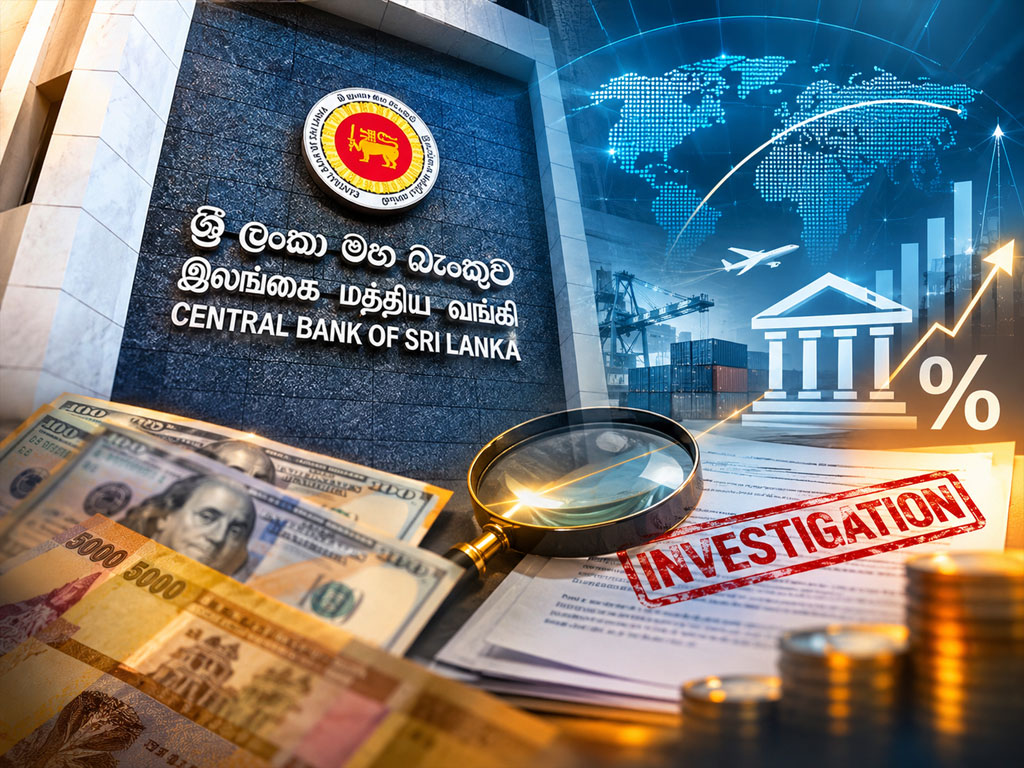
COLOMBO, November 22, 2026 — Sri Lanka is investigating approximately US$1 billion in suspicious foreign exchange transfers as the Central Bank raises its policy rate to 9% and reserve requirements to 3%. New findings expose weaknesses in import controls and banking oversight.
The findings emerged as the Central Bank announced further monetary tightening on November 20, 2026, raising its Overnight Policy Rate (OPR) to 9.00% and increasing the Statutory Reserve Ratio (SRR) to 3.00% to absorb excess liquidity and contain mounting inflationary pressures.
Central Bank Governor Dr. Nandalal Weerasinghe disclosed that investigators had identified individuals using multiple companies and commercial bank branches to transfer dollars overseas through import advance payment facilities, without subsequently bringing the goods into Sri Lanka.
The broader investigation concerns approximately US$1 billion, equivalent to nearly Rs. 300 billion, in suspected irregular telegraphic transfers since 2023. That figure represents the value under investigation and should not be interpreted as an independently established amount of fraud.
The latest disclosures also come amid growing attention to unregulated digital lending, the Gampaha District Sanasa financial crisis and the Government’s fiscal programme following Parliament’s approval of the second reading of the 2027 Budget.

How the US$50,000 Import Advance Scheme Operated
According to the Central Bank Governor, weaknesses in the procedures governing import advance payments allowed individuals to repeatedly transfer foreign currency overseas while avoiding timely scrutiny.
Under an earlier Ministry of Finance circular, commercial banks were permitted to release advance payments of up to US$50,000 upon presentation of an invoice for the intended importation of goods.
Transactions were expected to be recorded through Sri Lanka Customs’ ASYCUDA system, with the relevant goods imported within 180 days.
Where goods failed to arrive within that period, Customs was responsible for notifying the Central Bank’s Department of Foreign Exchange so that appropriate regulatory or legal action could be considered.
Investigators subsequently discovered serious weaknesses in this reporting arrangement.
Customs had not supplied the necessary information to the Central Bank for an extended period, despite repeated requests. Authorities also identified transfers that had not been recorded in Customs’ systems.
The absence of timely information prevented investigators from identifying the full extent of the irregular remittances.
Banking inquiries further revealed that the same individuals had approached different commercial bank branches while representing different companies, repeatedly obtaining import advances of US$50,000.
The investigation raised concerns about the effectiveness of customer verification, beneficial ownership checks and coordination between financial institutions and Customs.
Authorities are examining whether the transactions involved fictitious companies, misrepresentation of import activity or other violations of foreign exchange regulations.
New Banking Controls and Legal Action Against Suspected Abuses
Following the discovery, the Central Bank and relevant government agencies introduced additional measures intended to prevent repeated misuse of import advance facilities.
The principal changes include:
- Mandatory Tax Identification Numbers: Applicants seeking import advance payments must provide a Tax Identification Number (TIN), strengthening the ability of authorities to identify and trace transactions.
- Beneficial ownership verification: Banks and relevant regulators must examine the identities of applicants, the ownership of companies and their transaction histories before approving payments.
- Cross-bank transaction checks: A mechanism has been introduced to identify applicants who have already obtained import advances through other commercial banks.
- Stronger background investigations: New procedures introduced by the Department of Import and Export Control require additional checks before foreign currency is released.
- Regulatory enforcement: Cases involving Board of Investment (BOI) companies are handled through the Import and Export Control Department, while the Central Bank’s Department of Foreign Exchange and law enforcement agencies pursue relevant violations involving non-BOI entities.
Weerasinghe confirmed that financial penalties had already been imposed on companies identified through the investigations.
The disclosures also raise wider concerns about the supervision of commercial bank branches and the mechanisms available to detect attempts to circumvent foreign exchange controls through repeated transactions.
Nevertheless, suspected wrongdoing must be established through the relevant investigations and legal proceedings before criminal responsibility can be attributed to particular companies, employees or individuals.
Central Bank Raises Policy Rate to 9% and Reserve Ratio to 3%
The Central Bank’s monetary policy decision on November 20 introduced two measures intended to restrain inflation and moderate excessive credit expansion.
Following its meeting on November 19, the Monetary Policy Board increased the OPR by 25 basis points, from 8.75% to 9.00%.
The SRR was raised by one percentage point, from 2.00% to 3.00%, with the revised requirement taking effect from the reserve maintenance period beginning December 9, 2026.
The increase is expected to absorb approximately Rs. 150 billion in excess banking system liquidity.
Unlike the policy interest rate, which influences the cost of borrowing, the statutory reserve requirement determines the proportion of eligible deposit liabilities that commercial banks must maintain as reserves with the Central Bank.
By increasing that requirement, the monetary authority reduces the funds available within the banking system, helping moderate credit expansion and contain inflationary pressure.
The decision follows continued private sector credit growth, reported at approximately 21.8%, despite earlier monetary tightening.
Inflation, measured by the Colombo Consumer Price Index, reached 8.3% in October 2026. Central Bank projections indicate that inflation could approach 9% by the end of November before gradually returning towards the 5% target in the second half of 2027.
The banking system’s excess liquidity has partly resulted from the Central Bank’s purchases of foreign exchange, which inject rupees into the domestic financial system.
These purchases have also supported Sri Lanka’s foreign reserves, which reached approximately US$7.1 billion by the end of October 2026, including the swap arrangement with the People’s Bank of China.
Treasury Bonds to Provide Another Liquidity Management Instrument
Deputy Central Bank Governor Chandranath Amarasekara has outlined a further mechanism expected to become available from March 2027.
The arrangement relates to government securities held by the Central Bank following Sri Lanka’s domestic debt restructuring.
Once the temporary step-down interest feature on those securities expires, the Central Bank is expected to hold a substantial stock of conventional, marketable Treasury bonds carrying a fixed annual coupon of 5%.
These securities, commonly described as plain vanilla bonds, would provide an additional market-based instrument for managing rupee liquidity.
By selling marketable government bonds, the Central Bank could absorb excess funds from the financial system without having to issue its own securities.
Such operations would supplement existing monetary policy instruments and provide greater flexibility in regulating liquidity.
Digital Micro-Lending Faces Growing Regulatory Scrutiny
Separate concerns have emerged over digital micro-lending services promoted through mobile messages, social media advertisements and online platforms.
A study by the Centre for a Smart Future (CSF) warns that some providers operate in what it describes as a regulatory black hole, leaving borrowers exposed to opaque lending conditions and potentially exploitative practices.
The research highlights concerns about consumer protection, the disclosure of loan terms and the collection and use of borrowers’ personal information.
Although the Microfinance and Credit Regulatory Act, No. 9 of 2026, establishes a framework covering money-lending and microfinance activities, including services offered digitally, the authority and regulations required for effective implementation have yet to become fully operational.
Consequently, the existence of legislation has not automatically eliminated the regulatory gaps affecting digital lending.
The findings underline the need for effective licensing, transparent loan agreements, appropriate data protection safeguards and accessible mechanisms through which borrowers can lodge complaints.
COPA Examines Gampaha District Sanasa Financial Crisis
Parliament’s Committee on Public Accounts (COPA) has also examined the financial crisis affecting the Gampaha District Sanasa Society, where members and external depositors have faced difficulties recovering their savings.
A COPA subcommittee chaired by Parliamentarian Ruwanthilaka Jayakody considered the matter during a meeting held on November 16, 2026.
According to Parliament, the financial difficulties arose following investments made in private companies without the required approvals.
The resulting losses and financial constraints have affected the Society’s ability to repay deposits.
The subcommittee examined several possible measures to facilitate repayment, including:
- Assessing and selling available assets to raise funds for depositors.
- Seeking the removal of court injunctions restricting asset disposals.
- Recovering surcharges from former board members responsible for unauthorised investments.
- Initiating legal proceedings against the relevant private company.
- Completing unfinished projects where doing so could generate additional revenue.
- Establishing a fair mechanism for distributing available funds among affected depositors.
The committee also considered weaknesses in the supervision and regulation of cooperative societies, particularly the responsibilities of the relevant departments of cooperative development.
While the proposals could help recover funds, their implementation remains dependent on the necessary legal, administrative and financial procedures.
Government Revenue and 2027 Budget Move Into Focus
The tightening of financial controls comes alongside the Government’s efforts to strengthen revenue collection and maintain fiscal discipline.
Budget figures cited in the original financial assessment indicate that the 2026 tax revenue target was revised from Rs. 4,910 billion to Rs. 5,478 billion.
The revised figure represents an increase of Rs. 568 billion, although its precise classification and status require confirmation against the final official fiscal estimates.
Meanwhile, Parliament passed the second reading of the 2027 Appropriation Bill on Friday, November 20, with a majority of 97 votes.
The vote was held at 6.50 p.m., with 157 Members of Parliament supporting the Budget and 60 voting against it.
The approval followed seven days of debate.
Parliament is scheduled to continue examining individual ministry expenditure allocations during the committee stage, which runs from November 21 to December 14.
The final vote is scheduled for December 14.
Housing, Youth Development and Regional Air Connectivity
Other policy initiatives have attracted attention as the Government prepares to implement its 2027 programme.
Housing proposals in Colombo include plans affecting urban residential communities, with particular attention drawn to the Dematagoda Jana Sevana housing complex.
A youth skills development initiative has also been reported as covering Sri Lanka’s 14,008 Grama Niladhari divisions, reflecting an intention to extend training and employment-related opportunities across local administrative areas.
Separately, Vietnamese carrier Vietjet has announced a new Colombo–Maldives air service scheduled to commence on December 5, 2026.
The route is intended to improve regional travel connections and provide additional options for passengers travelling between Sri Lanka and the Maldives.
Stronger Oversight Remains the Central Challenge
Taken together, the foreign exchange investigation, monetary tightening, digital lending concerns and difficulties confronting cooperative depositors highlight the pressures facing Sri Lanka’s financial system.
The suspected misuse of import advance facilities demonstrates how gaps between banking supervision, Customs reporting and regulatory enforcement can create opportunities for significant financial irregularities.
Higher reserve requirements and interest rates may help contain inflation and excessive liquidity, but their effectiveness will depend on how credit conditions, prices and broader economic activity respond.
Likewise, stronger financial legislation can protect borrowers and depositors only when the relevant institutions have the resources and authority to enforce it.
The immediate test for the Central Bank and other agencies will be whether the investigations into overseas remittances identify those responsible, establish the full value of unlawful transfers and lead to recoveries or legal action where justified.
Beyond individual enforcement cases, the larger challenge is ensuring that regulatory weaknesses are corrected before they permit further losses to the economy and the public.