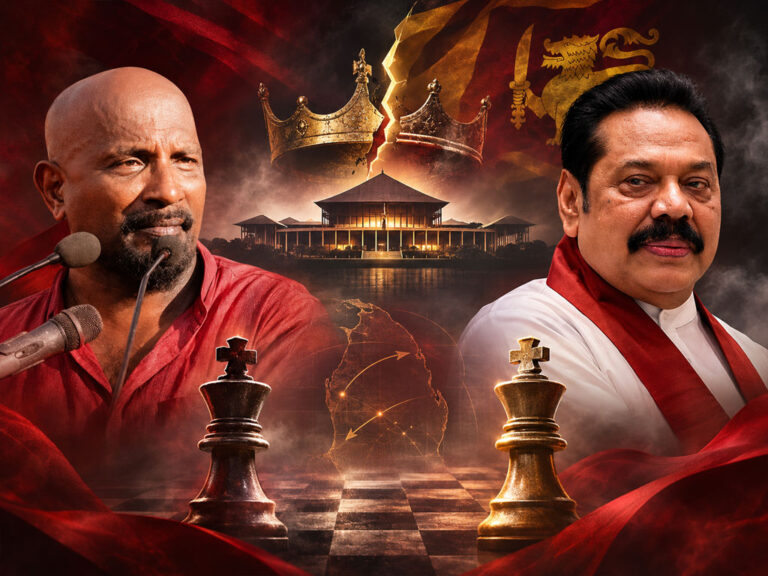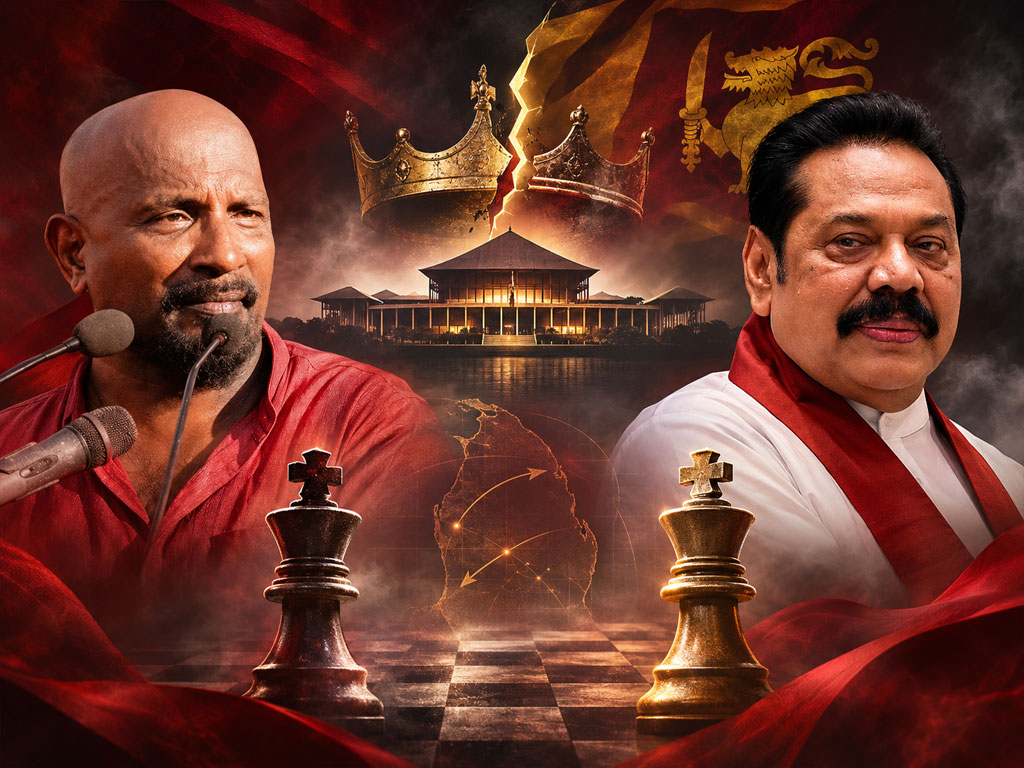
COLOMBO, Sri Lanka, November 23, 2026 — Two influential figures from Sri Lanka’s political past, former President Mahinda Rajapaksa and Frontline Socialist Party leader Kumar Gunaratnam, are seeking to recover political ground lost to President Anura Kumara Dissanayake, whose rise to power has transformed both the nationalist movement once dominated by the Rajapaksas and the leftist political tradition from which Gunaratnam emerged.
Their rivalry with Dissanayake is rooted in decades of alliances, ideological divisions, political confrontations and struggles for leadership within Sri Lanka’s principal political movements.
Rajapaksa and Gunaratnam share an unusual distinction: both were born on November 18. Their political careers have followed markedly different paths, yet each has played a part in shaping the forces that eventually contributed to Dissanayake’s political ascendancy.
For Rajapaksa, the challenge is to rebuild the political influence of the Sri Lanka Podujana Peramuna (SLPP), popularly known as the Pohottuwa. For Gunaratnam, it is to advance an alternative leftist movement against the Janatha Vimukthi Peramuna (JVP), the party in which he was once a prominent organiser.
The coincidence of their birthdays offers a historical parallel to another pair of Sri Lankan political adversaries whose lives were closely intertwined.

Two Men Born on November 26 Who Shaped Sri Lanka’s Conflict
Velupillai Prabhakaran, the founder and leader of the Liberation Tigers of Tamil Eelam (LTTE), was born on November 26, 1954.
His emergence as a Tamil militant leader followed political developments that transformed relations between Sri Lanka’s ethnic communities, particularly the Sinhala Only policy introduced under Prime Minister S.W.R.D. Bandaranaike’s government after its victory in 1956.
Prabhakaran’s political trajectory was shaped by the growing Tamil nationalist opposition to policies perceived as discriminatory, eventually leading him towards armed separatism.
Another influential figure, Lalith Athulathmudali, was also born on November 26.
Athulathmudali was studying at Oxford University when Bandaranaike became Prime Minister. According to accounts of his early life, financial assistance arranged through Bandaranaike helped him continue his education in Britain.
Their subsequent careers placed them on opposing sides of Sri Lanka’s escalating ethnic conflict.
Athulathmudali entered Parliament following the 1977 general election, at a time when Prabhakaran was consolidating his involvement in Tamil militancy.
Following the escalation of the conflict in 1983, President J.R. Jayewardene appointed Athulathmudali Minister of National Security.
As the government intensified military operations against the LTTE, Athulathmudali became one of the principal civilian figures overseeing the state’s security response.
In 1987, Sri Lankan forces launched a major offensive against LTTE positions in the Jaffna Peninsula. Indian intervention subsequently altered the course of the military campaign.
Some political commentators have argued that, without India’s intervention, the offensive might have resulted in a decisive defeat for Prabhakaran. That outcome, however, remains a historical counterfactual rather than an established certainty.
Athulathmudali was assassinated on April 23, 1993, after breaking with President Ranasinghe Premadasa’s administration.
Responsibility for his assassination became the subject of competing investigations and political controversy. Although investigators initially implicated the LTTE, a subsequent presidential commission challenged that explanation.
It would therefore be inaccurate to treat Prabhakaran’s personal responsibility for Athulathmudali’s murder as an established judicial finding.
Nevertheless, the careers of these two men, born on the same date, illustrate how sharply divergent political movements can become connected through a country’s history.
A different rivalry emerged in the following decade.
Mahinda Rajapaksa and Kumar Gunaratnam: A Shared Political Beginning
Former President Mahinda Rajapaksa was born on November 18, 1945.
He became Prime Minister in 2004 under President Chandrika Bandaranaike Kumaratunga, following the formation and electoral success of the United People’s Freedom Alliance (UPFA).
The JVP played an important role in establishing that alliance and bringing Kumaratunga’s political coalition to power.
Within the JVP, Kumar Gunaratnam was an influential organiser associated with the party’s ideological development and internal strategic debates.
Gunaratnam, who also celebrates his birthday on November 18, belonged to a generation of activists whose political experience had been shaped by the JVP’s underground activities and the violent confrontation between the state and the movement during the late 1980s.
Accounts of his political career describe his involvement in the Trincomalee region during the period when JVP founder Rohana Wijeweera led the organisation.
Gunaratnam was associated with efforts to establish links between southern leftist activists and Tamil political groups in the North and East.
Historical reporting has also linked him to militant activities directed against the Indian Peace Keeping Force (IPKF), including a landmine attack on July 25, 1989, in which 14 Indian soldiers were reportedly killed.
Such accounts form part of the contested history of the JVP’s armed struggle and should be distinguished from findings established through judicial proceedings.
Gunaratnam was detained during the period of state repression against the JVP and subsequently left Sri Lanka after escaping custody, according to accounts of his political life.
His eventual return to domestic politics coincided with a period of growing political cooperation between the JVP and Kumaratunga’s administration.
The alliance helped establish the political conditions in which Rajapaksa became Prime Minister in 2004 and successfully contested the presidency in 2005.
Gunaratnam and those aligned with him were among the JVP activists who supported the political mobilisation surrounding that period.
Yet the political partnership that helped elevate Rajapaksa would not survive the competing ambitions and ideological divisions that followed.
How Mahinda’s Presidency Divided the JVP
After Rajapaksa became President in 2005, disagreements intensified within the JVP over its relationship with the government and its future political direction.
Gunaratnam advocated a stronger leftist orientation, including cooperation with Tamil political organisations and a departure from the nationalist positions that had helped the party support Rajapaksa’s presidential campaign.
Others within the JVP, including Wimal Weerawansa, opposed aspects of that ideological direction.
The resulting disputes were compounded by the party’s relationship with Rajapaksa’s administration.
Political accounts have alleged that Rajapaksa and his brother Basil encouraged divisions within the JVP to weaken its influence as an independent political force.
Those allegations remain political interpretations of the party’s internal conflicts rather than established findings of deliberate interference.
By 2008, Weerawansa and his supporters had broken away from the JVP, significantly changing its internal balance of power.
Gunaratnam subsequently became associated with another current seeking to rebuild the leftist movement independently of both the Rajapaksa administration and the JVP leadership.
Anura Kumara Dissanayake and his allies pursued a different political strategy, increasingly positioning the JVP within broader opposition politics.
These competing approaches eventually produced a formal rupture.
In 2012, Gunaratnam and his supporters established the Frontline Socialist Party, creating a new political organisation outside the JVP.
The separation reflected fundamental disagreements over ideology, alliances and the direction of Sri Lanka’s leftist politics.
It also established the foundations of the rivalry between Gunaratnam’s movement and the party that Dissanayake would later lead to power.
The 2012 Abduction and the Breakdown of Political Trust
Gunaratnam’s emergence as a leader of the new party coincided with one of the most controversial episodes of his political career.
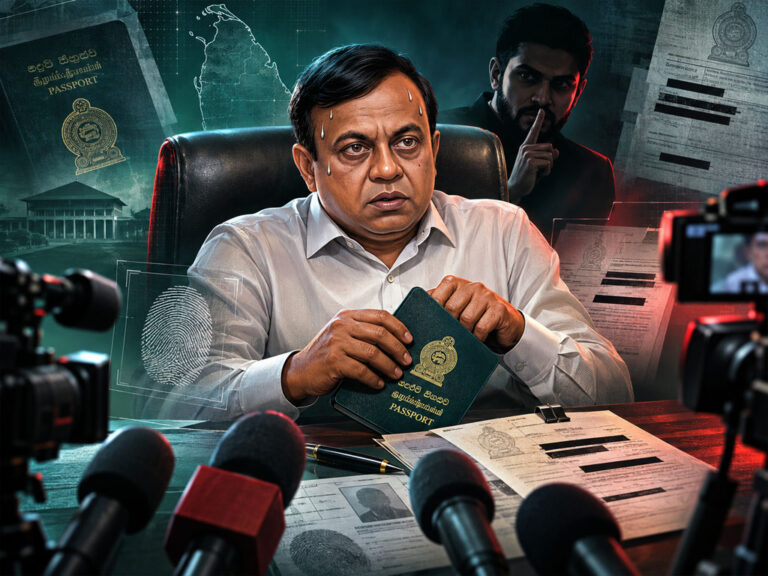
In April 2012, shortly before the Frontline Socialist Party’s inaugural convention, Gunaratnam was reportedly abducted by armed men.
He subsequently alleged that he had been detained, interrogated and tortured by individuals connected to the security establishment before being released and returned to Australia.
His supporters accused the Rajapaksa administration and the security apparatus operating under then Defence Secretary Gotabaya Rajapaksa of responsibility.
Sri Lankan authorities disputed the abduction account, maintaining that Gunaratnam had violated immigration regulations.
The accusations against the Rajapaksa administration were never conclusively established through a judicial finding.
Gunaratnam’s associates nevertheless regarded the episode as an attempt to suppress their emerging political organisation.
The dispute deepened divisions between the Frontline Socialist Party, the Rajapaksa administration and the JVP.
For Gunaratnam, who had previously helped advance political arrangements that benefited Mahinda Rajapaksa, the experience represented a decisive break with the political order he had once supported.
The 2022 Aragalaya and Kumar Gunaratnam’s Political Return
A decade later, Sri Lanka’s economic collapse created conditions for a mass protest movement against President Gotabaya Rajapaksa’s government.
The 2022 Aragalaya brought together citizens from diverse political, ethnic, religious and social backgrounds, united by economic hardship and demands for political accountability.
Gunaratnam’s Frontline Socialist Party and organisations associated with it played an active role in mobilising sections of the protest movement.
Its supporters participated in demonstrations and helped sustain opposition to the Rajapaksa administration.
The JVP and other political organisations also became involved in the broader protest movement, although their strategies and levels of participation differed.
Gunaratnam’s supporters regard the Frontline Socialist Party’s role as particularly important in advancing the protests during their formative stages.
It would, however, be inaccurate to attribute the entire Aragalaya to any single individual or political organisation. The movement was driven by a broad coalition of citizens, activists, trade unions, students and political groups.
As demonstrations intensified, the Rajapaksa family’s political authority deteriorated.
Mahinda Rajapaksa resigned as Prime Minister in May 2022, amid escalating unrest, and subsequently took refuge at the Trincomalee naval base.
Gotabaya Rajapaksa eventually fled Sri Lanka and resigned from the presidency in July 2022.
For Gunaratnam, the collapse of the Rajapaksa administration carried considerable political significance.
The leadership that his supporters accused of attempting to suppress the Frontline Socialist Party in 2012 had been forced from power by a mass protest movement in which the party was actively involved.
Yet the eventual political beneficiary was not Gunaratnam.
It was Anura Kumara Dissanayake.
How Anura Dissanayake Captured the Political Ground
Dissanayake’s electoral victory in September 2024 represented a fundamental transformation in Sri Lankan politics.
The JVP, once associated primarily with revolutionary leftist politics and a comparatively limited electoral base, had become the principal force within the National People’s Power (NPP) alliance.
Through that broader coalition, Dissanayake attracted voters dissatisfied with the established political parties, the economic crisis and the record of successive governments.
His presidential victory was followed by an overwhelming parliamentary mandate in November 2024.
The NPP secured 159 of Parliament’s 225 seats, establishing a two-thirds majority and reducing the SLPP, which had previously dominated the legislature, to just three seats.
The scale of the transformation was remarkable.
A political movement that had secured only a small parliamentary presence in the preceding election now commanded the country’s executive and legislative branches.
Dissanayake’s success also reflected a major realignment of voters who had previously supported the Rajapaksa political establishment.
Gotabaya Rajapaksa had secured approximately 6.9 million votes in the 2019 presidential election. Five years later, a substantial portion of the electorate had shifted away from the political movement associated with his family.
Although those voters did not transfer uniformly to the NPP, the collapse of Rajapaksa support created an electoral opening that Dissanayake successfully exploited.
For Mahinda Rajapaksa, this meant losing the political dominance his family had exercised for years.
For Gunaratnam, it meant watching a former JVP colleague lead the broader leftist political tradition into government, while the Frontline Socialist Party remained outside the principal institutions of power.
The political outcome was therefore doubly significant.
Dissanayake had achieved what neither Rajapaksa nor Gunaratnam had anticipated in their earlier struggles for influence: the consolidation of a powerful electoral movement capable of displacing both the traditional political establishment and competing factions of the left.
Two Political Rivals With Different Ambitions
On November 18, 2026, Mahinda Rajapaksa and Kumar Gunaratnam marked another shared birthday.
Both remain associated with political movements whose futures have been reshaped by Dissanayake’s rise.
Rajapaksa, now 81, no longer possesses the political authority he exercised during his presidency.
His age and declining public activity have changed his personal role, but his political legacy continues to influence the SLPP and sections of the electorate.
The Rajapaksa family retains established political networks, particularly in constituencies where its influence was once dominant.
Rebuilding that support, however, presents an entirely different challenge from maintaining it while in government.
Gunaratnam faces a separate task.
His Frontline Socialist Party continues to advocate a more explicitly socialist political programme than the governing NPP.
While Dissanayake has adopted the responsibilities and compromises associated with national administration, Gunaratnam remains positioned outside government, where he can challenge policy decisions and argue for a different direction.
The ideological differences between the two movements may become increasingly important as the government addresses economic reform, public expenditure, labour relations and the expectations of voters who supported political change.
Unlike Rajapaksa, Gunaratnam is not attempting to restore a former presidency or recover a previously dominant electoral party.
His ambition is to strengthen an alternative leftist movement and challenge the political legitimacy of the JVP-led governing coalition from within the broader socialist tradition.
Their objectives are different, but both confront the same political reality.
Dissanayake now occupies territory that each once considered central to his own movement’s future.
Can Anura Defend the Political Kingdom He Has Built?
Sri Lankan political history offers repeated examples of leaders whose dominance appeared secure until changing economic conditions, internal party divisions or public dissatisfaction transformed the political landscape.
Mahinda Rajapaksa experienced that reversal after years of extraordinary electoral strength.
Gunaratnam experienced a different form of political displacement when the JVP moved towards a strategy he opposed and eventually reached power without him.
Dissanayake now faces the challenge that confronts every leader who converts opposition politics into government authority.
His political survival will depend increasingly on performance rather than promises.
Economic recovery, public confidence, the cost of living, employment, accountability and the government’s handling of political dissent will all influence whether the NPP can retain its electoral coalition.
Rajapaksa’s prospects depend on whether his political movement can recover credibility after the collapse of the family’s former dominance.
Gunaratnam’s prospects depend on whether his alternative leftist platform can attract voters who become dissatisfied with the direction of the NPP administration.
Neither outcome is inevitable.
For now, Dissanayake holds the presidency and commands a substantial parliamentary majority. His opponents remain divided by ideology, history and political ambition.
Yet the two men born on November 18 represent different challenges to the political order he has established.
One seeks to revive a nationalist political movement that once dominated the country. The other seeks to reclaim influence within a leftist tradition that helped produce the present government.
Sri Lanka’s political history has repeatedly demonstrated that electoral dominance is neither permanent nor immune to unexpected challenges.
The question is whether Mahinda Rajapaksa and Kumar Gunaratnam can rebuild their respective movements strongly enough to challenge Dissanayake, or whether the President can consolidate his position and establish a political legacy that survives beyond the extraordinary circumstances of his rise to power.