COLOMBO, Sri Lanka, November 24, 2026 — Sri Lanka Podujana Peramuna (SLPP) National Organiser and Parliamentarian Namal Rajapaksa has challenged the government to explain the progress of a promised US$4 billion Chinese investment, accusing the administration of failing to translate international agreements into tangible economic benefits while questioning its foreign policy, tourism revenue calculations and support for small businesses.
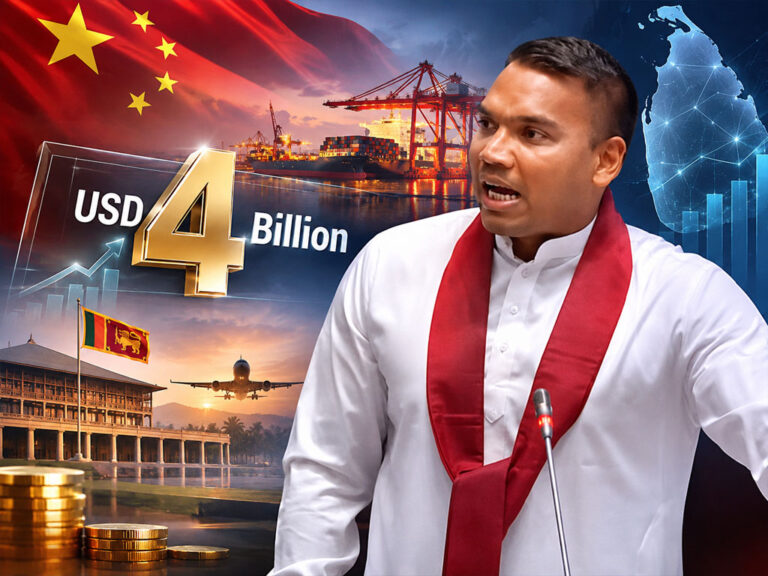
Addressing Parliament during the debate on expenditure relating to the ministries responsible for foreign affairs, tourism and foreign employment, Rajapaksa demanded an explanation of what had happened to the investment commitments announced following President Anura Kumara Dissanayake’s visit to China.
He questioned whether the agreements publicised by the government had resulted in actual investment and criticised what he described as the administration’s failure to provide clear answers on major economic projects.
“The President went to China and signed an agreement with the Chinese President to bring a USD 4 billion investment to Sri Lanka. Now, as I recall, there were even four media discussions about this signed investment. So what measures did you take to make those investments a ground-level reality?” he asked.
Rajapaksa also accused the government of discouraging major foreign investors, specifically referring to India’s Adani Group and China’s China Merchants.
“As soon as you came to power, you sent back the Indian investor called Adani. You sent back the China Merchant Chinese company. Now those investors have turned away,” he claimed.
The remarks come amid continuing uncertainty over the proposed US$3.7 billion Sinopec refinery project in Hambantota, for which an agreement was signed during the President’s January 2025 visit to China. Its implementation has remained subject to unresolved commercial and policy negotiations.

Only 20% of Allocated Capital Expenditure Used, Rajapaksa Claims
Turning to government spending, Rajapaksa questioned the ministries’ ability to implement development programmes despite receiving budgetary allocations.
He said approximately Rs. 2.119 billion had been allocated for capital expenditure in the previous budget, but only Rs. 420 million had been spent, leaving approximately Rs. 1.6 billion unutilised.
According to his figures, expenditure represented roughly 20% of the allocation.
Rajapaksa argued that the unspent funds could have supported tourism infrastructure, industry training and employment-related initiatives.
He questioned why the government had failed to use the available financial resources to strengthen the tourism sector and improve opportunities for young Sri Lankans.
The figures were presented during his parliamentary address and would require examination against the relevant ministry expenditure reports to establish their precise scope.
Foreign Policy, Maritime Security and Regional Cooperation
Rajapaksa also criticised the government’s foreign policy, alleging that its international positions had become inconsistent with the principles it advocated before assuming office.
He claimed the administration was changing its diplomatic approach according to immediate political circumstances rather than following a clearly defined national strategy.
Referring to an incident involving an Iranian vessel in waters associated with Sri Lanka, he acknowledged what he regarded as the government’s humanitarian response in assisting those aboard.
Rajapaksa compared that intervention with the non-aligned foreign policy associated with former Prime Minister Sirimavo Bandaranaike.
Nevertheless, he questioned whether the authorities had possessed sufficient advance information about the incident and whether Sri Lanka’s maritime surveillance capabilities were adequate.
He called for greater attention to Maritime Domain Awareness (MDA), describing it as essential to national security and regional cooperation.
Rajapaksa referred to the Colombo Security Conclave and its origins in regional maritime cooperation initiatives dating to 2011, recalling discussions involving Sri Lanka, India and other Indian Ocean partners, including Seychelles.
He urged the government to strengthen that framework and pursue an effective programme for monitoring maritime activity.
Trade Agreements and Vacant Diplomatic Appointments
The SLPP parliamentarian argued that economic development, foreign policy and national security could no longer be considered separately.
A stronger economy, he maintained, was essential to protecting Sri Lanka’s strategic interests.
He questioned whether the government’s economic strategy was primarily focused on taxation under the International Monetary Fund programme or on attracting productive foreign investment.
Rajapaksa also referred to the President’s statements about modernising international trade arrangements.
He asked what progress had been made in updating agreements involving India, China and Thailand, noting that similar commitments had been outlined in the previous year’s Budget.
The parliamentarian further criticised delays in appointing ambassadors to several important diplomatic missions.
He specifically identified China, the United States, Germany and Canada, claiming that some posts had remained vacant for six or seven months.
According to Rajapaksa, the absence of senior diplomatic representatives could undermine efforts to negotiate trade agreements, expand commercial partnerships and attract investment.
He accused the administration of failing to honour its election promises and extending what he described as misleading assurances to international partners.
These were political allegations made during the parliamentary debate, rather than independently established findings.
Foreign Employment Risks and the Anojan Sivarasa Case
Addressing foreign employment, Rajapaksa warned that instability in the Middle East could threaten employment opportunities for Sri Lankan migrant workers.
He specifically referred to uncertainty surrounding jobs in Israel and urged the government to identify alternative overseas employment markets before existing opportunities were disrupted.
Waiting until workers had already lost their jobs would be inadequate, he argued.
Rajapaksa also welcomed the government’s diplomatic intervention in the case of Sri Lankan national Anojan Sivarasa, who had faced a death sentence in Saudi Arabia over allegations concerning religiously offensive social media content.
Saudi Arabia’s Supreme Court set aside the death sentence on October 13, 2026, and the authorities subsequently decided not to pursue further proceedings.
Using the case to advance a domestic political argument, Rajapaksa called on President Dissanayake to consider granting a presidential pardon to Ven. Galagoda Aththe Gnanasara Thero.
He argued that the President should demonstrate comparable compassion domestically after intervening on behalf of a Sri Lankan facing punishment overseas.
The comparison was presented as Rajapaksa’s political position. The two cases arose under different legal systems, and any presidential pardon in Sri Lanka would be subject to the applicable constitutional procedures.
Tourism Revenue Calculations and Support for Small Businesses
Rajapaksa challenged the government’s presentation of tourism performance, arguing that increasing visitor arrivals did not necessarily demonstrate that tourism was generating the expected economic returns.
He questioned how much of the money spent by tourists ultimately remained within Sri Lanka’s economy.
Particular attention was directed at changes to the methodology used to calculate tourism earnings.
Citing a report published by EconomyNext, Rajapaksa referred to the Sri Lanka Tourism Development Authority’s decision to revise its monthly earnings estimates retrospectively from January 2026.
He demanded an explanation of the basis for the revision and questioned whether the change had affected the reported performance of the industry.
The revised methodology, introduced in May 2026, was intended to improve the accuracy and representativeness of tourism earnings estimates by incorporating country-specific information on visitor arrivals, expenditure and length of stay.
Rajapaksa nevertheless called for greater transparency in explaining the calculation and its consequences for assessing tourism revenue.
Turning to the industry itself, he accused the government of concentrating its attention on major hotels and tour operators while overlooking smaller businesses.
He highlighted the contribution of safari jeep operators, tourist guides, water sports providers, guesthouses, homestays and other small enterprises.
According to Rajapaksa, these businesses play an essential role in distributing tourism income to villages and communities outside the country’s major commercial centres.
He criticised the demolition of tourist-related commercial establishments during the tourism season, referring to incidents at Cramm Beach, Mirissa, Unawatuna and Weligama.
The parliamentarian argued that authorities should have consulted affected business owners and explored practical solutions before taking enforcement action.
He also questioned delays in obtaining tourism-related licences, claiming that smaller operators face greater administrative difficulties than large hotel businesses.
Rajapaksa called for a regulatory system that protects legitimate commercial activity while providing small and medium-sized tourism enterprises with fair access to licensing and development opportunities.
Inflation, Public Sector Salaries and Trade Union Demands
Concluding his parliamentary address, Rajapaksa turned to rising living costs, public sector employment and industrial relations.
He said trade unions were increasingly concerned about inflation, professional recognition and job security.
Referring to the Central Bank Governor’s warning that inflation could reach approximately 9%, Rajapaksa accused the government of failing to acknowledge the economic pressure experienced by workers.
He contrasted those warnings with the President’s statements in Parliament, arguing that the administration had not adequately addressed the effect of rising prices on household incomes.
The parliamentarian also recalled election commitments concerning salary adjustments for public servants, claiming that the government had promised increases every six months in line with inflation.
He accused the authorities of attempting to suppress trade union grievances rather than engaging constructively with employees and their representatives.
Rajapaksa referred to a deadline set by trade unions for November 30 and urged the government to respond before industrial tensions escalated.
He called on ministers to abandon what he described as an arrogant approach to labour relations and engage directly with the organisations representing public sector workers.
The parliamentary intervention brought together several challenges confronting the administration, including the implementation of foreign investment agreements, the use of development allocations, regional security, tourism policy and the cost of living.
While Rajapaksa’s criticisms reflected the opposition’s assessment of government performance, the central questions he raised concern measurable outcomes: how much promised investment has materialised, whether allocated public funds are being effectively used, and what steps the administration intends to take to address concerns raised by businesses and workers.
With trade unions seeking answers before November 30 and the future of major investment projects still under discussion, the government’s responses to these matters will remain an important measure of its economic and administrative performance.