At just 15, Carlo Acutis used his love for computers to spread the faith, earning the title “God’s Influencer.” Now, Pope Leo XIV has declared him a saint, making history and inspiring a new generation of Catholics.
Pope Leo XIV presided Sunday, September 7, over the canonisation of Carlo Acutis, a 15-year-old computer whiz who became the Catholic Church’s first millennial saint. Tens of thousands filled St. Peter’s Square for the open-air Mass that formally declared Acutis a saint, a moment that marked the first saint-making ceremony of Leo’s pontificate. Alongside Acutis, Pier Giorgio Frassati, another beloved Italian figure who died young, was also canonised.
History’s first American pope, Leo, made an unscripted appearance before the Mass began, welcoming the young faithful gathered for the occasion. “Truly, it’s a blessing of the Lord,” he said, urging them to remain afterward so he could greet them from his popemobile.

Both ceremonies had been scheduled earlier this year but were postponed after Pope Francis’ death in April. Francis had strongly supported Acutis’ sainthood case, believing that his example could attract young Catholics while addressing the promises and perils of the digital age.
By the time the Mass began, St. Peter’s Square was already filled with pilgrims, many of them young Italians who saw Acutis as a relatable model of faith. “I learned from different people what his professors, his teachers said about his joy and the light he carried around him,” said Leopoldo Antimi, a 27-year-old Roman. “So for me personally as an Italian, even on social networks that are used so much, it is important to have him as an influencer.”
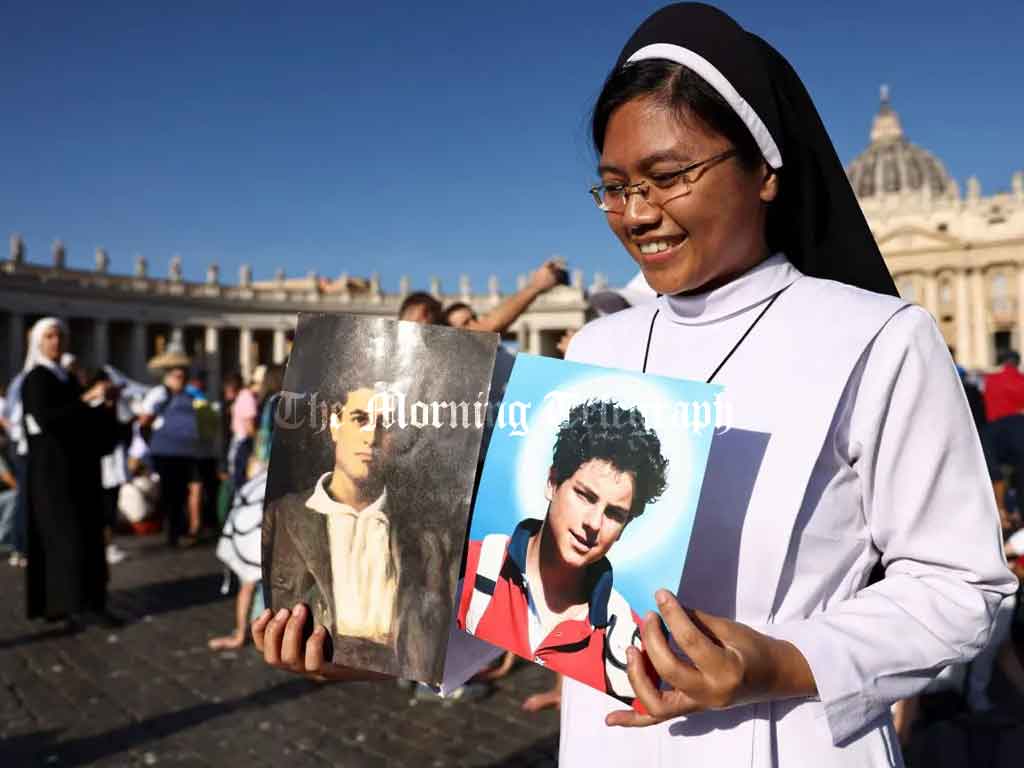
Born on May 3, 1991, in London to a wealthy but not devout Catholic family, Acutis moved with his parents to Milan where he enjoyed a happy childhood marked by growing religious devotion. He developed a fascination for computer science, reading college-level programming books as a child. He earned the nickname “God’s Influencer” through his groundbreaking multilingual website documenting Eucharistic miracles, a project far ahead of its time.
Known for his devotion, Acutis spent hours in prayer before the Eucharist each day. Church leaders, concerned that many Catholics no longer believe in Christ’s physical presence in the Eucharistic hosts, highlighted his devotion as an inspiration.
In October 2006, Acutis was suddenly diagnosed with acute leukemia. Within days, he passed away at the age of 15. He was entombed in Assisi, the city of St. Francis, and millions of young Catholics have since flocked to his glass-sided tomb where he is seen dressed in jeans, sneakers, and a sweatshirt.
Acutis’ rapid rise to sainthood reflects his enduring popularity among young Catholics, many of whom see him as a modern role model. “It’s like I can maybe not be as great as Carlo may be, but I can be looking after him and be like, ‘What would Carlo do?’” said Leo Kowalsky, an 8th grader from Chicago. Kowalsky, a student of Blessed Carlo Acutis Parish School, said he was especially excited that Pope Leo, his namesake, was canonising Acutis. “It’s kind of all mashed up into one thing, so it is a joy to be a part of,” he added.
Frassati, the other saint canonised on Sunday, was born in 1901 into a prominent Turin family. He dedicated his short life to serving the poor, spreading his faith among friends, and performing acts of charity before dying of polio at just 24.