By Roshan Jayasinghe
A society that waits to be told what to believe slowly forgets how to see for itself.
The more I look at my life and the world around me, I keep coming back to one simple concern. It is not only that stories are being told to us every day. It is that we have become willing to receive the stories we prefer, especially when our lives are too busy for us to stop, observe, and understand things for ourselves.

We live in a world where everyone is moving. We wake up, work, earn, build, provide, protect, and try to create some sense of stability for ourselves, our families, our children, our communities, and whatever group or identity we feel we belong to. Life itself has become so full that many of us do not have the space to sit quietly and really observe the condition of the world. So without realizing the seriousness of it, we hand that responsibility to someone else. We allow others to look for us, think for us, interpret for us, and then tell us what has happened and what it should mean to us.
As I look at this more deeply, I feel we did not lose our clarity suddenly. We slowly moved away from it. News was supposed to inform the human mind, not shape it into sides. It was supposed to bring the facts of a situation to people so that human beings could understand what is happening around them. But over time, we stopped asking whether something is true and began asking whether it sounds right to us, whether it fits what we already feel, whether it protects the side we have emotionally chosen.
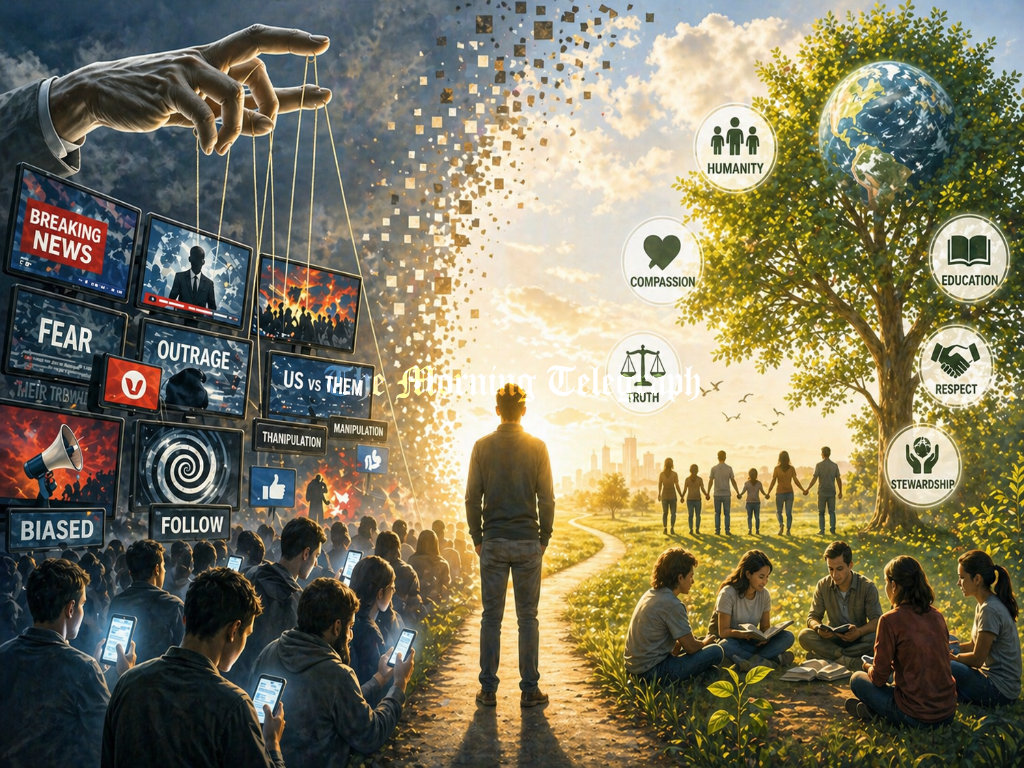
That is where the problem becomes deeper than media itself. When we listen only for what comforts our existing belief, truth becomes secondary. Agreement becomes the reward. Comfort becomes the measure. And once that becomes the condition of the listener, the storyteller does not have to work very hard. The media only has to feed what is already waiting inside us. It gives one person fear, another person outrage, another person a sense of moral correctness, another person a villain, another person a hero, and everyone walks away feeling informed, when many have only been emotionally arranged.
This is why I feel this is not only a media problem. It is a shift in human morality. When we begin to prefer a version of truth that feels good over a truth that is real, we move away from our own responsibility as human beings. We wait to be told what happened. We wait to be told who is right. We wait to be told who is wrong. We wait to be told how to feel. And after some time, this waiting becomes normal, as if our own direct observation is no longer required.
Truth also needs something from the listener. It does not only require someone brave enough to speak it. It requires a human being mature enough to receive it. If we only want truth when it protects our side, comforts our belief, or makes our position look right, then we are not truly asking for truth. We are asking for confirmation. To be humane is not only to speak about justice, dignity, care, and fairness. It is to stand with truth even when it disturbs the comfort of our own position.
We also have to be honest about the world we are living in now. There are too many so-called truth tellers, so-called teachers, so-called experts, and interpreters of the world who speak with authority but are not rooted in truth. Learned knowledge has its place. Academia has its place when it is in service of understanding. But when knowledge, language, law, and influence are used to bend truth toward power without a humane foundation, it becomes something dangerous. It becomes a tool in the hands of whoever has the loudest platform, the strongest institution, or the greatest influence. That, to me, is one of the core issues of our time.
When we step back from all the noise, the question is still simple. Is what we are seeing, hearing, supporting, and defending protecting human life? Is it creating dignity? Is it helping people have food, healthcare, safety, and a fair chance to live without being crushed by systems they did not design? If the answer is no, then why are we defending it? And if any person, institution, or system cannot align with that basic human question, then we must look honestly at why. Not with hatred, but with clarity. Because somewhere, something has moved away from being human and humane.
This is why education must begin again from the foundation of human values. Not education only for achievement, competition, status, career, and success inside a system, but education that forms a human being who can see clearly. Children must be shown duality, not as a fight between one side and another, but as a way to understand life. Truth and untruth. Care and harm. Service and manipulation. Power and stewardship. When a child can see both sides of this human equation, clarity begins to form. And when clarity forms, the mind begins to evolve beyond simply following narratives. It begins to observe life directly.
In that kind of human foundation, media would not need to provoke, persuade, decorate, divide, or manipulate. It would simply need to tell what happened as it happened. Nothing more. Nothing less. Because when human beings are clear, truth does not need to be sold to them. It only needs to be presented.
And when truth is understood together, the struggle for power begins to lose its meaning. The hunger for recognition begins to soften. Leadership becomes less about control and more about responsibility. We begin to remember that we are here only for a short time, and within that short human span, what matters becomes very clear. That people live with dignity. That food, healthcare, shelter, safety, and the ability to live meaningfully are not treated as privileges for some, but as part of our shared responsibility to one another.
This is not a dream outside reality. To me, it is the natural direction of clarity. When humanity aligns with truth, not as a slogan but as a way of living, division begins to lose its fuel. There is less need to manufacture enemies. There is less need to manipulate stories for power. There is less need to make people afraid of one another. What remains are human problems to solve, human lives to protect, and a world we are responsible for stewarding together.
A good human being is not someone who never gets misled. A good human being is someone who keeps returning to clarity. Someone who is willing to correct themselves when truth shows them something different. That is how humanity grows. Not by insisting we are already right, but by becoming honest enough to see where we are not.
So the correction does not begin only with media. It begins within us. It begins when we stop outsourcing our observation. It begins when we stop choosing comfort over clarity. It begins when we raise children who value truth more than identity, humanity more than division, and stewardship more than power.
Only then will the systems around us begin to reflect that same honesty. Only then will media return to its rightful place. And only then will humanity begin to move together, not divided by stories, but grounded in understanding.
Author’s Note:
This is not written against media alone. It is written toward all of us. Media can only shape us to the degree that we are willing to be shaped. The deeper question is whether we still want truth, or only the version of truth that keeps us safe inside what we already believe. The moment we become honest in that way, the world we keep asking for begins to take shape within us first.
About the Author
Roshan Jayasinghe is a writer and observer of human systems. His work explores the gap between man made constructs and lived humanity, with a focus on how economics, trade and everyday choices intersect with questions of fairness, responsibility and inner alignment. Through essays for publications in The Morning Telegraph, he aims to remind readers that they are not passengers in a fixed machine, but active custodians of a shared world.