Eelam illusion is being revived through Mullivaikkal rhetoric, risking deeper division while Tamil regions face urgent economic crises.
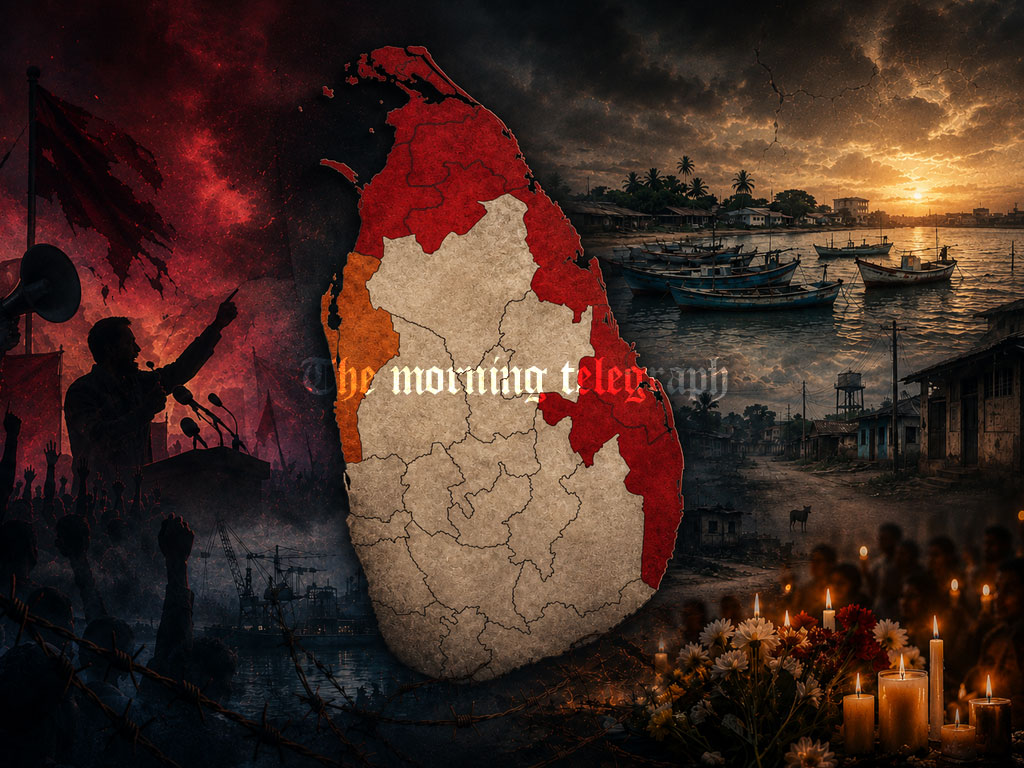
Eelam illusion is once again being revived as political currency, with renewed calls framed as liberation risking deeper division in Sri Lanka.
The so-called “declaration” emerging from the rhetoric of Mullivaikkal remembrance is not a serious roadmap for justice.
Nor is it a credible political programme for the future.
At its core, it is a recycled political script that reopens old wounds, rebrands grievance as strategy, and repackages a tragic history into a tool for contemporary mobilisation.
What is presented as a “resolution” is, in reality, a carefully constructed narrative.
It appears designed less to solve the real problems facing Tamil communities and more to sustain a permanent state of political agitation around the idea of Tamil Eelam.

The language of the declaration deliberately presents an already concluded armed conflict as an unfinished war.
That is not accidental.
It serves a clear political function.
It keeps alive a maximalist separatist vision that no longer has any viable pathway within Sri Lanka’s real political landscape.
The illusion of an imminent or reactivable Eelam is repeatedly invoked, not as a practical goal, but as a mobilising myth.
It operates as a political identity engine, particularly within sections of the diaspora ecosystem.
From a distance, such narratives can evolve without the constraints of daily governance, economic hardship, or the difficult realities of post-war reconciliation.
What is often ignored in these narratives is the complex reality faced by Tamil communities themselves, especially in the North and East.
Issues such as unemployment, drug abuse, social fragmentation, caste-based discrimination, and limited economic mobility remain urgent concerns.
These are not abstract political slogans.
They are lived realities requiring governance solutions, investment, institutional reform, and social healing.
Yet these pressing issues are often overshadowed by high-decibel political declarations that prioritise symbolic confrontation over practical development.
There is also a growing disconnect between diaspora-driven political activism and the lived experience of local communities.
While diaspora groups often present their engagement as solidarity, critics argue that parts of this activism risk becoming self-sustaining political industries.
Conferences, commemorations, advocacy campaigns, and NGO-linked initiatives sometimes generate visibility and funding cycles.
But those activities do not always translate into tangible improvements on the ground.
In this context, the concern is not legitimate remembrance or advocacy.
The concern is the transformation of historical trauma into a permanent fundraising and influence mechanism detached from present-day realities.
It is also important to acknowledge that international NGO engagement in post-conflict regions is not inherently problematic.
Many organisations contribute meaningfully to human rights documentation, humanitarian support, and development work.
However, sustained criticism has emerged from various quarters regarding performative engagement.
In such cases, complex local realities are reduced to simplified narratives that fit external advocacy frameworks.
When external actors briefly visit affected regions, document selective imagery, and leave without sustained engagement, a distorted picture of ground realities can be created.
That distortion is then amplified through global advocacy networks.
Often, it reinforces pre-existing political positions instead of encouraging genuine dialogue.
At the same time, it would be intellectually dishonest to blame the region’s challenges solely on external influence or diaspora politics.
The Sri Lankan state also bears responsibility for long-standing governance failures, uneven development, and the slow pace of meaningful political reconciliation after the war.
Infrastructure development alone cannot substitute for unresolved questions of political representation, accountability, and dignity.
Any serious analysis must hold multiple realities together.
These include the persistence of state shortcomings, the danger of extremist rhetoric, and the fragmentation of Tamil political representation across competing visions.
Religious institutions are also often drawn into these debates.
Sometimes they act as moral voices calling for justice.
At other times, they are perceived as aligning with particular narratives.
However, reducing complex faith communities to political labels is inaccurate and unhelpful.
The real issue is not religious involvement itself.
The issue is the politicisation of suffering in ways that risk deepening divides rather than promoting reconciliation.
What is ultimately most concerning about declarations of this nature is not only their content, but their political function.
They risk reinforcing a cycle in which historical trauma is continuously reactivated to justify present-day polarisation.
This creates an environment where compromise becomes harder.
Moderate voices are drowned out.
The space for practical problem-solving shrinks further.
In such a climate, communities that most urgently need economic development, social stability, and institutional support are instead pulled back into symbolic battles rooted in the past.
That past continues to dominate the present.
The idea that any single narrative, whether of triumph, victimhood, or resistance, can fully define an entire community is itself a distortion.
Tamil society, like any other society, is not monolithic.
It contains diverse political opinions, generational differences, and competing aspirations.
Many within these communities are increasingly focused not on abstract national projects, but on education, employment, migration opportunities, and local governance reform.
These voices are often overshadowed by louder and more polarised rhetoric.
A sustainable future cannot be built on permanent confrontation politics.
Nor can it be built on the monetisation of historical grief.
It must be built on addressing real socio-economic conditions, strengthening democratic representation, and creating space for genuine reconciliation without coercion from any ideological extreme.
Grievance narratives may continue to offer political utility for some actors.
But their long-term value for the people they claim to represent is far more questionable.
The greatest disservice to the memory of past suffering is not remembrance itself.
It is the transformation of remembrance into a perpetual political instrument that prevents closure, distorts present realities, and delays the possibility of a shared future.